%20{%20:root%20{%20--deepread-stroke:%20%23E5E7EB;%20}%20}%20.dark%20{%20--deepread-stroke:%20%23E5E7EB;%20}%20%3c/style%3e%3crect%20x='40'%20y='30'%20width='220'%20height='260'%20rx='28'%20ry='28'%20stroke='var(--deepread-stroke)'%20stroke-width='16'%20fill='none'/%3e%3cpath%20d='M180%2030v52c0%2010%208%2018%2018%2018h62'%20stroke='var(--deepread-stroke)'%20stroke-width='16'%20fill='none'/%3e%3cline%20x1='70'%20y1='130'%20x2='200'%20y2='130'%20stroke='var(--deepread-stroke)'%20stroke-width='16'%20stroke-linecap='round'/%3e%3cline%20x1='70'%20y1='165'%20x2='200'%20y2='165'%20stroke='var(--deepread-stroke)'%20stroke-width='16'%20stroke-linecap='round'/%3e%3cline%20x1='70'%20y1='200'%20x2='170'%20y2='200'%20stroke='var(--deepread-stroke)'%20stroke-width='16'%20stroke-linecap='round'/%3e%3c!--%20green%20download%20arrow%20in%20bottom%20right%20corner%20--%3e%3cpath%20d='M210%20202v58'%20stroke='var(--deepread-accent)'%20stroke-width='18'%20stroke-linecap='round'/%3e%3cpath%20d='M195%20245l15%2015%2015-15'%20fill='none'%20stroke='var(--deepread-accent)'%20stroke-width='18'%20stroke-linecap='round'%20stroke-linejoin='round'/%3e%3c/svg%3e)
Is Nanonets Safe? Security, Compliance, and Data Privacy Review
Is Nanonets safe? What it says on encryption, SOC 2, ISO 27001, HIPAA, and data retention; what you can verify; and the questions to ask before you upload.
"Is Nanonets safe?" has no yes or no answer, and a vendor's own marketing cannot give you one. Nanonets is an AI document processing platform used for invoices, receipts, and other business documents. It publishes security documentation, names its certifications, and offers enterprise options such as private deployment. What matters for you is which of those controls apply to your plan, and which claims you can check.
This guide separates three things: what Nanonets says, what independent sources show, and what you should ask for before uploading real documents. It is a review of public information as of November 2026. It is not a security audit, and it does not rank Nanonets against other vendors. For a side-by-side of options, DeepRead's document processing vendor comparison guide covers the category.
The Short Answer
Nanonets documents the controls a normal vendor review looks for. Its privacy policy says it uses encryption of data in transit using TLS 1.2 or higher, AES 256-bit encryption at rest, and an information security program certified to ISO/IEC 27001:2022 with an annual SOC 2 Type II examination. For ordinary business documents, that is a reasonable starting point.
The answer changes with the data and the plan. Protected health information needs a signed BAA, and Nanonets says a BAA is available for enterprise plans. EU data residency, private deployment, and SSO are also described as enterprise features. If you are on the Starter plan, do not assume you get them.
What Nanonets Says It Does
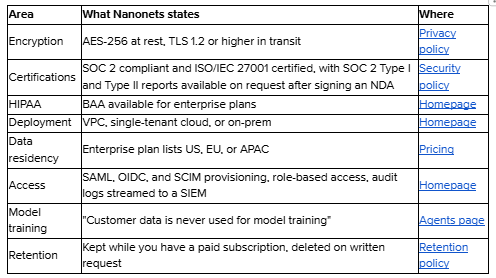
Two details deserve a closer read. First, the terms of service say Nanonets may retain customer data for up to 30 days after an order ends, after which it may be irretrievably deleted. Second, enterprise customers can request specific retention policies that are added to their contract, which means custom retention is a negotiation, not a default. The terms of service are an older document, so confirm the retention terms in your own contract.
Nanonets also publishes a penetration testing policy that gives customers a defined way to test its services. It requires at least 14 days notice and prohibits load testing and testing of the management dashboard.
What Is Independently Visible
Vendor pages are claims. An outside view comes from a security rating service. UpGuard's report for Nanonets, scanned on November 17, 2026, showed a grade of A (Excellent) with a score of 803 out of 950, and listed no data breaches. The same report listed eight failed checks, including a DMARC policy of p=none, HSTS not enforced, and weak cipher suites supported in TLS 1.2.
Read that carefully. A rating scans the public surface of a domain, such as email and web configuration. It does not test how Nanonets protects documents inside its systems. The failed checks are configuration issues a security team may want explained, not evidence of a breach. Ratings also move: an earlier cached copy of the same report showed a lower score, so check the live page.
I searched for reports of a Nanonets data breach and found none, and UpGuard lists none. That is an absence of evidence, not proof. Ask the vendor how it notifies customers of incidents.
Where Nanonets's Own Pages Differ
Security pages age, and Nanonets's do not all say the same thing. These are the differences worth raising in a review:
- Data location. An older security policy page says all customer data is stored in the USA. The pricing page now lists data residency in the US, EU, or APAC on the Enterprise plan. Ask which applies to your contract.
- Tenancy. The same security policy says customer data lives in multi-tenant datastores with logical separation in application code. Newer pages offer single-tenant and on-prem options. If separation matters to you, ask for single-tenant in writing.
- TLS version. The policy page says 256-bit encryption in transit, the privacy policy says TLS 1.2 or higher, and newer pages say TLS 1.3. These can all be true at once, but ask what your contract guarantees.
- FedRAMP. A third-party security profile lists FedRAMP among its certifications. The Nanonets pages I found list SOC 2, ISO 27001, GDPR, and HIPAA, and do not list FedRAMP. Do not assume it.
What "Compliant" Does and Does Not Mean
Compliance labels are easy to misread.
SOC 2 is an attestation, not a certificate. The AICPA itself refers to a SOC 2 attestation, meaning an auditor reports on a company's controls. A Type I report covers the design of controls at one point in time. A Type II report covers how they operated over a period. Nanonets says independently attested SOC 2 Type I and Type II reports are available on request after signing an NDA. Ask for the Type II report, and read the audit period, the scope, and any exceptions.
ISO 27001 depends on scope. A certificate names what the audit covered. Ask for it.
HIPAA has no government certification. HHS states that it and OCR do not certify any persons or products as "HIPAA compliant", and that a business associate cannot self-certify in place of a written contract. What matters is whether the vendor signs a BAA and operates under it. Nanonets says a BAA is available on enterprise plans, so confirm it is in your contract. DeepRead's guide to HIPAA compliant document processing explains what to look for, and its post on healthcare document OCR covers the document side.
Is It Safe for Your Data?
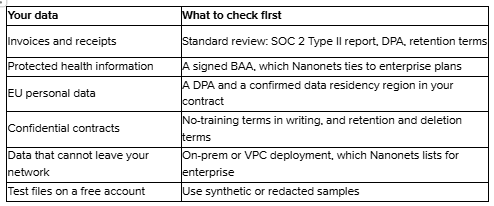
A Vendor Security Checklist
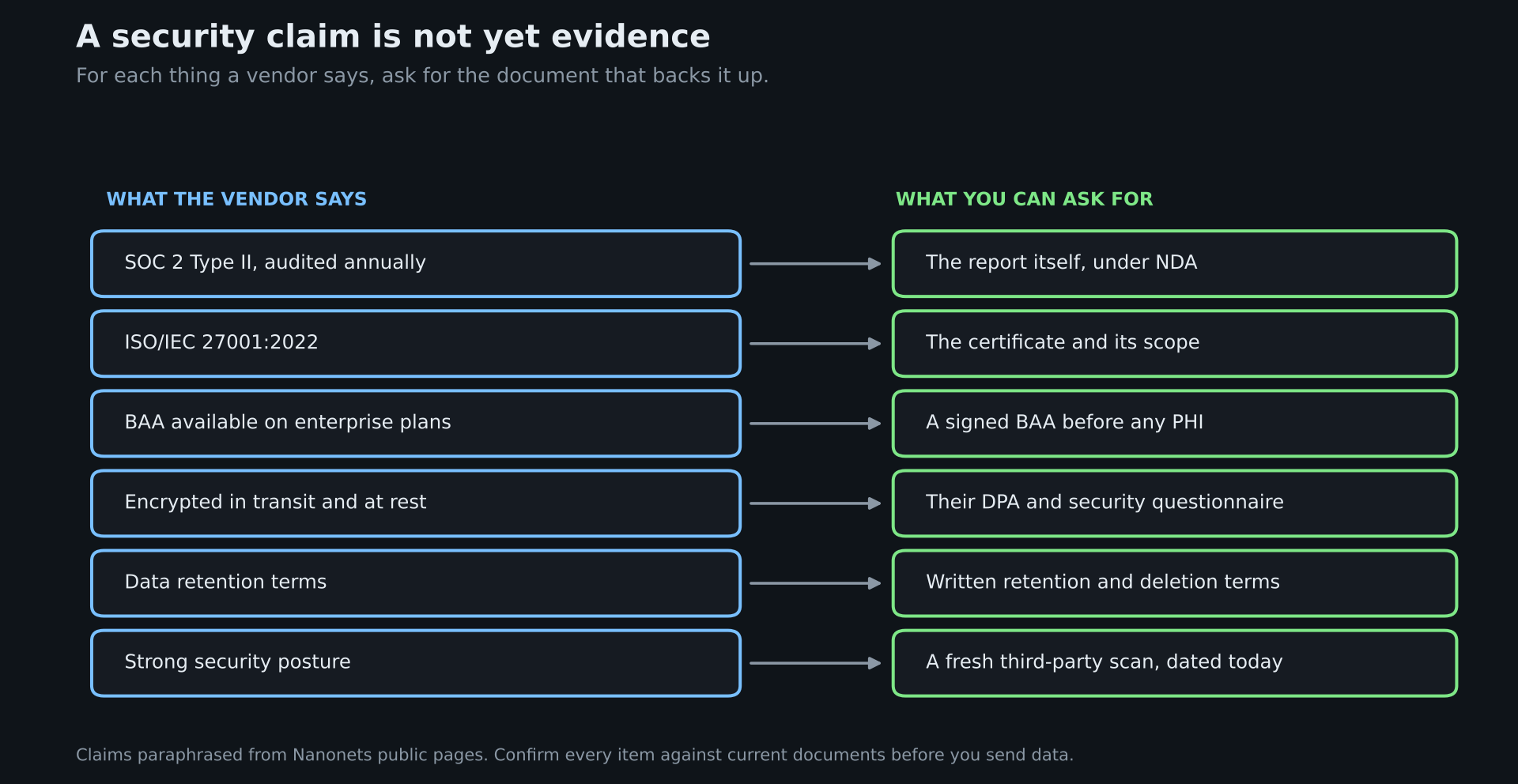
Run this on any document AI vendor, Nanonets included.
- Request the SOC 2 Type II report. Read the audit period, scope, and exceptions.
- Request the ISO 27001 certificate and its scope statement.
- Get the DPA and the subprocessor list. Know who else touches your documents.
- Get a BAA in writing if you handle PHI, and check that it covers the plan you are buying.
- Pin down data location. Get the region in the contract, not on a web page.
- Confirm retention and deletion. Ask how long files and extracted data are kept, and how a deletion request is carried out and confirmed.
- Get no-training terms in the contract. A web page claim can change.
- Ask for the incident notification window.
- Check that SSO and audit logs are on your plan, not only on a higher one.
- Test deletion with a sample file before you load real ones.
Test a Free Plan Safely
Nanonets lists $50 in free credits with no card required on its Starter plan, which makes it easy to try. Use that to test accuracy on sample documents, not to upload real ones. Upload a redacted invoice, confirm the output, then submit a deletion request and see how it is handled. DeepRead's guide to digital invoice processing shows what an invoice pipeline needs beyond extraction.
Where DeepRead Differs
If you are comparing options, here is how DeepRead's posture differs, including where it falls short.
DeepRead is a hosted API only. It defaults to US East, has no self-hosted option, and offers no BAA on any plan. If you need a BAA or on-prem deployment, DeepRead is not the fit, and an enterprise plan from Nanonets or another vendor is the place to look.
DeepRead's Enterprise plan adds retention controls from 1 to 365 days, incognito processing, EU and AU data residency, bring-your-own model keys, and SSO and SAML. The Free plan gives 2,000 pages a month with no card, up to 50 pages and 15 MB per document, and Standard has no monthly page limit with Extract at $15 and Deep Extract at $35 per 1,000 pages. Retention terms for Free and Standard should be confirmed in DeepRead's current documentation before you upload sensitive files.
What DeepRead offers for non-regulated documents is an API that returns schema-defined fields with the page, bounding box, and source text for each value, and marks uncertain values needs_review with a reason. DeepRead's guide to document processing APIs with validated JSON output explains why that matters for review.
Common Mistakes
- Treating a logo row as evidence. SOC 2, HIPAA, and GDPR badges are claims until you see the report or the contract.
- Assuming enterprise controls apply to every plan. Check which plan includes the BAA, SSO, and residency.
- Reading a rating as a verdict. A domain scan is one signal.
- Uploading real documents to test. Use samples.
- Skipping the deletion test. Find out how deletion works before you depend on it.
Conclusion
Nanonets documents the controls most buyers want, and its own materials describe an enterprise tier with a BAA, residency options, and private deployment. Whether it is safe for you depends on your data, your plan, and what you verify. Request the SOC 2 Type II report, get the BAA, residency, retention, and no-training terms in the contract, and test with a sample before you upload anything real.
FAQ
Is Nanonets safe to use?
Nanonets publishes standard controls, including encryption and ISO 27001 and SOC 2 Type II claims. Whether it is safe for you depends on your data and your plan, so verify the SOC 2 report and contract terms.
Is Nanonets HIPAA compliant?
Nanonets says it is HIPAA compliant and that a BAA is available for enterprise plans. There is no government HIPAA certification, so the BAA and your configuration are what matter.
Has Nanonets had a data breach?
I found no reports of a Nanonets data breach, and UpGuard's report lists none. That does not prove none has happened, so ask the vendor about its incident notification process.
Does Nanonets train on my data?
Its Agents page states that customer data is never used for model training. The product also lets you train a model for your own account. Nanonets's privacy policy says such a model is personalised to that customer's account and is never used to serve any other customer or to build a general-purpose model, though that wording sits in the section on Google user data. Get the no-training term in your contract, because a web page can change.
Where does Nanonets store data?
An older security policy page says all customer data is stored in the USA. Its pricing page lists US, EU, or APAC residency on the Enterprise plan. Confirm the region in your agreement.
Is the Nanonets free plan safe for real documents?
Treat it as a test environment. Nanonets offers $50 in free credits with no card, which is enough to try accuracy on redacted samples.
More articles

Amazon Textract Limits and Quotas: File Size, Pages, and API Rate Limits
Amazon Textract limits explained: 10 MB and 1 page for sync, 500 MB and 3,000 pages for async, plus default TPS by region and how to handle throttling.
Semantic Document Search: How It Works and How to Build It with Embeddings
How semantic document search works, plus a Python build: extract, chunk, embed, and search, with a tested keyword, semantic, and hybrid comparison.