%20{%20:root%20{%20--deepread-stroke:%20%23E5E7EB;%20}%20}%20.dark%20{%20--deepread-stroke:%20%23E5E7EB;%20}%20%3c/style%3e%3crect%20x='40'%20y='30'%20width='220'%20height='260'%20rx='28'%20ry='28'%20stroke='var(--deepread-stroke)'%20stroke-width='16'%20fill='none'/%3e%3cpath%20d='M180%2030v52c0%2010%208%2018%2018%2018h62'%20stroke='var(--deepread-stroke)'%20stroke-width='16'%20fill='none'/%3e%3cline%20x1='70'%20y1='130'%20x2='200'%20y2='130'%20stroke='var(--deepread-stroke)'%20stroke-width='16'%20stroke-linecap='round'/%3e%3cline%20x1='70'%20y1='165'%20x2='200'%20y2='165'%20stroke='var(--deepread-stroke)'%20stroke-width='16'%20stroke-linecap='round'/%3e%3cline%20x1='70'%20y1='200'%20x2='170'%20y2='200'%20stroke='var(--deepread-stroke)'%20stroke-width='16'%20stroke-linecap='round'/%3e%3c!--%20green%20download%20arrow%20in%20bottom%20right%20corner%20--%3e%3cpath%20d='M210%20202v58'%20stroke='var(--deepread-accent)'%20stroke-width='18'%20stroke-linecap='round'/%3e%3cpath%20d='M195%20245l15%2015%2015-15'%20fill='none'%20stroke='var(--deepread-accent)'%20stroke-width='18'%20stroke-linecap='round'%20stroke-linejoin='round'/%3e%3c/svg%3e)
Healthcare Document OCR: Medical Records, Prescriptions, and Top Tools (2026)
Healthcare document OCR for medical records and handwritten prescriptions: document types, how it works, real accuracy limits, and leading tools compared.
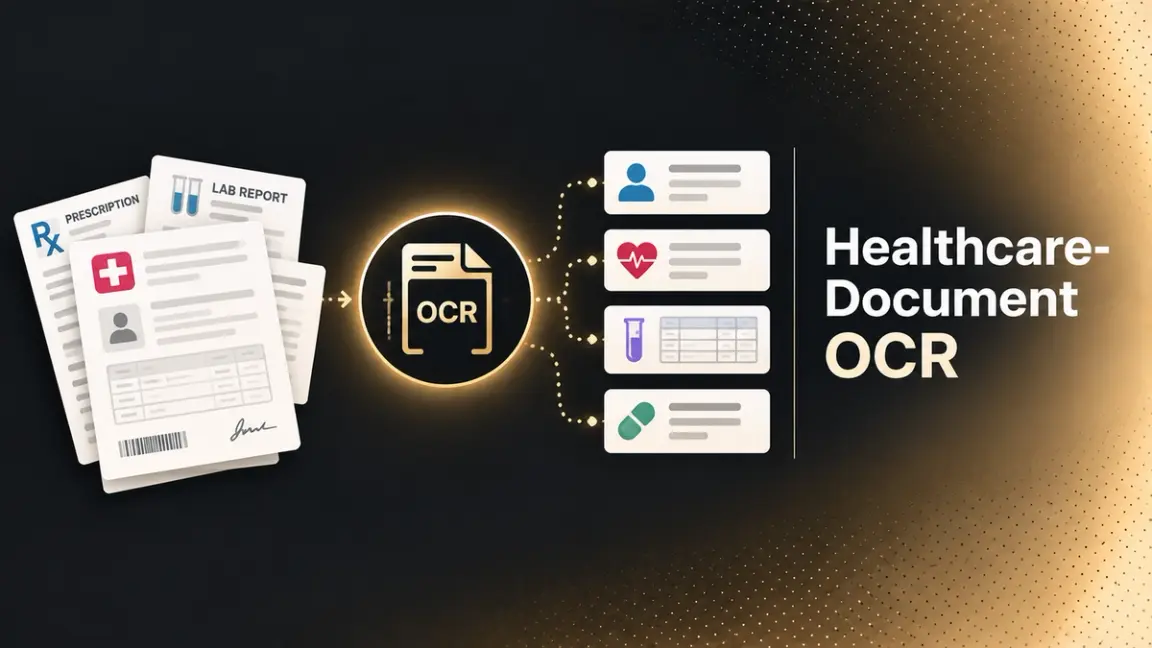
Healthcare document OCR reads scanned, photographed, and faxed documents and turns them into text and data. For medical records, that's only the first step. The text still has to be structured, mapped to medical vocabularies, checked, and sent to the right system, and for handwritten prescriptions, the reading itself is unsolved. This guide covers the document types involved, how the pipeline works, what the research says about handwriting, and which tools fit which job.
Anything that touches patient data also falls under privacy rules. If your focus is billing and revenue cycle, see DeepRead's healthcare RCM solution.
Who This Is For
- Health systems, clinics, and billing teams digitizing backlogs or processing incoming faxes and referrals.
- Health tech and EHR product teams building document intake into their software.
- Pharmacy and prior-authorization teams evaluating prescription OCR.
What Healthcare Document OCR Covers
Vendor and industry guides list a consistent set of documents:
- Clinical documents: progress notes, referral letters, discharge summaries, and clinical notes.
- Lab and diagnostic reports, often arriving by fax.
- Patient-facing forms: intake questionnaires and consent forms.
- Prescriptions, printed or handwritten.
- Insurance and billing documents: insurance cards, EOBs, and claim forms.
This is a different problem from AI scribes that listen to visits and draft notes. Our healthcare AI documentation guide explains where the two categories split.
One guide notes accuracy depends less on the OCR engine than on document quality, layout complexity, and the post-processing that maps text to structured fields.
Why Medical Documents Are Hard for OCR
- Handwriting. Notes and prescriptions vary by author. The same guide says OCR alone is rarely sufficient for handwritten clinical notes without human verification.
- Abbreviations and terminology. Medical shorthand and drug names make mistakes costly and hard to spot.
- Fax and scan quality. Faxes, photocopies, and phone photos degrade text.
- Layout variety. Lab tables, forms, and multi-page records vary by facility.
- Protected health information. Everything above also falls under privacy rules (see the data handling section).
Traditional vs. AI-Based OCR
Traditional OCR matches character shapes and is brittle on handwriting and variable layouts. AI-based tools read documents in context, which helps with layouts and abbreviations but can produce confidently wrong answers. The MIRAGE results below (single-digit scores for general models on prescriptions) show why confidence flags and verification still matter.
How Medical Records OCR Works
- Capture and preprocess. Scans or photos are cleaned (deskewed, denoised).
- Recognize text. OCR reads printed and, where supported, handwritten text.
- Structure it. Fields, tables, and sections are identified, such as patient details or lab values. Our structured data extraction guide covers how schema-driven extraction works.
- Add medical meaning (optional). Medical NLP finds clinical entities in the text. Amazon Comprehend Medical, for example, detects conditions, medications, dosages, tests, and procedures and links them to ICD-10-CM, RxNorm, and SNOMED CT. AWS documents it as analyzing text only in US English, so image-based records need OCR first.
- Validate and review. Rules and confidence thresholds route uncertain values to a person.
- Deliver. Data goes to the EHR, billing, or analytics system.
OCR and medical NLP solve different problems. OCR gets text off the page, while medical NLP turns text into coded clinical concepts.
What to Extract by Document Type
This is a typical-field checklist, not a vendor specification.
- Prescriptions: patient, drug, strength, dose and frequency, quantity, refills, prescriber, date.
- Lab reports: test name, value, unit, reference range, abnormal flag, collection date. Keep units attached to values.
- Discharge summaries: diagnoses, procedures, discharge medications, follow-up.
- Intake forms: demographics, insurance, allergies, medications, consent.
- Referral letters: patient, referring and receiving providers, reason, urgency.
EHR and Billing Integration
Outputs usually arrive as JSON, CSV, or XML through APIs. If your EHR accepts FHIR (HL7's exchange standard), ask whether the vendor can output it or whether you'll map fields yourself. Coded output from medical NLP (ICD-10-CM, RxNorm, SNOMED CT) is the normalized form downstream systems expect.
Where Healthcare OCR Gets Used
- Record digitization and backlog conversion.
- Referral and intake processing. Tennr, for example, is built around referral and intake workflows.
- Billing and claims. Claim forms, EOBs, and itemized bills.
- Insurance verification. Azure offers a prebuilt health insurance card model, and Doxis lists health insurance card OCR.
- Prescription processing.
- Records review for claims and legal cases.
- Research data. Abstracting charts for studies, covered in our research data management guide.
Handwritten Prescriptions: What the Research Says
"Best AI for OCR on handwritten prescriptions" has no clean answer, and the honest picture comes from a recent preprint (MIRAGE, arXiv, late 2024). The team fine-tuned multimodal models on 743,118 simulated handwritten records from 1,133 doctors across India.
- General models scored very low without training. On that dataset, GPT-4o scored 7.57%, Gemini 1.5 Pro 5.53%, and LLaVA 1.6 2%. The paper counted a medication wrong if either its name or dosage was wrong.
- The best fine-tuned model reached 82%. The authors state their accuracy is "in no way deployable and should not be deployed."
- Earlier work was lower. The paper cites 64 to 70%, 74.13%, and 68.78% in prior studies and calls those accuracies impractical for real-world use.
- Humans struggle too. It cites a South African study in which pharmacists read prescriptions with a median 75% correct, and says abbreviations contribute to 60% of medication name errors by experts.
Caveats: this is one preprint, the data is simulated Indian prescriptions, and the models tested were GPT-4o and Gemini 1.5 Pro, so newer models may score higher.
Vendors make stronger claims. Lido's pharmacy page says handwritten prescriptions are handled "with high accuracy" and cites 99.9% on medical records, and Hyperscience cites 99.5% on handwriting. None are independently validated on prescriptions, so demand a test on your own sample.
What this means in practice:
- Treat handwriting output as a suggestion. Route it to a pharmacist or clinician for verification.
- Constrain the answer. Matching extracted medications against a drug vocabulary such as RxNorm is a sensible check (my recommendation, not a vendor claim). Anything that doesn't map to a valid drug should be flagged.
- Avoid handwriting where you can. Typed or e-prescribed orders are far easier to read.
- Test on your own prescriptions. Handwriting varies by region, specialty, and clinician.
Benefits
- Searchable records instead of image archives.
- Less manual entry for intake, billing, and referrals.
- Faster referral and fax handling.
- Structured data for analytics and clinical coding workflows.
- Review where it matters, when confidence flags send only uncertain values to a person.
Named Platforms
Capability claims below are vendor-stated unless noted.
Extraction APIs and Document AI Platforms
DeepRead
DeepRead is a developer-first OCR and document AI API that returns structured JSON in the shape you define. For healthcare, its public skills repository includes a medical records skill with pre-built schemas for patient information, diagnoses, medications, and vitals, aimed at records, lab reports, prescriptions, and discharge summaries.
- Per-field transparency. The skill's sample response gives each field a value, a human-review flag, and the page it was found on, so reviewers know what to check and where.
- Multi-model consensus. Its deployment template describes consensus across GPT, Gemini, and dual OCR, with async processing and webhooks.
- PII redaction. Detects and redacts 14 PII types with irreversible black-bar redaction, context-aware (doctor versus patient). Its community repo markets this as HIPAA/GDPR ready. Check which plans include it.
- Benchmarks. Medical bills score 98.6% on its benchmarks page. There's no published benchmark for clinical notes, lab reports, or handwritten prescriptions.
- Free tier. A 2,000 monthly allowance with no credit card (pricing, docs).
- Compliance. BAA availability isn't stated in the materials I reviewed, so confirm before sending PHI.
- Best fit: teams building typed and printed medical record intake who want schema control and visible uncertainty.
Lido
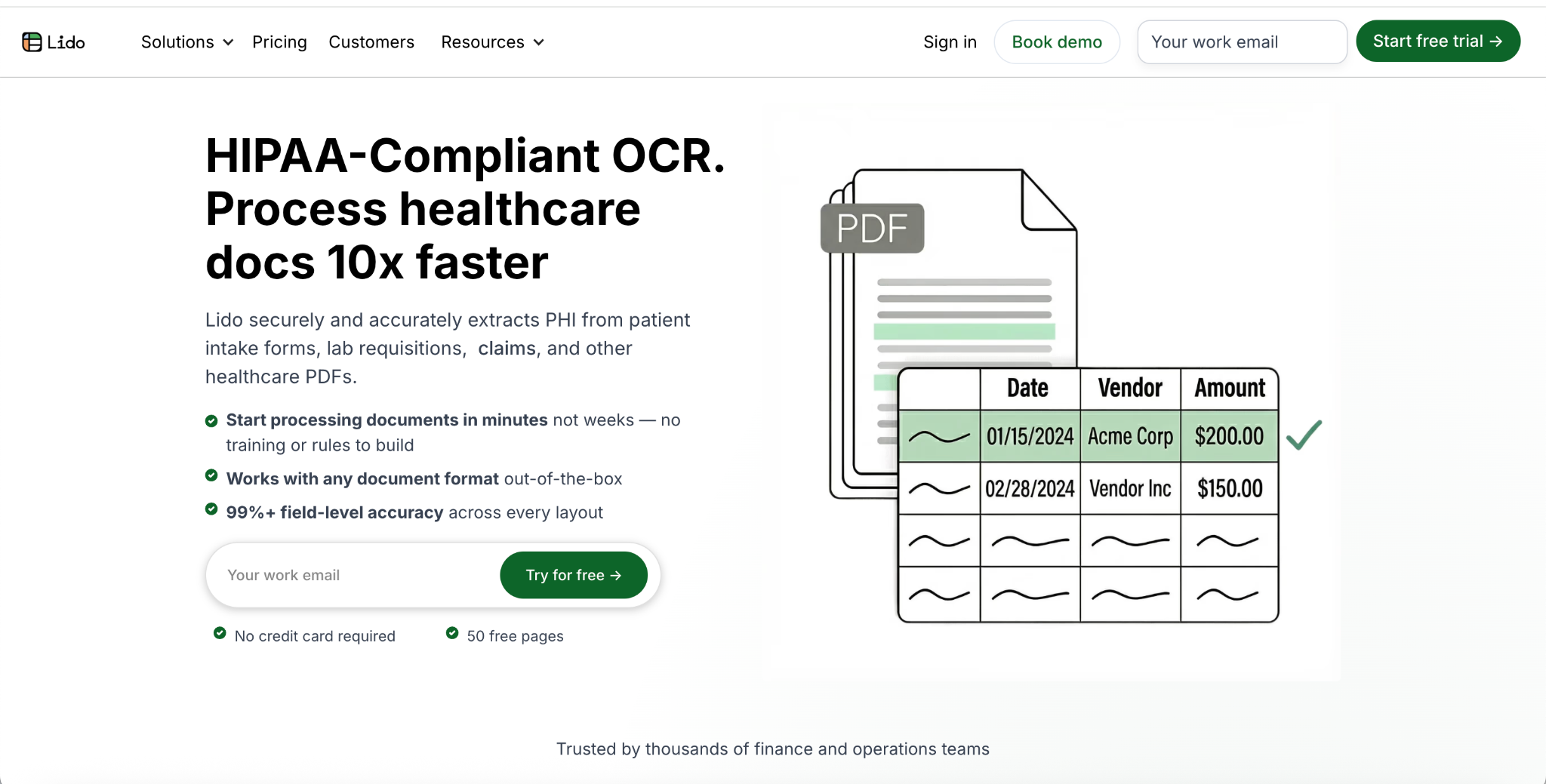
Lido is an AI extraction platform with a dedicated HIPAA OCR page for healthcare. It lists CMS-1500 and UB-04 claims, EOBs, intake forms with handwriting, faxed referrals, prior authorizations, lab requisitions, medical records, and prescription documents, processed without templates.
- Handwriting. Says its vision models read handwriting in context, including cursive and abbreviations. It claims 99.5% on healthcare documents, though its own medical forms site concedes handwritten fields score lower.
- Security. SOC 2 Type II, HIPAA-compliant, AES-256 at rest, TLS 1.2+, audit logs, and 24-hour document deletion per its compliance pages.
- BAA caveat. Its pages differ on which plans include a BAA, so confirm in writing.
- Pricing. Plans from $29 a month, with 50 free pages, per its pages.
- Best fit: teams with messy faxed and handwritten intake who want compliance stated up front.
Doxis AI.dp (formerly Klippa DocHorizon)
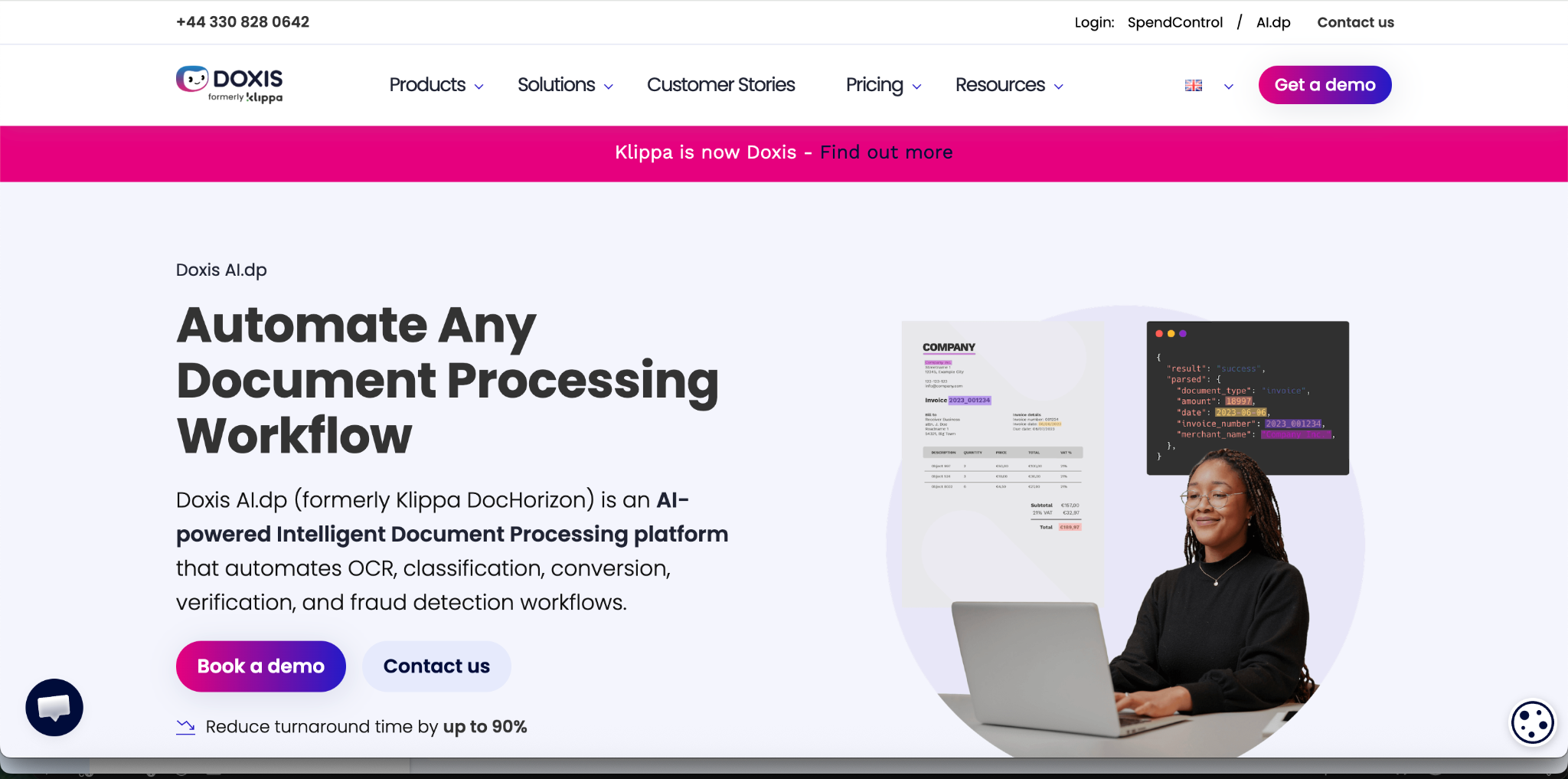
Doxis AI.dp is an IDP platform combining OCR, classification, conversion, verification, fraud detection, and anonymization modules, with 50+ document types out of the box. Its medical categories include health insurance cards and medical prescriptions, and it lists patient onboarding as a use case.
- Custom fields and types. 150+ data fields, trainable custom document types, and workflows you assemble from modules.
- Human review. An optional operator-validation module, which it says approaches 100% accuracy.
- Outputs. JSON, XML, CSV, XLSX, UBL, PDF, and TXT, via API, SDK, or connectors.
- Compliance. GDPR, ISO 27001, ISAE 3000 Type I, and CCPA, EU-hosted. HIPAA isn't listed on the page I reviewed.
- Pricing. Based on volume and workflow complexity, by quote.
- Best fit: European or multi-region teams wanting configurable workflows.
Hyperscience
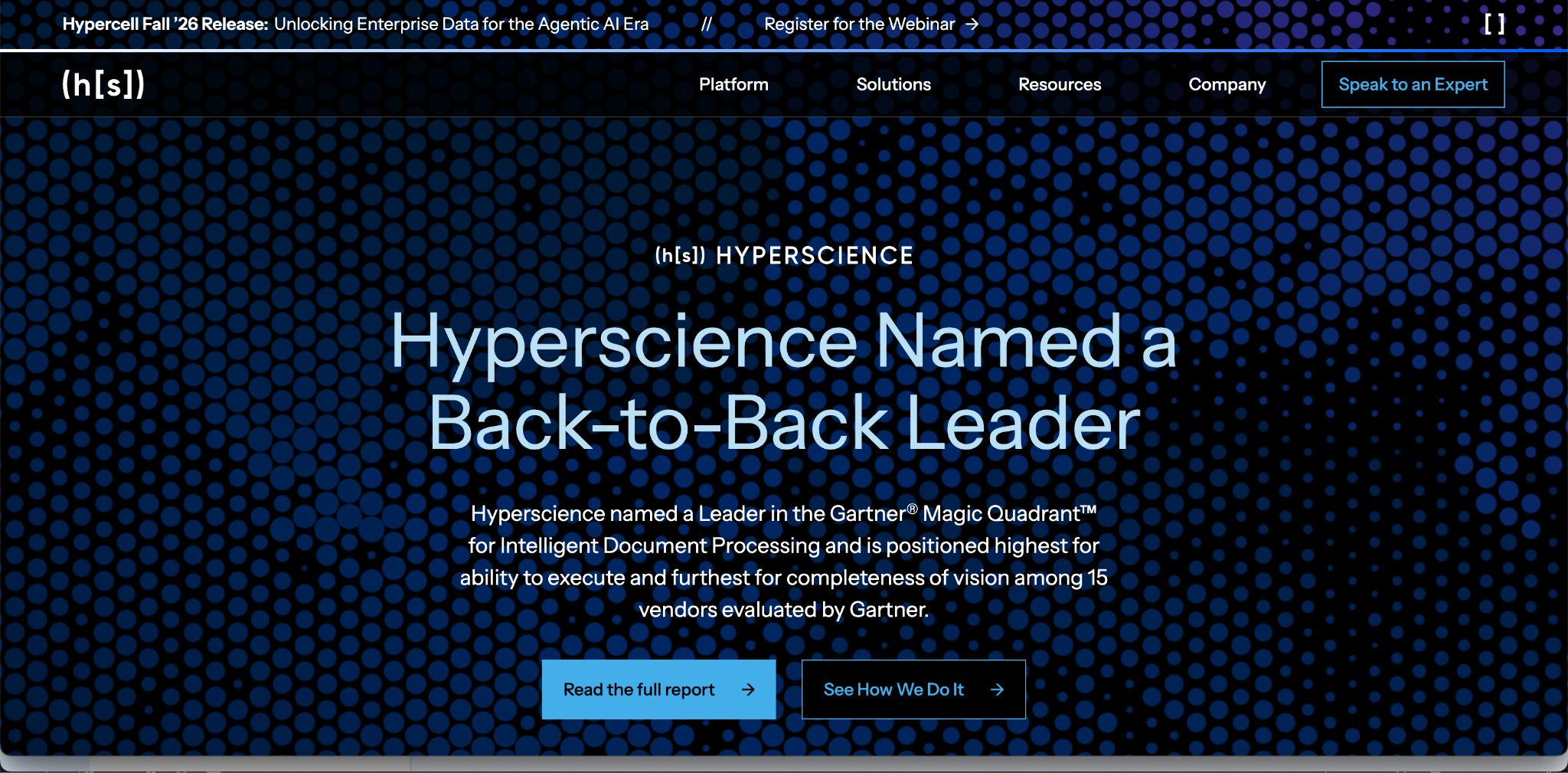
Hyperscience's Hypercell is an enterprise IDP platform that turns forms, handwriting, and records into structured data, with routing and human-in-the-loop review. Its page cites an IDC MarketScape remark that handwriting remains a challenge for many vendors and that Hyperscience should be shortlisted when high accuracy is required.
- Claims. 99.5% accuracy and 98% automation even with hard-to-read handwriting.
- Degraded input. Reads faxes and mobile photos, and human review feeds corrections back into models.
- Pricing. I found no public pricing.
- Best fit: high-volume, handwriting-heavy operations with implementation resources.
Cloud OCR and Medical NLP
Amazon Textract with Comprehend Medical
Textract is AWS's OCR and document analysis service for printed text, handwriting, forms, tables, and signatures. Comprehend Medical is a separate HIPAA-eligible NLP service that reads clinical text and extracts medical entities, so the pair covers both layers of records processing.
- Textract pricing. Billed per page by feature. AWS's pricing page shows Forms at $0.05 and Tables at $0.015 per page (US West Oregon, first million pages), and features add up.
- Comprehend Medical. Detects conditions, medications, dosages, tests, treatments, procedures, and PHI, and links them to ICD-10-CM, RxNorm, and SNOMED CT. AWS documents it as US English only.
- Compliance. HIPAA-eligible, which still needs a signed BAA and your own safeguards.
- Best fit: AWS teams assembling OCR plus coding themselves.
Azure AI Document Intelligence
Microsoft's document extraction service offers REST APIs and SDKs for .NET, Python, Java, and JavaScript, plus Document Intelligence Studio for testing. Its Read model extracts printed and handwritten text and is the OCR engine underneath its other prebuilt models.
- Prebuilt models include invoice, receipt, ID, health insurance card, W2, bank statement, and pay stub.
- Read model detects paragraphs, lines, words, locations, and languages, with handwriting for supported languages.
- Compliance. Confirm HIPAA and BAA coverage on Microsoft's side.
- Best fit: Microsoft-stack teams and insurance card intake.
Google Document AI
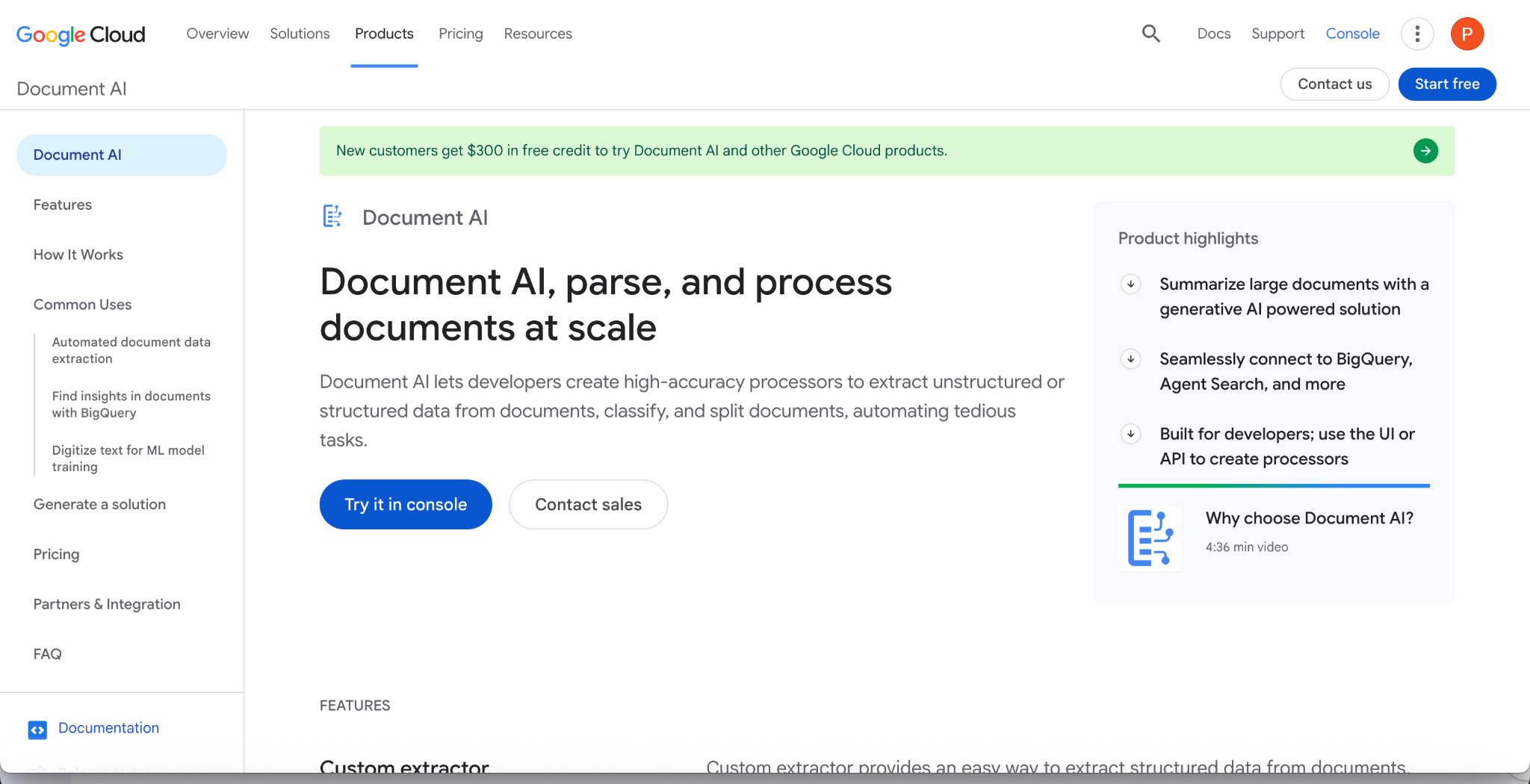
Google Cloud's document platform pairs Enterprise Document OCR with a Workbench for custom extractors. OCR covers 200+ languages, and handwriting recognition covers 50 languages, plus checkbox detection.
- Pricing from Google's page: OCR $1.50 per 1,000 pages, Layout Parser $10, Form Parser $30.
- Workbench builds custom extractors with foundation models, plus classifiers and splitters. Google's processor list says generative extraction officially supports English only.
- Compliance. Confirm HIPAA coverage for the processors you use.
- Best fit: Google Cloud teams.
Healthcare Workflow Specialists
Tennr
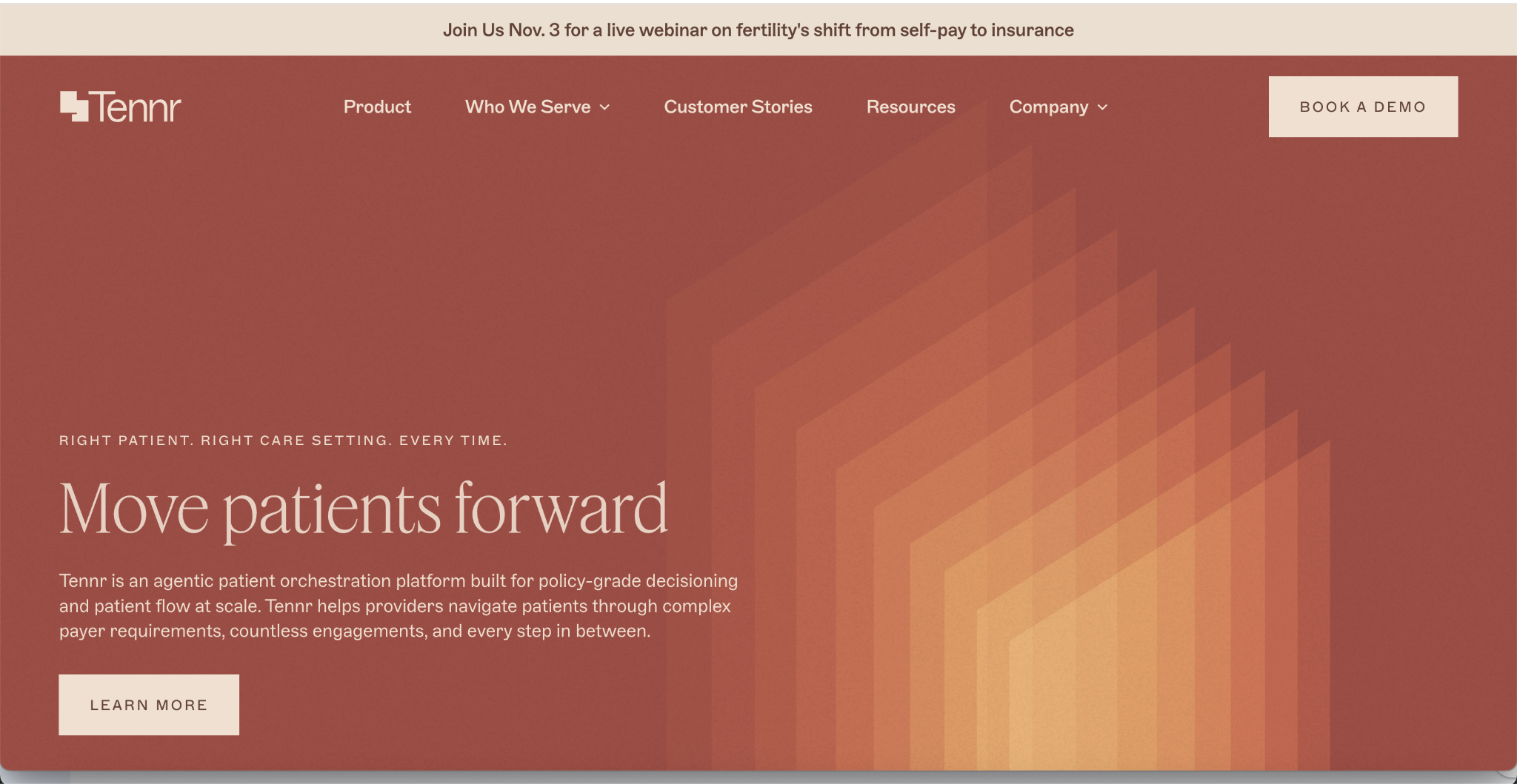
Tennr calls itself an agentic patient orchestration platform for providers. It pulls data from faxes, charts, and insurance plans, routes patient data from any source into the right workflow, and compares documentation against payer criteria.
- Missing documents. Identifies what's missing for the specific patient and service, requests it from the right party, and tracks it to completion.
- Payer tasks. Eligibility checks, benefits investigation by phone, and prior authorization submission.
- Serves DME, infusion, fertility, physician groups, hospitals, and specialty pharmacies, and displays HIPAA and SOC 2 badges. Its customer stories include a move from a three-week backlog to same-day intake.
- Best fit: specialty practices buried in referral faxes. It's workflow software, not an OCR API.
Wisedocs
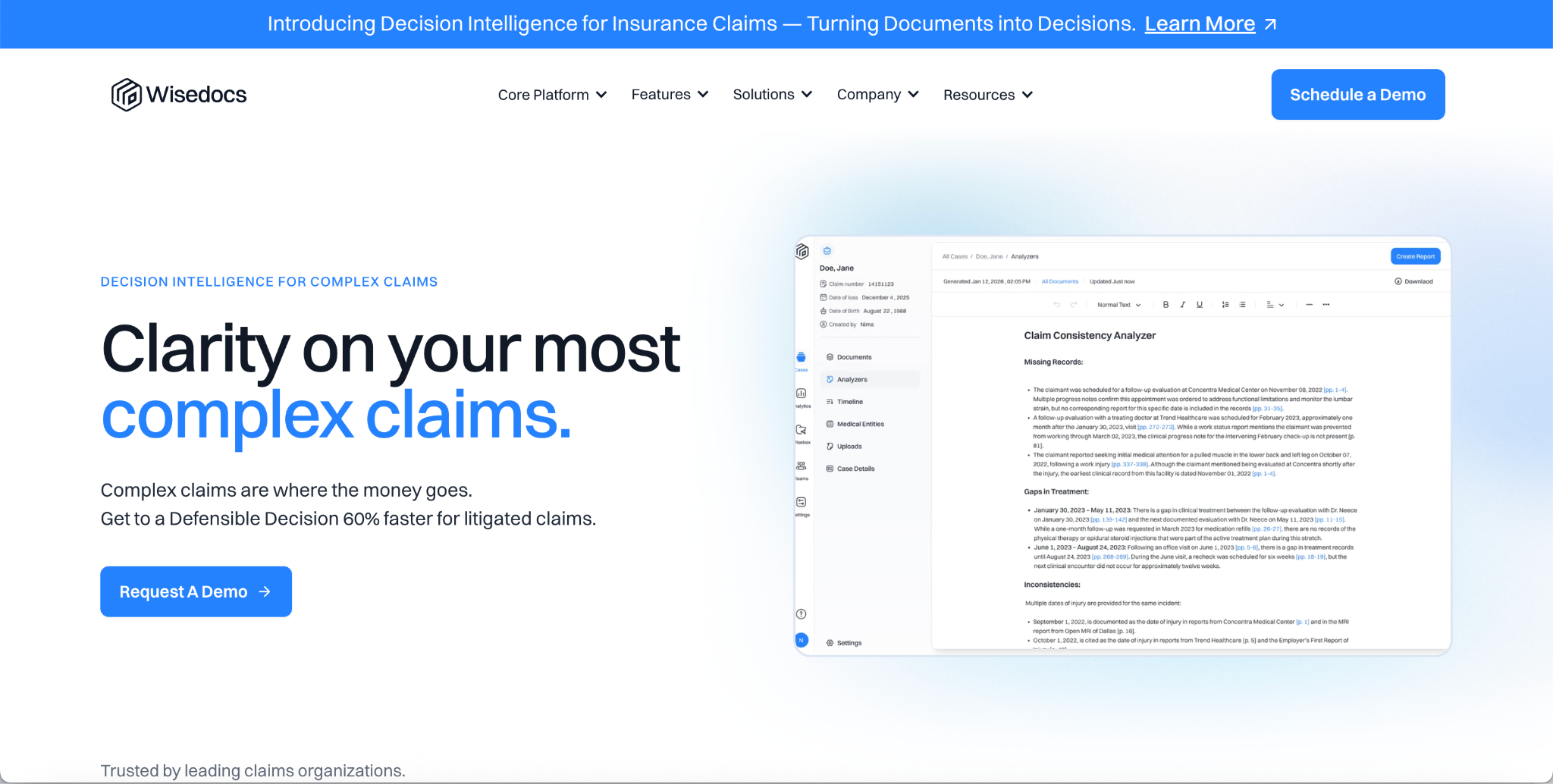
Wisedocs is an AI claims documentation platform that organizes, indexes, and reviews medical records for insurance, legal, and IME teams. It produces medical chronologies, summaries, and cited insights, with expert human oversight.
- Record cleanup. Handwritten detection, deduplication, and detection of mixed-up claimant records.
- Defensibility. Findings keep their document, page, reviewer, and action history, with side-by-side source review.
- Lines served: workers' comp, auto and general liability, medical malpractice, disability, and government. It displays SOC 2 Type II, HIPAA, and GDPR badges and publishes customer results such as 60% lower cost per page at a malpractice insurer (vendor-published).
- Best fit: claims and legal teams who want record summaries instead of field extraction.
ABBYY Vantage, LlamaParse, Mindee, and Tesseract also appear on most healthcare OCR shortlists. I didn't verify healthcare-specific details for them.
Pricing at a Glance
Verified rates only:
- Amazon Textract: Forms $0.05 and Tables $0.015 per page, stacking by feature.
- Google Document AI: OCR $1.50, Layout $10, and Form Parser $30 per 1,000 pages.
- Lido: from $29 a month, 50 free pages.
- DeepRead: a free tier with a 2,000 monthly allowance, plus paid plans on its pricing page.
- Doxis: quote-based.
- Hyperscience, Tennr, and Wisedocs: no public pricing found.
What Accuracy Figures Mean
Vendor figures aren't comparable across tools. Hyperscience's 99.5% describes printed and handwritten text on forms, Lido's 99.5% describes healthcare documents generally, while the MIRAGE results measure exact matches on medication name and dosage in cursive prescriptions. Measure field-level accuracy on the fields where errors do harm (medication, dose, allergies, lab values and units, dates, patient identifiers), and track how often a person has to step in.
Data Handling and HIPAA
- Medical records contain PHI. Our HIPAA-compliant document processing guide covers the safeguards: BAAs, encryption, audit trails, and model-training policies.
- "HIPAA-eligible" isn't "compliant." AWS documents Comprehend Medical as HIPAA-eligible, but you still need a signed BAA and your own controls.
- Minimize what moves. When downstream systems don't need identifiers, redact first.
- Confirm per service, not per vendor, and ask where data is processed and retained.
Which Approach Fits Which Situation
- Typed and printed documents, building your own intake: an extraction API with confidence flags, such as DeepRead's medical records schemas.
- Fax- and handwriting-heavy back office: Hyperscience or Lido, with human verification.
- Already on AWS, Azure, or Google: that cloud's OCR, plus medical NLP where you need coded output.
- Referral and intake queues: Tennr.
- Case review and summaries: Wisedocs.
- Handwritten prescriptions: treat OCR as assisted entry, never as the final record.
Getting Started
Pick one document class and start with typed or printed documents. Assemble a representative sample, including your worst faxes and scans, and define which fields carry clinical risk. Measure field-level accuracy against human-verified answers, set review thresholds for those fields, and expand only after the numbers hold.
Conclusion
Healthcare document OCR is two problems: getting text off the page and giving it medical meaning. Typed and printed records are largely tractable, with the work shifting to structuring, validation, and privacy. Handwritten prescriptions are different, since current research shows even fine-tuned models are far from deployable, so human verification stays in the loop. Choose by document type and risk, and test on your own records.
FAQ
What is healthcare document OCR?
Software that reads scanned, photographed, or faxed healthcare documents and converts them into text and structured data for EHR, billing, or analytics systems.
Can OCR read handwritten prescriptions?
Partially. A late-2024 preprint reports fine-tuned multimodal models reaching 82% on simulated prescriptions, while its authors call that accuracy not deployable, and prior studies report 64 to 74%. Use OCR output as a suggestion to be verified.
What is the best AI for OCR on handwritten medical prescriptions?
No tool is reliable enough to trust unreviewed. Cloud services such as Azure's Read model and Amazon Textract support handwriting, but test on your own prescriptions and keep a pharmacist or clinician in the loop.
What's the difference between OCR and medical NLP?
OCR converts images into text. Medical NLP, such as Amazon Comprehend Medical, finds clinical entities in that text and links them to ICD-10-CM, RxNorm, and SNOMED CT.
Which documents does medical records OCR handle?
Clinical notes, referral letters, discharge summaries, lab reports, intake and consent forms, prescriptions, insurance cards, EOBs, and claim forms.
Is OCR for medical records HIPAA compliant?
Compliance depends on the service and your setup. Several cloud services are HIPAA-eligible, which still requires a signed BAA and your own safeguards.
How accurate is medical records OCR?
It varies with document quality, handwriting, and what's measured. Vendor figures reach the high 90s on printed text, while handwritten clinical content is much lower, so measure on your own records.
Does DeepRead support healthcare documents?
Yes, for typed and printed records. DeepRead publishes a medical records skill with schemas for patient information, diagnoses, medications, and vitals, and a medical bill benchmark of 98.6%. It has no published benchmark for clinical notes, lab reports, or handwritten prescriptions, so test those on your own documents and confirm BAA availability before sending PHI.
More articles
AI Parse Document: How AI Document Parsing Works and Which Tools to Use (2026)
How AI parse document works: Databricks ai_parse_document vs Snowflake AI_PARSE_DOCUMENT, costs, limits, other tools, and BOQ and supplier quote extraction.
OCR Software for Handwritten Text: What Works, What Doesn't, and How to Choose (2026)
Compare OCR software for handwritten text: handwriting OCR APIs, free tools, cursive and Chinese support, real pricing and limits, and how to test accuracy.