%20{%20:root%20{%20--deepread-stroke:%20%23E5E7EB;%20}%20}%20.dark%20{%20--deepread-stroke:%20%23E5E7EB;%20}%20%3c/style%3e%3crect%20x='40'%20y='30'%20width='220'%20height='260'%20rx='28'%20ry='28'%20stroke='var(--deepread-stroke)'%20stroke-width='16'%20fill='none'/%3e%3cpath%20d='M180%2030v52c0%2010%208%2018%2018%2018h62'%20stroke='var(--deepread-stroke)'%20stroke-width='16'%20fill='none'/%3e%3cline%20x1='70'%20y1='130'%20x2='200'%20y2='130'%20stroke='var(--deepread-stroke)'%20stroke-width='16'%20stroke-linecap='round'/%3e%3cline%20x1='70'%20y1='165'%20x2='200'%20y2='165'%20stroke='var(--deepread-stroke)'%20stroke-width='16'%20stroke-linecap='round'/%3e%3cline%20x1='70'%20y1='200'%20x2='170'%20y2='200'%20stroke='var(--deepread-stroke)'%20stroke-width='16'%20stroke-linecap='round'/%3e%3c!--%20green%20download%20arrow%20in%20bottom%20right%20corner%20--%3e%3cpath%20d='M210%20202v58'%20stroke='var(--deepread-accent)'%20stroke-width='18'%20stroke-linecap='round'/%3e%3cpath%20d='M195%20245l15%2015%2015-15'%20fill='none'%20stroke='var(--deepread-accent)'%20stroke-width='18'%20stroke-linecap='round'%20stroke-linejoin='round'/%3e%3c/svg%3e)
Healthcare AI Documentation Automation Solutions: A 2026 Guide
Comparing ambient AI clinical scribes and document processing platforms for healthcare — named tools, evidence, compliance, and what to evaluate.
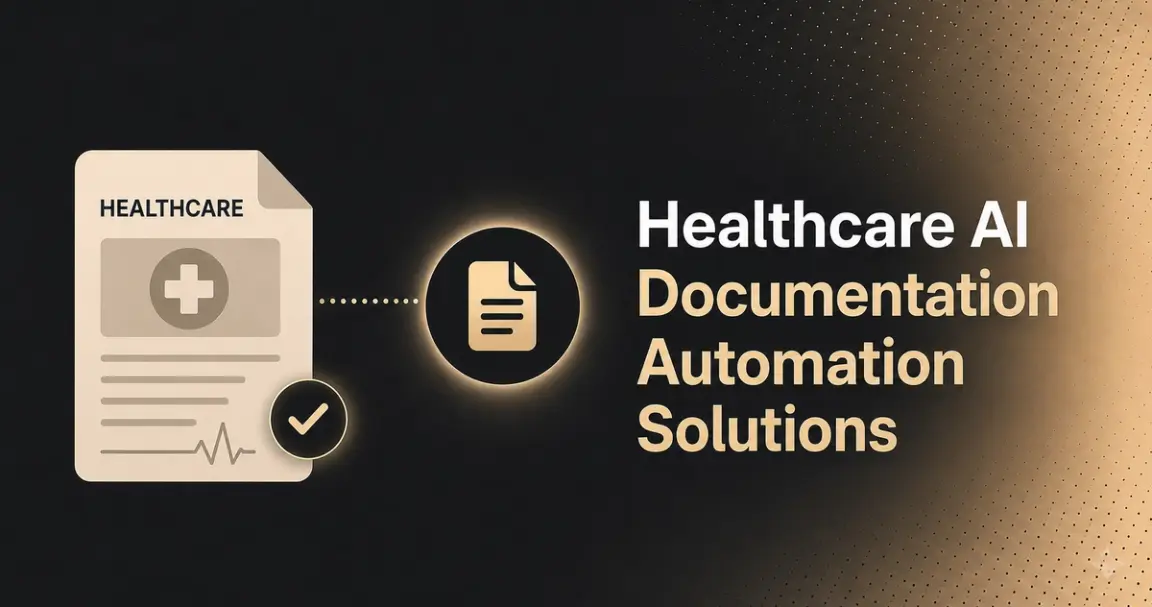
"Healthcare AI documentation automation" covers two genuinely different technologies solving different problems. Ambient AI clinical scribes listen during a patient encounter and generate a new clinical note, speech-to-text plus generative clinical language modeling, aimed at reducing the hours physicians spend typing after every visit. AI document processing platforms extract structured data from documents that already exist — faxes, scans, claims, medical bills, turning paper and PDFs into usable data. Both get called "AI documentation automation," and a search for this term lands on both, often without much explanation of why they're different purchases.
One disambiguation worth stating upfront: not everything marketed as "ambient AI" is a medical scribe. Some are generic meeting summarizers with no signed Business Associate Agreement — fine for a business call, not appropriate for a patient encounter involving PHI. If a tool can't confirm a BAA, it's not a candidate for this category regardless of how it's marketed.
This covers both categories: how ambient scribes actually work, named tools, evidence behind the claims, compliance requirements, and what to evaluate in each.
Who This Is For
- Physicians and clinical operations leaders evaluating ambient scribes to reduce documentation burden and burnout.
- Health system CIOs and CMIOs negotiating enterprise ambient-scribe contracts with deep EHR integration requirements.
- Healthcare ops, claims, and records teams processing existing paper and fax documentation — a different problem than clinical note generation.
- Compliance and revenue-cycle teams who need to understand what's actually billable and audit-ready for AI-generated documentation.
Category 1: Ambient AI Clinical Documentation (Scribes)
These tools listen during a patient encounter, transcribe the conversation, and use a language model to draft a structured clinical note for physician review and EHR write-back. This is currently the fastest-growing category in health IT: documentation burden is cited by 16% of providers as their primary driver of burnout, and one JAMA Network Open study of 263 clinicians found burnout dropped from 51.9% to 38.8% after 30 days using an ambient AI scribe.
How Ambient Scribes Actually Work
Most run a similar pipeline: capture audio during the encounter, transcribe speech to text, use a large language model to draft a SOAP-format note, map relevant terms to standard code sets (ICD-10, SNOMED, CPT), and write the draft back into the EHR for physician review before it's finalized. Tools diverge on timing: DAX Copilot, Abridge, and Suki generate a streaming draft in real time during the visit, typically updating every 5–15 seconds, with a finalized version ready within a minute of the encounter ending. Nabla and DeepScribe instead operate in near-real-time or fully post-encounter modes.
A compliance point worth naming directly, with an appropriate caveat: one industry comparison source states that CMS guidance treats ambient-generated notes as billable provided the physician reviews and signs them. This is plausible and specific, but it's less independently corroborated in the research behind this article than the clinical evidence below; confirm current CMS guidance directly with your compliance team rather than treating this as settled from a single source.
Abridge
The most decorated startup in this category — winner of the 2025 and 2026 Best in KLAS award in the Ambient Speech category, deployed across 200+ health systems including Mayo Clinic, UCSF, Yale New Haven, and Emory, with a landmark rollout to Kaiser Permanente's 40 hospitals and 600+ medical offices described by Kaiser as its largest generative AI implementation to date.
- Best for: large health systems wanting deep Epic integration and system-wide contracts.
- Pricing: enterprise, quoted per health system.
Nuance DAX / Microsoft Dragon Copilot
Microsoft acquired Nuance for $19.7 billion in 2022; the DAX product is now branded Dragon Copilot, and leads the category on installed base with 600+ deployed organizations.
- Best for: large enterprise health systems already on Microsoft/Dragon infrastructure, wanting the most established, highest-volume deployment track record.
- Pricing: enterprise, typically $500+ per provider per month at scale.
Ambience Healthcare
Positioned alongside Abridge and Dragon Copilot as an enterprise health-system player, competing specifically on the same deep-Epic-integration, system-wide-contract ground.
- Best for: large health systems evaluating enterprise ambient scribes alongside Abridge and Dragon Copilot as direct alternatives.
- Pricing: enterprise, quoted per health system.
Suki
In continuous clinical use since 2017 — the longest-running ambient scribing tool in the category — with two-way integration confirmed across Epic, Oracle Health, athenahealth, and MEDITECH. Distinct from passive ambient tools in that it supports voice commands during the visit, not just background listening.
- Best for: clinicians who want active voice interaction with documentation and coding support, not just passive ambient capture.
- Pricing: self-serve tiers commonly cluster around $49–99/month per provider.
Nabla
A mid-market/specialty-focused scribe, part of the UCLA randomized controlled trial comparing DAX Copilot and Nabla against usual care — one of the few studies in this category with Level I (RCT) evidence, showing measurable documentation time reduction and burnout improvement.
- Best for: ambulatory and specialty practices wanting a mid-market option with genuine trial evidence behind it.
- Pricing: not consistently published; confirm directly.
DeepScribe
One comparison source reports a 98.8/100 KLAS-style score, with particular strength cited in specialty fit and E/M coding accuracy — this figure appeared in only one of the sources reviewed for this piece, so treat it as directional rather than independently confirmed.
- Best for: specialty practices prioritizing coding accuracy alongside note generation.
- Pricing: not consistently published; confirm directly.
Freed
An SMB/individual-clinician-focused tool, optimized for fast setup and speed-to-value rather than enterprise EHR integration depth.
- Best for: smaller clinics and individual clinicians wanting to start quickly without a large procurement process.
- Pricing: among the more accessible in the category, with published self-serve rates.
Notable Health
Named among the vendors compared across features, pricing, EHR integration depth, and total cost of ownership in this category — worth including on a shortlist alongside the tools above rather than treating the field as limited to just the best-known names.
- Best for: buyers running a broader comparison across the category rather than defaulting straight to the two or three most-marketed names.
- Pricing: confirm directly.
Epic's Native Ambient Scribe
Epic announced its own ambient AI scribe, built on Microsoft Dragon AI, in 2025, a genuinely important factor for the buying decision, not just another vendor. For a health system already on Epic, the real comparison may not be "which third-party scribe," but "third-party specialist tool vs. what's already inside the EHR we run." Confirm current capability and rollout status directly, since EHR-native features in this category are moving quickly.
A note on the broader vertical: home health and hospice have their own dedicated ambient documentation tools — Lime Health AI, WellSky Scribe, and Homecare Homebase's Curate: Scribe — distinct from the ambulatory/hospital-visit tools above. If you're evaluating for that setting specifically, these are worth a separate look rather than assuming the general-practice vendors above transfer directly.
Category 2: AI Document Processing for Existing Healthcare Records
A separate problem: turning documents that already exist — faxes, scans, claims, medical bills, intake forms — into structured, usable data. No conversation to transcribe, no note to generate; this is extraction, not generation.
DeepRead
A schema-driven document extraction API — not built specifically for healthcare, but with a directly relevant, published benchmark: 98.6% accuracy on medical bill extraction specifically, measured against named competitors on identical documents against a manually verified ground truth.
- Strengths: the one entry in this category with a fully public, checkable accuracy methodology, plus async processing, webhook delivery, and needs_review confidence flagging for uncertain fields.
- Honest limitation: general-purpose, not a healthcare-specific platform — no built-in claims workflow, coding logic, or healthcare-specific compliance tooling beyond what schema-driven extraction and PII detection provide.
- Pricing: free — 2,000 documents/month, no credit card required.
readabl.ai
Turns faxes, scans, and narrative reports into structured healthcare information using NLP to identify discrete data within documents, with human-in-the-loop review when recognition confidence is low, and EHR integration for the extracted output.
- Best for: healthcare organizations still receiving significant volume via fax and scanned reports wanting classification, indexing, and extraction in one workflow.
ibml
Positions itself around high-volume intelligent capture — automating classification and extraction across revenue cycle management, records processing, and general document-heavy healthcare workflows.
- Best for: healthcare organizations processing high document volume across multiple use cases (claims, records, billing) rather than one narrow document type.
Staple AI
Extracts data from medical claims, bank statements, and healthcare documents, with specific strength in handwritten document extraction across Asian and Latin-script languages.
- Best for: organizations with genuinely multilingual or handwriting-heavy document volume.
MHC
Healthcare-specific document automation focused on eliminating manual paper-file retrieval and improving document security and patient-information access, with a track record of organizations expanding from one department (accounts payable) to others (HR) after initial success.
- Best for: organizations starting with one high-friction document process and planning to expand automation department by department.
Compliance Considerations for Both Categories
- HIPAA and BAAs are non-negotiable in both categories — confirm a signed Business Associate Agreement directly with any vendor before sharing PHI, whether that's audio from a patient encounter or a scanned medical bill.
- For ambient scribes specifically: confirm where audio and generated notes are stored, retention periods, and whether the physician-review-and-sign step is built into the workflow.
- For document processing specifically: confirm PII/PHI detection is a first-class extraction step, not a manual step applied afterward.
- Audit trails matter in both categories — for scribes, evidence of physician review before a note is finalized; for document processing, evidence of what was extracted, flagged, and reviewed.
What to Evaluate
For ambient scribes: EHR integration depth (Epic/Oracle Health/athenahealth specifically, not just "EHR integration" generically), specialty-specific accuracy if you're not general practice, whether evidence behind claims is trial-based (RCT, KLAS) or vendor-stated only, and total cost at your actual provider count.
The single most practical step: trial two or three shortlisted tools with real patients and your actual EHR configuration before committing; a demo environment doesn't reveal integration friction the way a real pilot does.
For document processing: accuracy on your actual document mix (not a demo set), confidence scoring and human review workflow for uncertain fields, handwriting performance if that's part of your document volume, and whether the accuracy claim is independently checkable.
Common Challenges
- Category confusion during evaluation, comparing an ambient scribe against a document processing platform as if they solve the same problem, when they don't overlap functionally at all.
- Trusting vendor-stated accuracy without independent evidence, particularly in the scribe category where peer-reviewed, trial-based evidence remains sparser than the volume of vendor marketing claims would suggest.
- Underestimating EHR integration depth requirements, and specifically underestimating how much the EHR-native option (Epic's own scribe) changes the shape of the evaluation for Epic-based health systems.
- No named owner for physician review of ambient-generated notes — genuine review, not a rubber-stamp workflow, is what the billing and compliance case depends on.
- Assuming any "ambient AI" tool is automatically a compliant medical scribe — confirm a signed BAA specifically, since some ambient AI products are general-purpose meeting summarizers not built for PHI at all.
Conclusion
"Healthcare AI documentation automation" isn't one category — it's two, solving genuinely different problems. Ambient AI scribes reduce the time physicians spend generating clinical notes from patient encounters, with real (if still maturing) trial evidence behind the leading vendors, and a fast-moving market that now includes Epic's own native scribe as a serious factor in the decision. AI document processing platforms extract structured data from healthcare records that already exist, a different technology entirely. Get the category right first — the right vendor shortlist looks completely different depending on which problem you're actually trying to solve.
FAQ
What's the difference between an ambient AI scribe and AI document processing for healthcare?
An ambient scribe listens during a patient encounter and generates a new clinical note using speech-to-text and generative AI. Document processing extracts structured data from documents that already exist (faxes, scans, claims). Different technology, different use case, largely different vendors.
How do ambient AI scribes actually generate a clinical note?
Most follow the same pipeline: capture audio, transcribe it, use a language model to draft a SOAP-format note, map terms to standard codes (ICD-10, SNOMED, CPT), and write the draft back into the EHR for physician review. Some tools stream the draft in real time during the visit; others generate it in near-real-time or after the encounter ends.
Should a health system already on Epic still evaluate third-party ambient scribes?
Worth doing, but the comparison has changed — Epic now offers its own native ambient scribe built on Microsoft Dragon AI. The real evaluation for Epic-based systems is increasingly "specialist third-party tool vs. what's already inside the EHR," not just choosing between third-party vendors.
Is every "ambient AI" healthcare tool a compliant medical scribe?
No, confirm a signed Business Associate Agreement specifically. Some tools marketed broadly as "ambient AI" are general-purpose meeting summarizers not built for handling PHI, which makes them unsuitable for a patient encounter regardless of how they're positioned.
Is DeepRead an ambient AI scribe?
No, DeepRead is a document extraction API, relevant to the document-processing category (extracting data from existing healthcare records like medical bills), not the ambient-scribe category (generating clinical notes from patient encounters).
Which category should a health system evaluate first?
Whichever matches the actual bottleneck. If physicians are spending hours typing notes after visits, that's the ambient-scribe problem. If claims, faxes, and scanned records are piling up and needing manual data entry, that's the document-processing problem. Many health systems eventually need both, but they're separate evaluations with separate vendor shortlists.
More articles
Structured Data Extraction: A Technical Guide
How to extract structured data from documents using an AI API, the architecture, grounding, and named tools compared.
Key Features of AI Document Workflow Automation
AI document workflow automation features, governance, prioritization framework, and real examples with measurable benefits for 2026.