%20{%20:root%20{%20--deepread-stroke:%20%23E5E7EB;%20}%20}%20.dark%20{%20--deepread-stroke:%20%23E5E7EB;%20}%20%3c/style%3e%3crect%20x='40'%20y='30'%20width='220'%20height='260'%20rx='28'%20ry='28'%20stroke='var(--deepread-stroke)'%20stroke-width='16'%20fill='none'/%3e%3cpath%20d='M180%2030v52c0%2010%208%2018%2018%2018h62'%20stroke='var(--deepread-stroke)'%20stroke-width='16'%20fill='none'/%3e%3cline%20x1='70'%20y1='130'%20x2='200'%20y2='130'%20stroke='var(--deepread-stroke)'%20stroke-width='16'%20stroke-linecap='round'/%3e%3cline%20x1='70'%20y1='165'%20x2='200'%20y2='165'%20stroke='var(--deepread-stroke)'%20stroke-width='16'%20stroke-linecap='round'/%3e%3cline%20x1='70'%20y1='200'%20x2='170'%20y2='200'%20stroke='var(--deepread-stroke)'%20stroke-width='16'%20stroke-linecap='round'/%3e%3c!--%20green%20download%20arrow%20in%20bottom%20right%20corner%20--%3e%3cpath%20d='M210%20202v58'%20stroke='var(--deepread-accent)'%20stroke-width='18'%20stroke-linecap='round'/%3e%3cpath%20d='M195%20245l15%2015%2015-15'%20fill='none'%20stroke='var(--deepread-accent)'%20stroke-width='18'%20stroke-linecap='round'%20stroke-linejoin='round'/%3e%3c/svg%3e)
Top Healthcare Document Processing Systems for Research Data (2026)
Healthcare document processing tools ranked for research data, clinical extraction, abstraction, and compliance, with a decision framework.
An estimated 80% of clinical data has no fixed schema; it lives in free-text notes, scanned forms, and handwritten records, a figure repeated consistently enough across NIH-indexed literature to function as an industry consensus rather than a single study's finding.
For research specifically — clinical trials, lab data, chart abstraction for risk adjustment or quality review, that unstructured mass sits behind PHI restrictions, multi-site format inconsistency, and a requirement most general business tools don't account for: the ability to show exactly where an extracted value came from and how confident the system was, since research integrity depends on that traceability as much as privacy protection does.
This is a guide to document processing systems built for that specific problem, not general healthcare document management (storage, retention, e-signing), and not general hospital operations tooling (fax intake, claims, revenue cycle), both genuinely different categories covered elsewhere. Defined evaluation criteria, nine tools across four categories, and a framework for matching the category to your actual research workflow.
Who This Is For
- Clinical research teams and CROs processing case report forms, informed consent documents, and multi-site trial reports.
- Diagnostic and clinical laboratories processing test requisition forms and lab results at research scale.
- Payers and risk-bearing organizations doing chart abstraction for risk adjustment, HEDIS quality review, or value-based care.
- Research informatics teams needing structured, provenance-traceable data across collaborating research sites.
- Engineering teams at health-tech and life sciences companies deciding whether to build on an extraction API or adopt a purpose-built platform.
Document Processing vs. Document Management
Worth separating clearly, since search results for this space blend both under overlapping queries. Document processing (IDP) classifies documents and extracts structured, validated data from them. Document management (DMS) — platforms like DocuWare, M-Files, or FileHold — stores, retrieves, and versions documents after capture, sometimes with light extraction layered on top.
If your primary need is retention policies and e-signatures rather than turning a scanned form into structured, usable data, you're evaluating a different category than this guide covers.
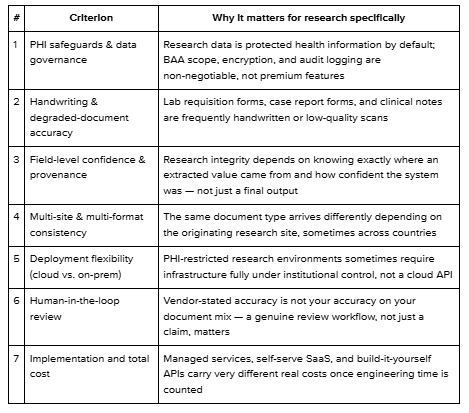
Seven Evaluation Criteria for Research-Specific Document Processing
Clinical & Research Extraction APIs
Built for teams embedding extraction directly into a research pipeline or clinical AI application, rather than adopting a full platform.
1. LlamaParse and LlamaExtract (LlamaIndex)
An agentic document processing platform built specifically for teams creating clinical AI systems, not just digitizing archives — schema-based extraction with citations back to the source document.
- Positioned around document understanding and auditability rather than simple text capture, relevant directly to criterion 3 (provenance)
- Handles layout-aware parsing suited to complex clinical document structures
- Best for: teams building AI applications on top of clinical or research documents, where citation-backed, schema-driven extraction matters more than a finished workflow product
- Confirm current PHI/BAA support directly given the pace of change in this space
2. Reducto
A developer-first document processing API handling clinical notes, records, and forms through a single interface, with field-level citations back to the exact page, line, and region of the source document.
- The citation-to-source mechanism is a direct, concrete answer to criterion 3 — it's what an audit-ready extraction layer for research actually needs to look like
- A component, not a workflow — intake channels, review queues, and downstream integration are your build
- Best for: engineering teams embedding healthcare/research extraction into their own product or pipeline, with the technical capacity to build the surrounding system
3. IBM Research's Docling
An open-source document converter with high-fidelity parsing and local execution — layout, reading order, and table structure analysis run entirely on infrastructure you control.
- The clearest answer to criterion 5 (deployment flexibility) on this list — genuinely local execution rather than a cloud API with an on-prem option bolted on
- Open-source, meaning no vendor lock-in but also no vendor support contract — engineering capacity is required to operate and maintain it
- Best for: PHI-restricted research environments that specifically require on-premise, local control over clinical documents rather than any cloud-hosted service, regardless of that service's compliance certifications
Clinical Data Abstraction Platforms
A different altitude of "research data" processing — reading longitudinal charts for risk adjustment, quality review (HEDIS), and value-based care, mostly on the payer and research-adjacent side rather than front-line intake.
4. Datavant
A health data exchange and abstraction platform combining record connectivity across a large network of healthcare organizations with AI-driven chart abstraction for risk adjustment, quality, and real-world evidence use cases.
- Network connectivity is the differentiator here — abstraction at scale depends on first having access to the records, which is a genuinely different problem than extraction accuracy alone
- Best for: payers and risk-bearing research organizations doing value-based care or risk-adjustment chart work where record access at network scale is half the challenge
- Confirm current network coverage and specific abstraction capabilities directly, since this space has seen significant consolidation and product changes recently
5. Reveleer
A focused chart abstraction platform for risk adjustment, HEDIS quality measurement, and member management, built around AI-assisted review of retrieved clinical records.
- A dedicated abstraction workbench rather than a network/connectivity play — the more relevant comparison if record access isn't your bottleneck but structured abstraction from records you already have is
- Best for: health plans and risk-bearing provider groups wanting a focused abstraction platform without contracting for a broader data exchange network
General IDP Platforms with Healthcare Depth
Horizontal document processing platforms with a demonstrated healthcare practice, relevant when research needs sit alongside broader clinical or administrative document processing.
6. ABBYY (Vantage / FlexiCapture)
An established, mature IDP platform with decades of document capture experience, including healthcare-specific capture use cases and broad, multilingual format support.
- Strong fit for multi-country research operations needing broad language coverage and layout retention at scale
- Configuration effort and the skills it demands are a commonly cited implementation consideration
- Best for: large research organizations or multi-site operations with IT and configuration capacity, wanting a proven, mature capture engine
7. Hyperscience
An enterprise IDP platform with handwriting extraction as a signature strength, plus confidence-based routing to human review built centrally into the platform rather than as an add-on.
- Directly relevant to criteria 2 and 6 — handwriting performance and genuine confidence-routed review are core to the product, not peripheral features
- Entry pricing and implementation scope tend to suit larger organizations rather than small research teams
- Best for: research operations with significant handwritten document volume (case report forms, lab requisition forms) at enterprise scale
8. Nanonets
A self-serve IDP platform with published pricing tiers and fast setup, including healthcare-specific use cases such as structured extraction from lab reports.
- The most accessible entry point on this list in terms of setup speed and pricing transparency
- Healthcare depth is generally use-case level rather than a hardened, research-specific clinical stack
- Best for: smaller or mid-size research teams wanting self-serve IDP running quickly, with pricing finance can evaluate without a sales cycle
9. Hyland (OnBase + IDP)
An enterprise content platform widely deployed in health systems, with an IDP layer for document classification and extraction added on top of established content management infrastructure — including a stated capability around managing research data specifically, supporting synchronized data sharing and collaboration among research teams.
- Directly relevant if research data collaboration and synchronization across teams is a named requirement, not just extraction accuracy
- An ECM-heritage platform, meaning implementations tend to run heavier than a purpose-built extraction tool
- Best for: research organizations or health systems already invested in Hyland's content platform wanting extraction and research-data collaboration without adding a new vendor
Cloud Building Blocks
Not a workflow — a set of components for engineering teams building their own research data extraction pipeline, with the honest caveat that you're buying materials, not a finished house.
AWS Comprehend Medical extracts clinical entities and links them to standard medical ontologies (ICD-10-CM, RxNorm), paired with Amazon Textract for OCR, forms, and table extraction. Relevant for AWS-native research teams with engineering capacity to build intake, review, and downstream integration themselves — the ontology-linking capability is a genuine differentiator for structured clinical/research entity extraction specifically.
Google Cloud's Document AI and Healthcare NLP API support custom-trained parsers, useful when a research document type doesn't match any pre-built template, with medical entity extraction available under a signed BAA.
Azure AI Document Intelligence and Text Analytics for Health distinctively support container-based, on-premise deployment — relevant for research environments where documents genuinely cannot leave institutional infrastructure, similar in spirit to Docling but as a Microsoft-ecosystem commercial option.
All three require a genuine engineering team to turn into a usable research pipeline — pipeline orchestration, review queues, PHI governance, and downstream integration are your build regardless of which cloud you choose.
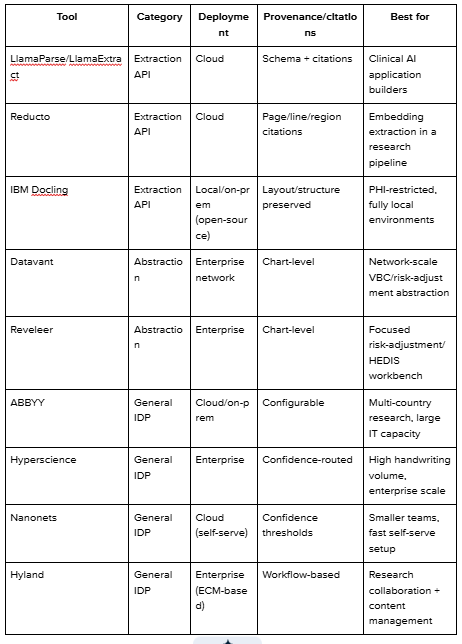
Master Comparison
How Do You Choose the Right Tool?
If you're building your own clinical AI application or research data pipeline, and have engineering capacity: start with the extraction APIs (LlamaParse/LlamaExtract, Reducto) for schema-based extraction with citations, or Docling specifically if your environment requires fully local, on-premise execution.
If your work is chart abstraction for risk adjustment, quality measurement, or value-based care: Datavant if record access across a network is part of the challenge, Reveleer if you already have record access and need a focused abstraction workbench.
If you need a horizontal platform with proven healthcare depth, covering document types beyond pure research documents: ABBYY for multi-country, IT-resourced operations; Hyperscience for high handwriting volume at enterprise scale; Nanonets for fast, self-serve setup at smaller scale; Hyland if research data collaboration across teams is a named requirement alongside extraction.
If you have a strong engineering team and cloud commitment: the AWS/Google/Azure building blocks, understanding that pipeline orchestration, review workflows, and PHI governance remain entirely your responsibility to build and maintain.
Then gate by team shape, not just workflow fit: extraction APIs and cloud building blocks require dedicated engineering capacity to become usable systems; abstraction platforms and general IDP platforms suit teams wanting more of the surrounding workflow handled for them, at the cost of less granular control.
Whatever you land on, bring your own messiest, most representative research documents — handwritten forms, low-quality scans, your actual multi-site format variation, to any evaluation. A vendor's headline accuracy number is close to meaningless until it's been tested against documents that look like yours.
Conclusion
Healthcare document processing for research data is a narrower, more specific category than general healthcare document management or hospital operations tooling, it depends on handwriting and degraded-scan performance, field-level provenance for research integrity, multi-site consistency, and in some cases fully local deployment for PHI-restricted environments that no cloud API, however compliant, can satisfy. The tools that differentiate here do so specifically on these points, not on general OCR accuracy alone. Match the category to your actual workflow first, then test finalists on documents that resemble your real research data before committing.
FAQ
What's the difference between document processing and document management for healthcare research?
Document processing (IDP) extracts structured data through classification, extraction, and validation. Document management handles storage, retrieval, and retention after capture. Some platforms combine both; most tools in this category specialize in one or the other.
What is clinical data abstraction, and how is it different from general document extraction?
Abstraction is reading longitudinal patient charts to extract structured data supporting risk adjustment, quality measurement (HEDIS), or research analysis — a different problem than extracting fields from a single form, since it requires understanding an entire clinical record over time, not just one document.
Can healthcare research document processing run entirely on-premise?
Some tools support this specifically — IBM's Docling is built for fully local execution with no cloud dependency, and Azure AI Document Intelligence offers container-based on-premise deployment. Most commercial IDP platforms are cloud-hosted by default, so confirm on-premise support directly if your research environment requires it.
Why does field-level provenance matter more for research than general business document processing?
Research integrity depends on being able to show exactly where an extracted data point came from and how confident the system was, not just a final structured output. This is a stricter requirement than most general business extraction use cases, where a wrong field is inconvenient rather than a research-validity concern.
Is a vendor's accuracy claim reliable for research documents specifically?
Treat headline accuracy numbers as best-case, not representative, they're typically measured on the vendor's own document set. Test any tool on your actual research documents (handwritten forms, multi-site format variation, degraded scans) before trusting a general accuracy claim.
More articles
Structured Data Extraction: A Technical Guide
How to extract structured data from documents using an AI API, the architecture, grounding, and named tools compared.
Key Features of AI Document Workflow Automation
AI document workflow automation features, governance, prioritization framework, and real examples with measurable benefits for 2026.