%20{%20:root%20{%20--deepread-stroke:%20%23E5E7EB;%20}%20}%20.dark%20{%20--deepread-stroke:%20%23E5E7EB;%20}%20%3c/style%3e%3crect%20x='40'%20y='30'%20width='220'%20height='260'%20rx='28'%20ry='28'%20stroke='var(--deepread-stroke)'%20stroke-width='16'%20fill='none'/%3e%3cpath%20d='M180%2030v52c0%2010%208%2018%2018%2018h62'%20stroke='var(--deepread-stroke)'%20stroke-width='16'%20fill='none'/%3e%3cline%20x1='70'%20y1='130'%20x2='200'%20y2='130'%20stroke='var(--deepread-stroke)'%20stroke-width='16'%20stroke-linecap='round'/%3e%3cline%20x1='70'%20y1='165'%20x2='200'%20y2='165'%20stroke='var(--deepread-stroke)'%20stroke-width='16'%20stroke-linecap='round'/%3e%3cline%20x1='70'%20y1='200'%20x2='170'%20y2='200'%20stroke='var(--deepread-stroke)'%20stroke-width='16'%20stroke-linecap='round'/%3e%3c!--%20green%20download%20arrow%20in%20bottom%20right%20corner%20--%3e%3cpath%20d='M210%20202v58'%20stroke='var(--deepread-accent)'%20stroke-width='18'%20stroke-linecap='round'/%3e%3cpath%20d='M195%20245l15%2015%2015-15'%20fill='none'%20stroke='var(--deepread-accent)'%20stroke-width='18'%20stroke-linecap='round'%20stroke-linejoin='round'/%3e%3c/svg%3e)
Rossum Alternatives: 7 Document Processing Platforms Compared
Looking for a Rossum alternative? Compare seven document extraction platforms on price, scope, and verified features, plus what to test before you switch.
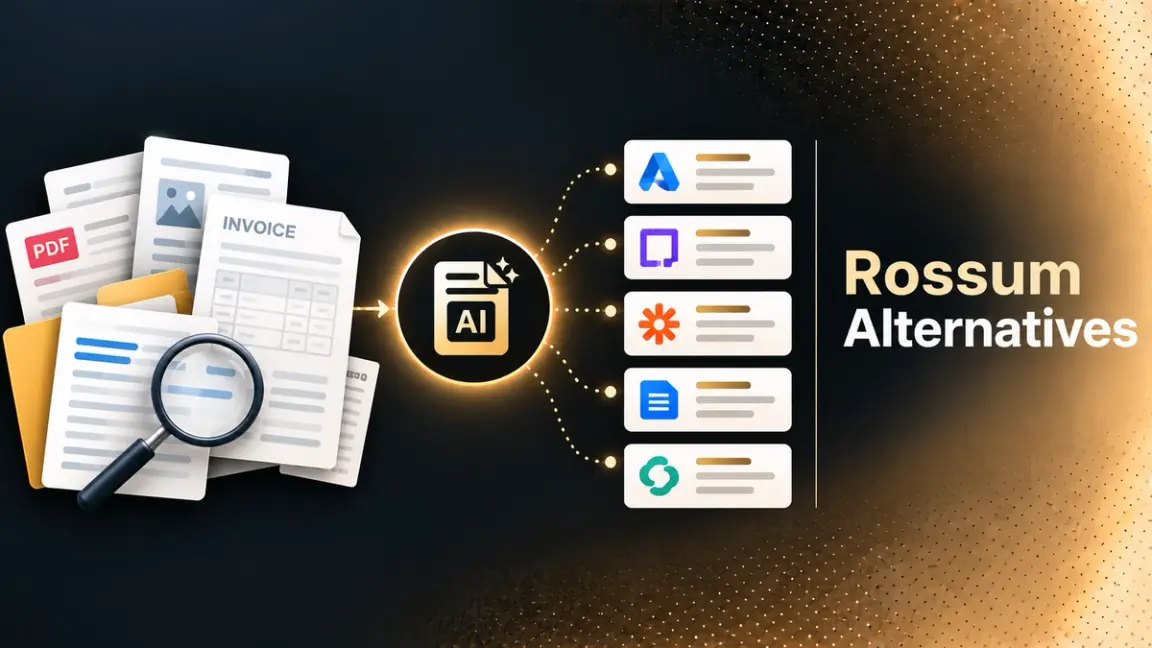
Rossum positions itself as an end-to-end AI document processing platform, AI agents that read incoming documents, validate and transform the data, trigger approvals and emails, and write results into an ERP like SAP, Coupa, Workday, or Oracle. It's built around Aurora, its proprietary transactional-document LLM, and Rossum announced in May 2026 that it was named a Leader in the Everest Group Intelligent Document Processing PEAK Matrix Assessment 2026. Coupa announced it had acquired Rossum on May 12, 2026. That's a serious platform for the right buyer.
It's also, by design, a platform you buy through a quote. Rossum's pricing page doesn't publish a free tier; every plan, including the Starter tier listed as "starting at $18,000 per year," routes to "Get A Quote." The page does describe a 14-day free trial, so testing isn't gated, but pricing and an annual contract are. For teams whose volume doesn't justify an annual enterprise contract and a full workflow platform, or who only need extraction, that gap is usually where the search for an alternative starts.
This covers seven platforms people evaluate instead, checked directly against each vendor's own site. A wider technical comparison of AI platforms for document extraction covers the category beyond these seven.
Who This Guide Is For
- Teams evaluating Rossum who want a published price first. Developers and ops leads who want to compare costs and test extraction accuracy on their own documents without entering a procurement process.
- Mid-market teams for whom $18,000+ per year is a hard floor, not a rounding error, and who want to know whether a lighter-weight API gets them comparable extraction quality.
- Engineering teams that only need the extraction layer, not Rossum's full workflow, email, and approval automation, because that logic already lives somewhere else in their stack.
- Procurement and IT teams comparing Rossum against other enterprise platforms like UiPath, where implementation timeline and contract terms matter as much as extraction quality.
What to Know About Rossum Today
A few things worth confirming before comparing alternatives, since they shape most of the comparison:
- Pricing is quote-based. Every plan on Rossum's pricing page, Starter, Business, Enterprise, and Ultimate, routes to "Get A Quote." Starter is listed as "starting at $18,000 per year." The page also describes a 14-day free trial, so confirm directly what it includes.
- Starter includes unlimited seats, document ingestion via email/API/manual upload, Rossum's Aurora Document AI extraction, a validation screen for exception handling, and a 12-month archive and search. Higher tiers add SSO, document translation, multi-document transactions, and a 3-year archive, all quote-based.
- It's a full workflow platform, not just extraction. Rossum's product spans document ingestion, validation, automated communications, and ERP write-back, more scope than a team that only needs structured data out of a document may actually want to buy. How that kind of workflow layer works in practice is explained in intelligent document workflow automation.
- Rossum is now part of Coupa. Coupa announced the acquisition on May 12, 2026, and said Rossum had been in its App Marketplace since 2024. If you're evaluating Rossum, confirm how the acquisition affects roadmap, pricing, and support for non-Coupa ERPs.
None of that makes Rossum a bad fit for the enterprise buyer it's built for. It does mean teams with a narrower need or a smaller budget are often better served by something else on this list.
The Alternatives
Each entry below is organized around the question that actually matters coming from Rossum: how do you get in, what do you actually get, what does it cost, and what do you give up or gain compared to Rossum specifically.
DeepRead
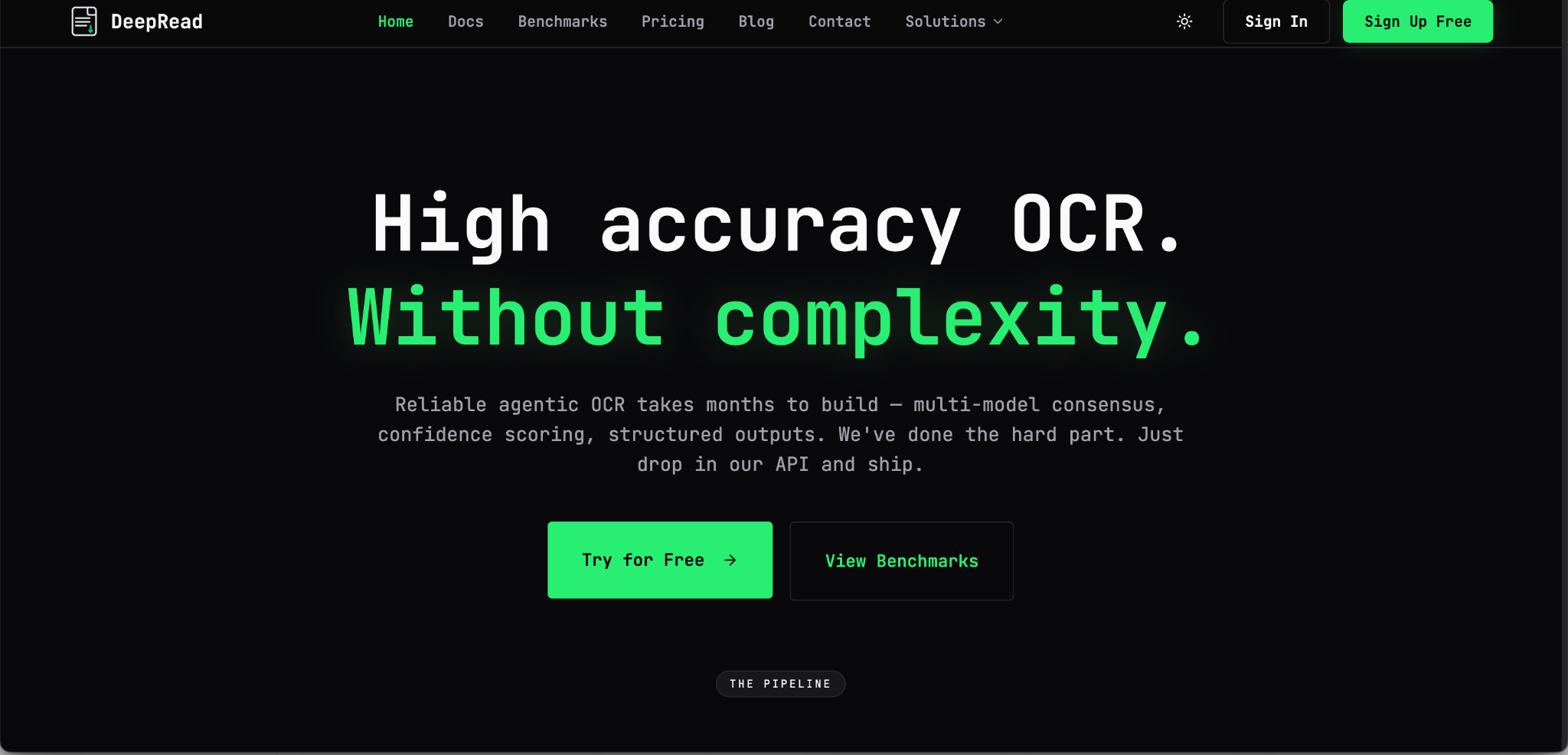
DeepRead is a document extraction API built for teams that want structured, schema-driven output without adopting a full workflow platform on top of it. It's aimed squarely at the gap Rossum leaves for smaller or more technical teams: accurate extraction you can test on your own documents before any commercial conversation happens.
- Getting started: No sales call. Create an account and get an API key the same day; the free tier is usable immediately on real documents, with no credit card.
- What you're buying: An extraction layer, not a workflow platform: Parse (the document as Markdown, with layout blocks and bounding boxes), Extract (Parse, then the fields you ask for as JSON against your schema), and Deep Extract (two OCR engines, adjudicated disagreements, and a verification pass on every value). One API key runs all three, and you choose one per request. On every plan, fields come back with page, bounding box, and source text citations, plus review flags with reasons, so uncertain values are marked needs_review instead of silently guessed.
- Cost to test it: Free for 2,000 pages a month (up to 50 pages per document, 15 MB per file). Standard is pay per page, with credits you buy and use as you go: $10 per 1,000 pages for Parse, $20 for Extract, and $40 for Deep Extract, with no monthly page limit and documents up to 1,000 pages. Enterprise is custom-priced, adding volume discounts, SSO/SAML, EU/AU data residency, bring-your-own model keys, a custom SLA and MSA, and pay by invoice or PO.
- Switching incentive: Up to $1,000 in credits for teams migrating from another document processor, per DeepRead's pricing page.
- Trade-off against Rossum: You keep the approval routing, email automation, and ERP write-back that Rossum bundles in-house, nothing ships pre-built for that. What you get instead is a published, checkable accuracy number at deepread.tech/benchmarks and no annual commitment to start.
Nanonets
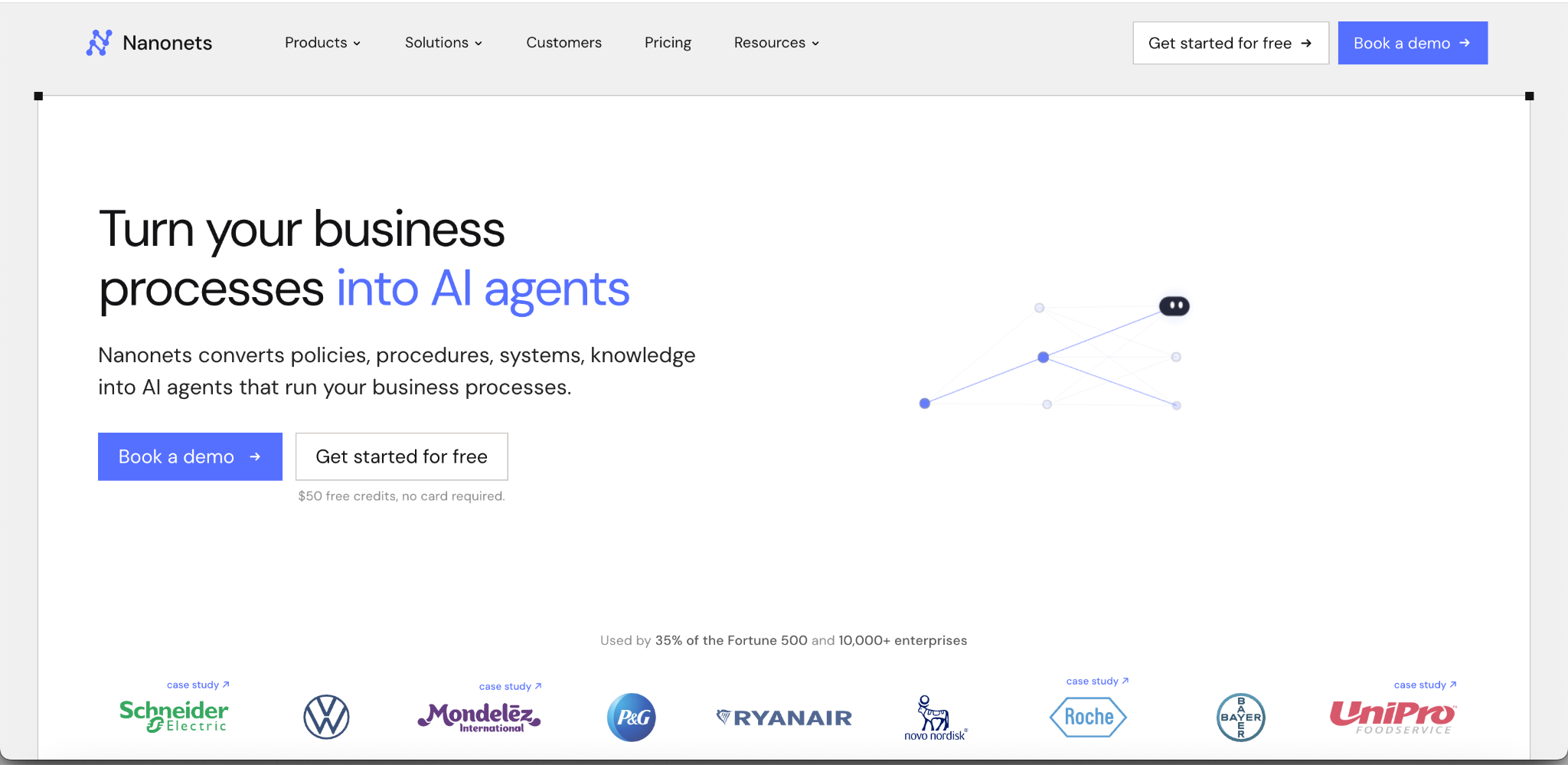
Nanonets has moved well past plain OCR into AI agents that run entire business processes, importing company policy into a context graph (Trail) and acting on it across tools like Slack, email, and ERPs. It's arguably the closest match to Rossum's ambition on this list, just priced by usage and reachable without a quote.
- Getting started: Self-serve. Every account starts with $200 in free credits (no card required), per Nanonets' pricing page.
- What you're buying: Agents built on Trail, which turns company policies into rules agents apply and trace back to source documents, flagging uncertain cases for human review. Nanonets lists SAML SSO, SCIM provisioning, RBAC, audit logs, and IP allow-listing among its enterprise controls.
- Cost to test it: Usage is metered per workflow step rather than per page: $0.02 for simple operations, $0.10 for standard AI steps, $0.30 for complex AI, with a typical invoice workflow running four to six steps.
- Trade-off against Rossum: Similar end-to-end scope, with usage-based pricing instead of an annual quote. On accuracy, the two companies tell different stories: Nanonets cites its own OCR-3 ranking on the IDP Leaderboard on its site, while DeepRead's published benchmark puts Nanonets at 58.8% average across eight document types against DeepRead's own 96.8% on the same set, check the methodology behind either claim before leaning on it.
Reducto
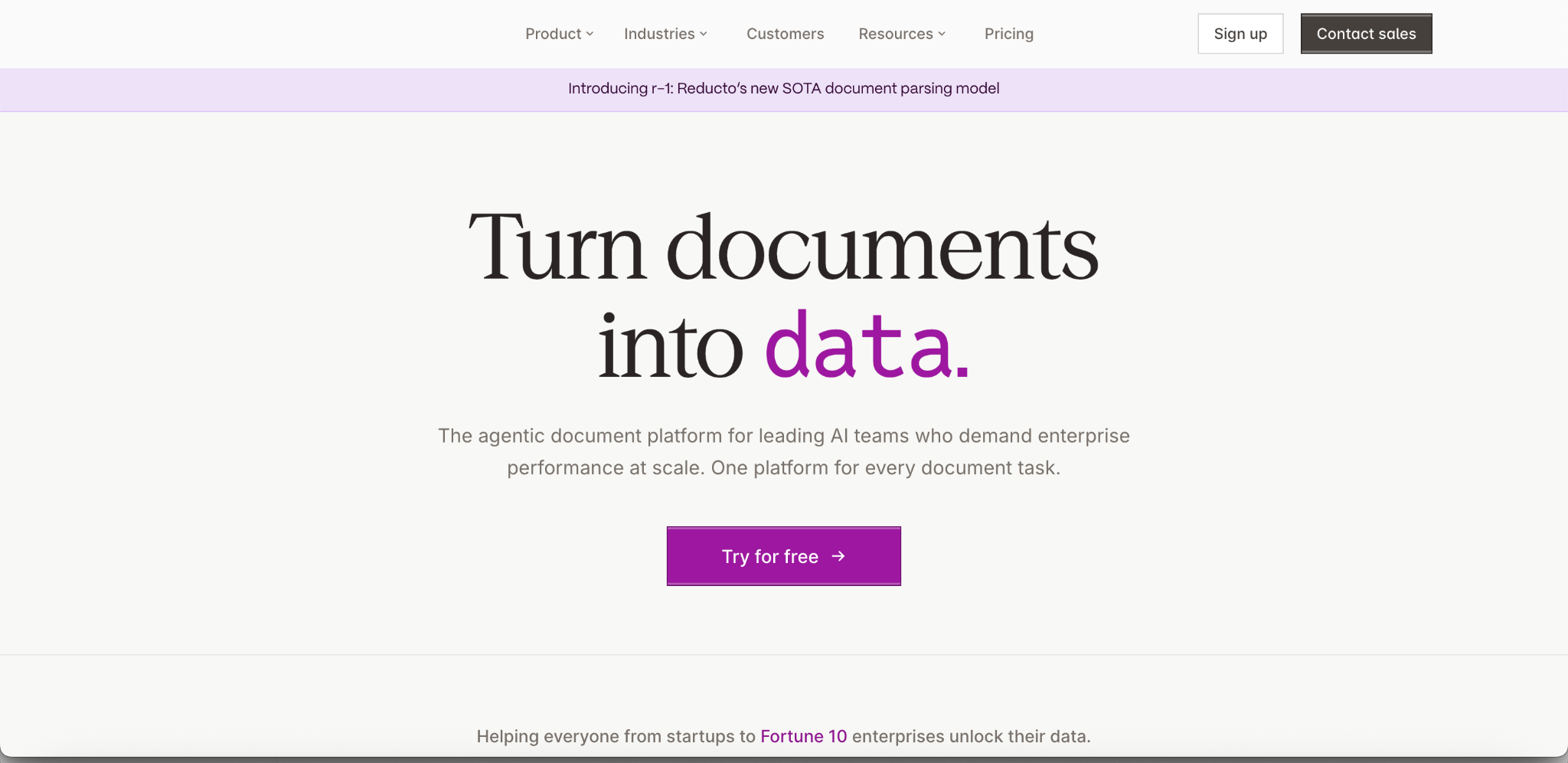
Reducto is a developer-first document platform built around its own parsing model, with a particular strength in dense, complex documents like financial filings and long contracts. It markets itself on raw scale, stating it has processed more than 5 billion pages, rather than on workflow or compliance tooling.
- Getting started: Self-serve, $150 in free usage credit (15,000 credits) to start testing immediately.
- What you're buying: A toolkit, not a finished product: Parse, Extract, Split, Classify, and Edit APIs built on Reducto's own r-1 model, with bounding-box citations on outputs.
- Cost to test it: $10 per 1,000 pages for Parse, $20 for Extract, $40 for Deep Extract, and $7.50 for Classify, billed per endpoint, plus up to $5,000 in migration credit for teams moving an existing workload.
- Trade-off against Rossum: No validation screen, no approval workflow, no ERP write-back; you're building the surrounding process yourself. In exchange, pricing is published per endpoint rather than quoted, and there's no seat-based annual floor.
Landing AI
Landing AI's Agentic Document Extraction product is built around traceability; every extracted value can be traced back to its exact location on the page. That emphasis puts it in similar territory to Rossum's audit-focused enterprise tier, just scoped to extraction rather than a full document workflow.
- Getting started: Self-serve credit system, 1,000 free credits to start, $1 buys 100 more.
- What you're buying: Parse (layout-aware Markdown), Split (multi-document segmentation and classification), and Extract (schema-first field extraction, including large multi-table extraction).
- Cost to test it: Pay-as-you-go on the Explore plan. Team starts at $250 a month in credit packs and adds shared usage, team management, zero data retention, and HIPAA-compliant processing with a BAA; Enterprise is custom-priced. Pricing is the same in US and EU regions.
- Trade-off against Rossum: Matches the traceability pitch without the communication and ERP write-back layer, worth it if auditability was the main reason Rossum was on your shortlist, less so if you needed the full workflow.
UiPath Document Understanding (IXP)
UiPath's document intelligence now sits under IXP (Intelligent Xtraction and Processing), which brings together Document Understanding and Communications Mining with generative extraction on the UiPath platform. It's the closest alternative in shape to Rossum: an enterprise platform rather than a standalone API.
- Getting started: UiPath's IXP pages show no self-serve signup or public rate card. IXP is also available through Google Cloud Marketplace, with Gemini as the default model for new projects since April 2026.
- What you're buying: Classification and extraction for documents and communications, with human-in-the-loop validation, feeding agents and robots on the UiPath platform. Document Understanding remains available as a standalone service in Automation Cloud and in Automation Suite deployments.
- Cost to test it: Not published on UiPath's IXP pages; confirm pricing with UiPath or the marketplace listing.
- Trade-off against Rossum: A genuine alternative mainly if you're already standardized on UiPath for RPA and want document understanding inside that same platform rather than as a separate vendor. Procurement and rollout realities for platforms like this are covered in enterprise-scale document automation software.
Amazon Textract
Amazon Textract is AWS's managed document extraction service, split across several purpose-built APIs rather than one general endpoint. It's less a vendor relationship than a line item inside infrastructure many teams already run, with no workflow or approval layer included.
- Getting started: Through an existing AWS account, no separate sales process.
- What you're buying: Five APIs rather than one endpoint: Detect Document Text (OCR for text and handwriting), Analyze Document (Forms, Tables, Queries, Signatures, and Layout, callable in combination), Analyze Expense, Analyze ID, and Analyze Lending for mortgage documents.
- Cost to test it: Usage-based, billed per page; AWS offers new customers a limited monthly free tier for the first three months, and the rate depends on which API and feature combination you call; current figures are on AWS's Textract pricing page.
- Trade-off against Rossum: A metered building block inside infrastructure you may already run, not a workflow product. Validation, approvals, and ERP integration are entirely your team's to build; there's nothing resembling Rossum's bundled process here.
Google Document AI
Google Document AI offers pretrained and custom extraction processors billed per page inside the Google Cloud ecosystem. Like Textract, it's a building block rather than a finished product, useful mainly to teams already standardized on GCP.
- Getting started: Through a GCP account; new customers get $300 in free credit to try Document AI and other Google Cloud products.
- What you're buying: Pretrained and custom processors: Custom extractor (generative-AI-powered; Google says as few as 10 documents can fine-tune it), Custom splitter, Custom classifier, and Enterprise Document OCR.
- Cost to test it: Enterprise Document OCR is $1.50 per 1,000 pages up to 5 million pages a month, then $0.60 above that. Custom extractor and Form Parser run $30 per 1,000 pages up to 1 million, $20 above. Layout Parser is $10 per 1,000 pages. Full rates are on Google Cloud's Document AI pricing page.
- Trade-off against Rossum: The same shape as Textract, billed and managed alongside cloud infrastructure you likely already pay for, with none of the workflow, communication, or approval layer Rossum includes.
How Accuracy Actually Compares
DeepRead publishes a benchmark measuring its own extraction accuracy against Nanonets, Reducto, and Landing AI on identical document sets across eight document types, with the dataset public for verification at deepread.tech/benchmarks. Accuracy is the percentage of fields that exactly match a manually verified ground truth, and every vendor is scored the same way. On DeepRead's published results, its average is 96.8%, against 58.8% for Nanonets, 73.2% for Reducto, and 72.7% for Landing AI.
The averages hide some close results. Competitors score above 90% on a few document types: Nanonets 93.3% on payslips and 92.3% on W-2s, Reducto 90.0% on medical bills, and Landing AI 93.8% on driver's licenses. Measured against the strongest competitor on each type, DeepRead's lead is widest on invoices (97.8% against 66.7%) and offer letters (95.0% against 66.7%), and narrowest on driver's licenses (96.7% against 93.8%) and payslips (96.6% against 93.3%). The page also reports a separate human-in-the-loop review rate, the share of fields flagged needs_review, which is independent of accuracy because a correct field can still be flagged.
That's DeepRead's own benchmark, so evaluate it on its own terms rather than as a neutral third-party study; the public dataset is what lets you check it. It doesn't include Rossum, UiPath, Textract, or Document AI, none of which appear in a measured, apples-to-apples comparison publicly available alongside this one, so any claim of superiority over those four, including Rossum, should be treated as unverified until tested on your own documents.
What to Actually Check Before Switching From Rossum
Rossum implementations tend to be deeper than a single API integration, which makes switching a bigger decision than swapping an endpoint. Before committing:
- Map what Rossum is actually doing for you today: extraction alone, or also validation workflows, automated email communication, and ERP write-back. An extraction API replaces one of those; the others need a plan.
- Run your own documents through the alternative before migrating anything. Confirm accuracy holds on your real document mix, not a demo set, regardless of which platform you're considering.
- Model the actual cost difference. A usage-based API can be cheaper or more expensive than an $18,000+ annual contract depending on your real volume; calculate it against your numbers rather than assuming either direction. Usage-based pricing is compared across vendors in pay-as-you-go document processing tools.
- Check what happens to existing ERP integrations. Rossum's native connectors (SAP, Coupa, Workday, Oracle) took implementation effort to set up; confirm what remapping that work to a new vendor actually requires.
- Ask about contract timing; annual enterprise contracts often have renewal windows and notice periods. Know your actual exit timeline before starting a parallel evaluation.
- Confirm compliance requirements carry over; SOC 2, data residency, and SSO support vary across this list; don't assume parity without checking directly.
Conclusion
Rossum is built for a specific buyer: an enterprise ready for a full document workflow platform, a quote-based annual contract, and a sales-led implementation. That's a reasonable trade for the right team. It's also exactly why teams whose volume doesn't justify that commitment, or whose actual need is extraction rather than a complete workflow platform, end up looking elsewhere. The seven alternatives here split into extraction-first APIs with self-serve access (DeepRead, Reducto, Landing AI), another self-serve agent-centric platform (Nanonets), another enterprise platform comparable in scope to Rossum (UiPath), and cloud-native building blocks (AWS Textract, Google Document AI).
Whichever direction fits, the same test applies before signing anything: run it against your own documents, and ask for an accuracy number you can verify rather than one you have to take on faith.
FAQ
Why do people look for Rossum alternatives?
The most common reason is Rossum's quote-based model: there's no published free tier, and the Starter plan is listed as starting at $18,000 per year before implementation. Teams whose volume doesn't justify an annual enterprise contract, or who only need extraction rather than a full workflow platform, often start comparing alternatives for that reason.
Is there a free trial for Rossum?
Rossum's pricing page describes a 14-day free trial, but every plan still requires requesting a quote. Ask Rossum what the trial includes for your use case.
Did Coupa acquire Rossum?
Yes. Coupa announced the acquisition on May 12, 2026, saying it would extend Rossum's document processing across its spend management platform. Rossum had been available in Coupa's App Marketplace since 2024.
Is DeepRead or another alternative as accurate as Rossum?
There's no independently published benchmark directly comparing Rossum's extraction accuracy against DeepRead or the other platforms on this list; Rossum isn't part of DeepRead's public benchmark, which currently covers Nanonets, Reducto, and Landing AI. Test any accuracy claim, including Rossum's, on your own documents before relying on it.
What's the difference between Rossum and an extraction API like DeepRead or Reducto?
Rossum bundles extraction with workflow validation, automated communications, and ERP write-back into one platform, aimed at teams that want the full process managed. An extraction API returns structured data and leaves workflow logic to you, generally at a lower cost and with self-serve access, but with more engineering effort to build the surrounding workflow.
Can I switch from Rossum without rebuilding my ERP integrations?
It depends on the alternative and your existing setup. Native connectors you built for Rossum (SAP, Coupa, Workday, Oracle) will need to be remapped to whatever you switch to; confirm the actual integration effort with any vendor directly before assuming it's a drop-in replacement.
Is a cheaper, self-serve alternative actually comparable to an enterprise platform like Rossum?
It depends on what you actually need. If your requirement is accurate structured extraction, several self-serve APIs are built specifically for that and publish verifiable accuracy data. If you need the full workflow, automated communications, and ERP write-back that Rossum bundles, a lighter-weight API alone won't replace that scope without additional engineering work on your side.
More articles
Automated Trade Documentation Tools: A 2026 Guide
Automated trade documentation tools compared, customs filing, export licensing, restricted-party screening, and named platforms.
Nanonets Alternatives: 7 Document Processing Platforms Compared
Explore 7 Nanonets alternatives with a side-by-side comparison of document extraction, IDP features, pricing.