%20{%20:root%20{%20--deepread-stroke:%20%23E5E7EB;%20}%20}%20.dark%20{%20--deepread-stroke:%20%23E5E7EB;%20}%20%3c/style%3e%3crect%20x='40'%20y='30'%20width='220'%20height='260'%20rx='28'%20ry='28'%20stroke='var(--deepread-stroke)'%20stroke-width='16'%20fill='none'/%3e%3cpath%20d='M180%2030v52c0%2010%208%2018%2018%2018h62'%20stroke='var(--deepread-stroke)'%20stroke-width='16'%20fill='none'/%3e%3cline%20x1='70'%20y1='130'%20x2='200'%20y2='130'%20stroke='var(--deepread-stroke)'%20stroke-width='16'%20stroke-linecap='round'/%3e%3cline%20x1='70'%20y1='165'%20x2='200'%20y2='165'%20stroke='var(--deepread-stroke)'%20stroke-width='16'%20stroke-linecap='round'/%3e%3cline%20x1='70'%20y1='200'%20x2='170'%20y2='200'%20stroke='var(--deepread-stroke)'%20stroke-width='16'%20stroke-linecap='round'/%3e%3c!--%20green%20download%20arrow%20in%20bottom%20right%20corner%20--%3e%3cpath%20d='M210%20202v58'%20stroke='var(--deepread-accent)'%20stroke-width='18'%20stroke-linecap='round'/%3e%3cpath%20d='M195%20245l15%2015%2015-15'%20fill='none'%20stroke='var(--deepread-accent)'%20stroke-width='18'%20stroke-linecap='round'%20stroke-linejoin='round'/%3e%3c/svg%3e)
Top AI Platforms for Document Extraction: A Technical Comparison
Comparing AI platforms for document extraction — legacy OCR/IDP APIs vs. newer agentic platforms — and how to actually evaluate one before you build on it.
Top AI Platforms for Document Extraction: A Technical Comparison
Document extraction has split into two distinct generations of tooling in the last two years. On one side: established cloud APIs and IDP platforms built around structured field extraction from known document types. On the other: newer AI-native platforms using vision-language models to treat extraction as a reasoning problem rather than a template-matching one — parsing nested tables, mixed layouts, and multimodal content that older pipelines handle inconsistently.
This is a comparison of both categories, what genuinely differs between them, and how to evaluate one before you build a pipeline on top of it.
Who This Is For
- Developers and engineering teams building document extraction into a product, RAG pipeline, or internal tool, choosing which API or platform to build on.
- Technical leads scoping an AI application — agents, copilots, or search systems — that depend on clean document ingestion as an upstream step.
- Product and ops teams evaluating whether an established extraction API or a newer agentic platform better fits their document mix.
Two Categories, Not One Market
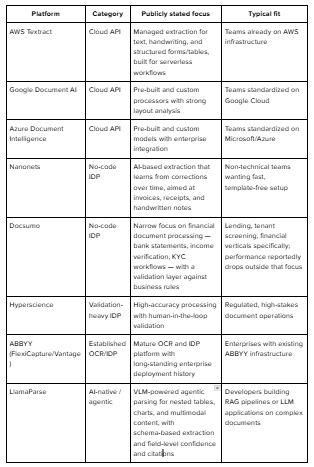
Legacy and cloud-native extraction platforms — AWS Textract, Google Document AI, Azure Document Intelligence, Nanonets, Docsumo, Hyperscience, ABBYY- center on structured field and table extraction, typically via pre-built or trainable models for specific document types (invoices, receipts, forms). A useful way to split this group: API-first platforms for pipeline integration (Google Document AI, Azure Document Intelligence, Amazon Textract), no-code or low-code tools for direct business use (Docsumo, Nanonets, Rossum), and validation-heavy platforms built for document operations at volume (Docsumo, Hyperscience).
AI-native / agentic platforms — LlamaParse and similar newer entrants — treat extraction as a semantic reasoning problem rather than a spatial one, using large language and vision-language models to understand document hierarchy and context rather than matching text against a fixed template. This connects document understanding directly to downstream RAG systems, chat interfaces, and agent workflows, which is why this category is concentrated among developers building LLM applications rather than teams automating a specific back-office workflow.
Neither category is strictly better — they're solving related but different problems. A platform optimized for RAG ingestion and semantic table reconstruction isn't necessarily the right choice for high-volume, field-level invoice extraction into an ERP, and vice versa.
Platform Snapshot
A note on how to read this table: the descriptions reflect each vendor's own public positioning, not an independent benchmark measuring all of them on a common dataset — no such benchmark exists across this full list. Verify current capability, pricing, and accuracy claims directly with each vendor.
What Actually Differs, Beyond the Category Label
Output format and structure. Legacy IDP platforms typically return structured fields mapped to a schema — good for feeding a database or ERP directly. Agentic platforms increasingly output markdown or structured JSON optimized for LLM consumption, which matters specifically if the downstream use is a RAG pipeline or an AI agent rather than a traditional system-of-record update.
How they handle documents they weren't specifically tuned for. Systems that rely on templates or rigid rules require ongoing updates as formats change; single-document accuracy in a demo doesn't guarantee correctness across a full, varied document set, which is true across both categories, not just legacy tools — agentic platforms reduce this risk but don't eliminate it.
Validation and confidence handling. This is where platforms diverge most in practice. Some surface field-level confidence scores and citations; others return output with no signal about which fields are uncertain. This matters more than most feature comparisons emphasize, since it determines whether a low-confidence extraction fails silently or gets flagged.
Document class fit. Structured documents with a fixed schema (forms, standardized intake documents) are fast to extract and stay reliably queryable; semi-structured documents that share field types but vary in layout across sources need more reasoning capability from the system — which is exactly where the legacy-vs-agentic distinction tends to matter most in practice.
How to Actually Evaluate One
The right tool depends on how inconsistent your documents are, how much validation you need, and whether you're solving extraction alone or building a system that has to survive production. Practically:
- Test on your own messy documents, not a demo set. The gap between a clean-sample demo and real accuracy is where vendor claims tend to break down — this holds regardless of which category a platform falls into.
- Check whether accuracy claims are independently verifiable. Ask what document set a number was measured against, and whether you can check it yourself rather than take it on faith.
- Confirm the output format matches your downstream use. Structured JSON for a database, markdown for an LLM pipeline — mismatched output format creates unnecessary post-processing work regardless of extraction quality.
- Check integration depth, not just existence — native connectors to your specific ERP, CRM, or content system versus open APIs for custom integration, since integration gaps are a common point where extraction projects stall after the pilot looks good.
- Understand the cost and latency model, especially for agentic/LLM-based platforms — reasoning-heavy extraction is often slower and priced differently than a purpose-built extraction API, which matters at production volume.
Where Extraction Accuracy Is Actually Measurable
Most of the comparison above is necessarily built on public positioning, since no single benchmark covers this entire list on common ground. The one place accuracy becomes genuinely checkable rather than asserted: a benchmark that runs the same documents through multiple engines and publishes the methodology alongside the results. DeepRead publishes exactly this — extraction accuracy measured against Nanonets, Reducto, and Landing AI on identical document sets across eight document types, with the methodology public rather than summarized in a slide. Worth using as a model for what to ask any platform on this list for, extraction-focused or agentic: not a headline number, but a dataset and method you can check yourself.
Conclusion
"AI platform for document extraction" now covers two genuinely different approaches — structured field extraction from established cloud and IDP platforms, and semantic, agentic parsing from newer LLM/VLM-native tools. Neither wins outright; the right choice depends on your document class, downstream use (system-of-record update versus LLM pipeline), and how much validation your use case demands. What holds across both categories: test on your real documents before committing, and treat any accuracy claim you can't independently verify as a starting point for evaluation, not a final answer.
FAQ
What's the difference between traditional OCR platforms and agentic document AI platforms?
Traditional OCR/IDP platforms extract structured fields using template or model-based matching, tuned to specific document types. Agentic platforms use vision-language models to reason over document layout and meaning more holistically, generally handling complex, nested, or multimodal documents with less tuning — at the cost of typically higher latency and cost per document.
Which document extraction platform has the best accuracy?
This varies significantly by document type and isn't answerable with a single ranking — a platform strong on invoices may perform differently on handwritten forms or nested tables. Ask any vendor what their accuracy claim was measured against and whether it's independently checkable, rather than relying on a headline percentage.
Do I need an agentic/LLM-based platform, or is a traditional extraction API enough?
If your documents are standard, single-format, and feed a structured system like an ERP, a traditional extraction API is usually simpler and cheaper. If you're building a RAG pipeline or handling complex, varied, or multimodal documents, agentic platforms are built specifically for that reasoning-heavy case.
Is Nanonets or Docsumo a better fit for financial document extraction?
They serve different scopes — Docsumo is positioned specifically around financial document workflows like KYC and bank statement analysis, while Nanonets covers a broader range of document types with a no-code setup. The right fit depends on whether your use case is narrowly financial or spans multiple document categories.
How is document extraction accuracy actually measured, and can I trust a vendor's number?
Rigorously, it should be checkable: the same document set run through multiple platforms, compared against a manually verified ground truth, with the methodology published. If a vendor's accuracy claim doesn't specify what it was measured against, treat it as a marketing figure rather than a verified benchmark until you can check it yourself.
More articles
Structured Data Extraction: A Technical Guide
How to extract structured data from documents using an AI API, the architecture, grounding, and named tools compared.
Key Features of AI Document Workflow Automation
AI document workflow automation features, governance, prioritization framework, and real examples with measurable benefits for 2026.