%20{%20:root%20{%20--deepread-stroke:%20%23E5E7EB;%20}%20}%20.dark%20{%20--deepread-stroke:%20%23E5E7EB;%20}%20%3c/style%3e%3crect%20x='40'%20y='30'%20width='220'%20height='260'%20rx='28'%20ry='28'%20stroke='var(--deepread-stroke)'%20stroke-width='16'%20fill='none'/%3e%3cpath%20d='M180%2030v52c0%2010%208%2018%2018%2018h62'%20stroke='var(--deepread-stroke)'%20stroke-width='16'%20fill='none'/%3e%3cline%20x1='70'%20y1='130'%20x2='200'%20y2='130'%20stroke='var(--deepread-stroke)'%20stroke-width='16'%20stroke-linecap='round'/%3e%3cline%20x1='70'%20y1='165'%20x2='200'%20y2='165'%20stroke='var(--deepread-stroke)'%20stroke-width='16'%20stroke-linecap='round'/%3e%3cline%20x1='70'%20y1='200'%20x2='170'%20y2='200'%20stroke='var(--deepread-stroke)'%20stroke-width='16'%20stroke-linecap='round'/%3e%3c!--%20green%20download%20arrow%20in%20bottom%20right%20corner%20--%3e%3cpath%20d='M210%20202v58'%20stroke='var(--deepread-accent)'%20stroke-width='18'%20stroke-linecap='round'/%3e%3cpath%20d='M195%20245l15%2015%2015-15'%20fill='none'%20stroke='var(--deepread-accent)'%20stroke-width='18'%20stroke-linecap='round'%20stroke-linejoin='round'/%3e%3c/svg%3e)
Automated Trade Documentation Tools: A 2026 Guide
Automated trade documentation tools compared, customs filing, export licensing, restricted-party screening, and named platforms.
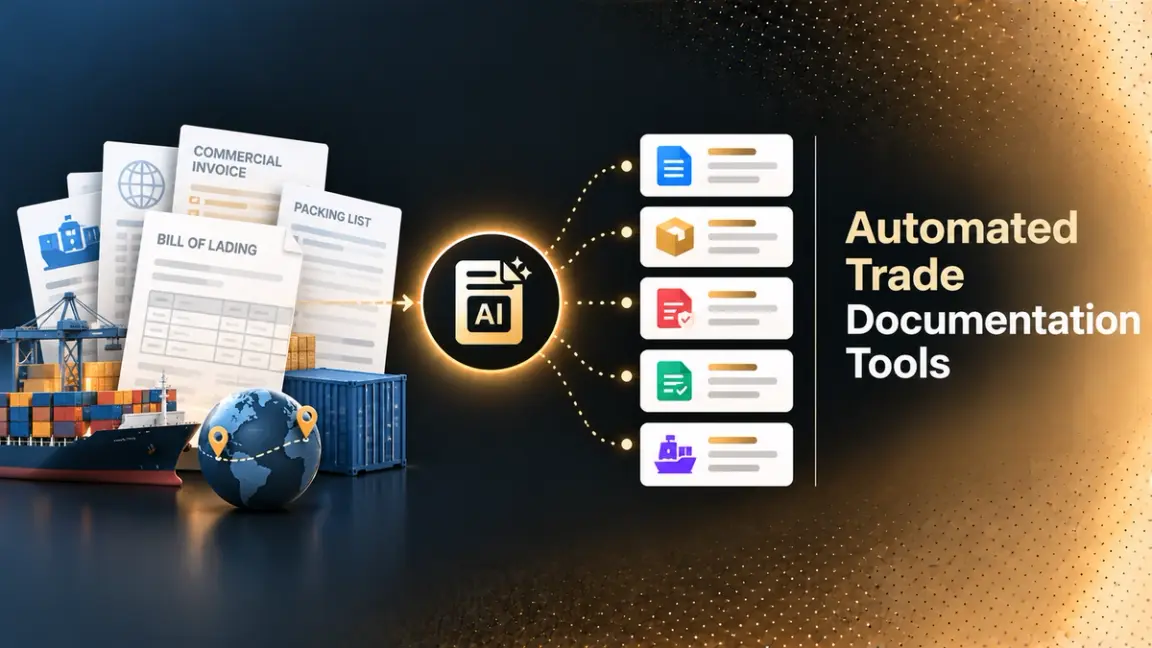
"Automated trade documentation" actually spans several distinct capabilities that get bundled together in marketing but solve different problems: customs entry filing, export licensing and compliance screening, and the underlying document generation and data extraction that feeds both. Manual trade documentation carries real consequences beyond inefficiency; errors here can lead to fines, penalties, shipment delays, and in more serious cases, seizure of goods at the border, a materially different risk category than a compliance fine. This guide covers what each of these capabilities actually requires, named platforms across the category, and where document extraction fits narrowly into the pipeline. DeepRead's customs solution addresses that upstream document layer.
Who This Is For
- Trade compliance teams managing customs filing, export licensing, and restricted-party screening across a multi-country supply chain.
- Importers and exporters evaluating whether to self-file with customs agencies or continue relying on a broker.
- Compliance and risk leaders needing documentation, screening, and audit trails to hold up under regulatory review.
- Software and operations teams building or integrating trade compliance tooling that depends on accurate upstream document data.
The Government Systems This Software Connects To
Worth knowing which government system is actually relevant to your use case, since they're distinct in purpose even where they now overlap in practice:
- AES (Automated Export System) is a joint venture between CBP, the Census Bureau's Foreign Trade Division, the Bureau of Industry and Security, the State Department's Directorate of Defense Trade Controls, and other federal agencies, the central point through which export shipment data gets filed electronically. AES functionality has moved onto the ACE platform, so exporters now submit their filings through ACE.
- ACE (Automated Commercial Environment) is CBP's centralized digital system for processing imports and exports, known as the U.S. "Single Window" because it connects CBP, partner government agencies, and the trade community through one access point. The CBP-run in-bond process built on it is covered in automated in-bond processing documentation.
Commercial trade documentation software doesn't replace either system; it prepares, validates, and submits the data these government systems require, and in the case of restricted-party screening and export licensing, handles compliance steps that happen before a filing is even submitted.
Key Document Types and Compliance Steps Involved
Worth separating two searches that often get bundled: customs filing (getting a shipment through import/export clearance) and export licensing (getting government authorization to export a controlled item in the first place) are related but distinct compliance steps, and the platforms below split along roughly this line; some cover both, some specialize in one.
- Commercial invoices, packing lists, and certificates of origin. The core documents underlying most customs declarations, containing the product, value, and origin data a filing depends on.
- Export licenses. Applications submitted to the Department of Commerce or Department of State for controlled goods, with standardized workflows for preparation, internal review, and tracking until authorization is received.
- Restricted/denied party screening. Checking counterparties against government and non-government denied-party lists before a transaction proceeds, commonly using fuzzy-logic matching to catch name variations and aliases, not just exact matches.
- HS (Harmonized System) tariff classification. Correctly classifying products under the World Customs Organization's Harmonized System, since misclassification is a named, common cause of cross-border delays, fines, penalties, and, in more serious cases, seizure of goods.
- AES submissions and exemption determination. Determining which shipments actually require AES submission versus which are exempt, then filing and validating the submission automatically rather than manually tracking exemption rules.
Named Platforms
A note on how to read this list: descriptions reflect each vendor's own documentation. Verify current capability and pricing directly.
iCustoms
iCustoms describes itself as a full customs operations automation platform connecting document intake, data extraction, compliance validation, and declaration submission into one continuous workflow, rather than requiring teams to switch between separate tools and re-key data at each stage. Its modules target UK, Irish, and EU customs systems.
- Combines AI document extraction, HS code classification, and direct declaration submission in a single workflow, and claims up to 99% accuracy (vendor-stated).
- Validates extracted data against regulatory requirements in real time before submission.
- Coverage described on its site: UK declarations integrated with HMRC's Customs Declaration Service, Ireland's import and export declaration modules, and ICS2, S&S GB, and NCTS Phase 5 for transit. Confirm US coverage directly before shortlisting it for AES or ACE work.
- Best fit: UK and EU importers, exporters, and brokers wanting one platform spanning the document-to-clearance workflow.
e2open
e2open is a global trade management suite covering both customs execution and export compliance, positioned around what it describes as the most comprehensive, current trade content database (regulatory controls, restricted parties, classifications, landed costs).
- Its Export Management application automates export compliance: country controls, restricted party screening, license determination and tracking, and document generation in one flow.
- Its Customs Filing application supports self-filing with customs agencies, positioned as a way to reduce broker fees for teams confident managing filing themselves.
- States access to over 900 restricted party and sanctions lists, with regulatory content covering 230+ countries.
- A named customer example, Allied Electronics & Automation, a distributor of industrial automation components, adopted automated export management to keep pace with increasing regulatory complexity, manage supplier expectations, maintain service levels, and gain a competitive advantage.
- Best fit: larger organizations wanting one platform covering both import-side customs execution and export-side compliance together.
Descartes Visual Compliance (formerly eCustoms / Visual Compliance)
Descartes acquired Visual Compliance, which operated under the names Visual Compliance, eCustoms, and MSR, in February 2019. Its Export Documentation Manager combines export document creation with compliance checks in one workflow, with a focus on US export compliance.
- AES filing with pre-submission compliance and verification checks, which Descartes says raises CBP acceptance rates and speeds generation of the Internal Transaction Number (ITN), with filings submitted to ACE for AES reporting.
- Item master tables and shipment templates for building export shipments and declaration documents faster.
- Restricted party screening, license determination, and license management in the same suite, covering BIS (EAR), DDTC (ITAR), and OFAC regimes.
- Older eCustoms pages still circulate with legacy wording, so confirm current features on the Descartes site.
- Best fit: US exporters wanting a focused tool for AES filing and export documentation without a broader import-side platform.
Descartes OCR Global EASE
Global EASE is a web-based global trade management platform from OCR Services, which now operates under the Descartes name like Visual Compliance, covering export licensing, export operations, and screening, with real depth on the license application process.
- Standardized workflow for preparing and internally reviewing export license applications to Commerce (through SNAP-R) and State (through DECCS), with e-signature and electronic submission.
- Export operations from order creation to customs filing, with built-in compliance checks, automated alerts, and centralized control.
- Watch list screening with fuzzy logic that detects aliases, close name matches, and address variations, against government and non-government lists updated daily.
- Real-time and batch integration with ERP systems such as SAP and Oracle E-Business Suite.
- Best fit: organizations with a heavier license-application workload, wanting structured application tracking alongside screening and filing.
VComply
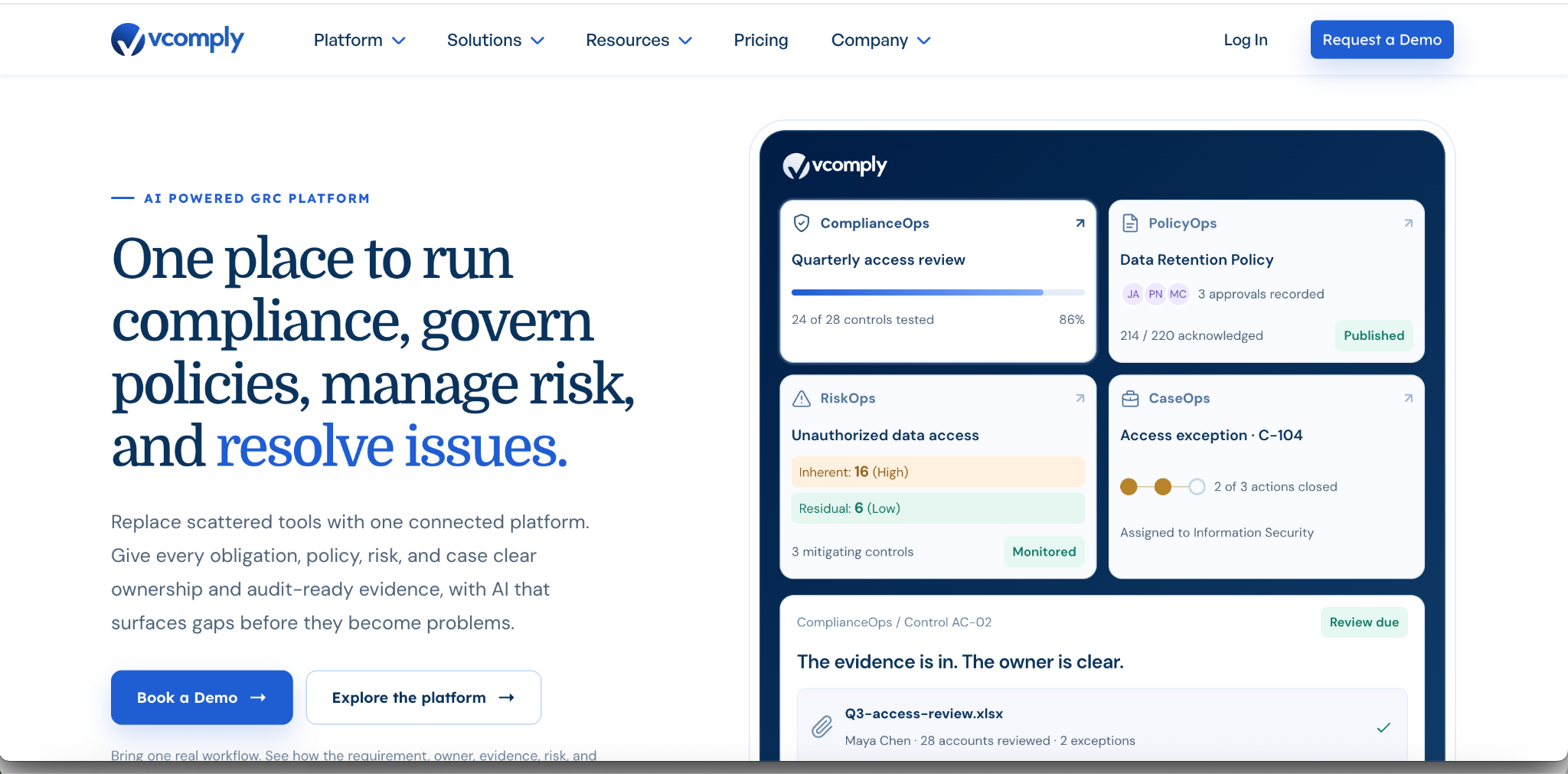
VComply is a general-purpose GRC (governance, risk, and compliance) platform with a trade compliance use case, not a shipment execution or customs filing tool. Its Compliance Ops solution is positioned around operationalizing trade compliance with centralized controls, ownership, and audit-ready documentation.
- Positioned against tracking trade obligations across spreadsheets, email, and disconnected systems, where visibility into ownership and overdue actions gets lost.
- Its trade compliance material covers the wider obligation set: sanctions requirements, restricted-party screening expectations, customs documentation, product classifications, country-of-origin rules, licensing, tariff exposure, supplier compliance, and audit evidence.
- Best fit: compliance teams needing a governance layer proving the organization can demonstrate compliance when regulators or auditors ask, rather than a tool that files shipments or generates documents itself.
Digicust
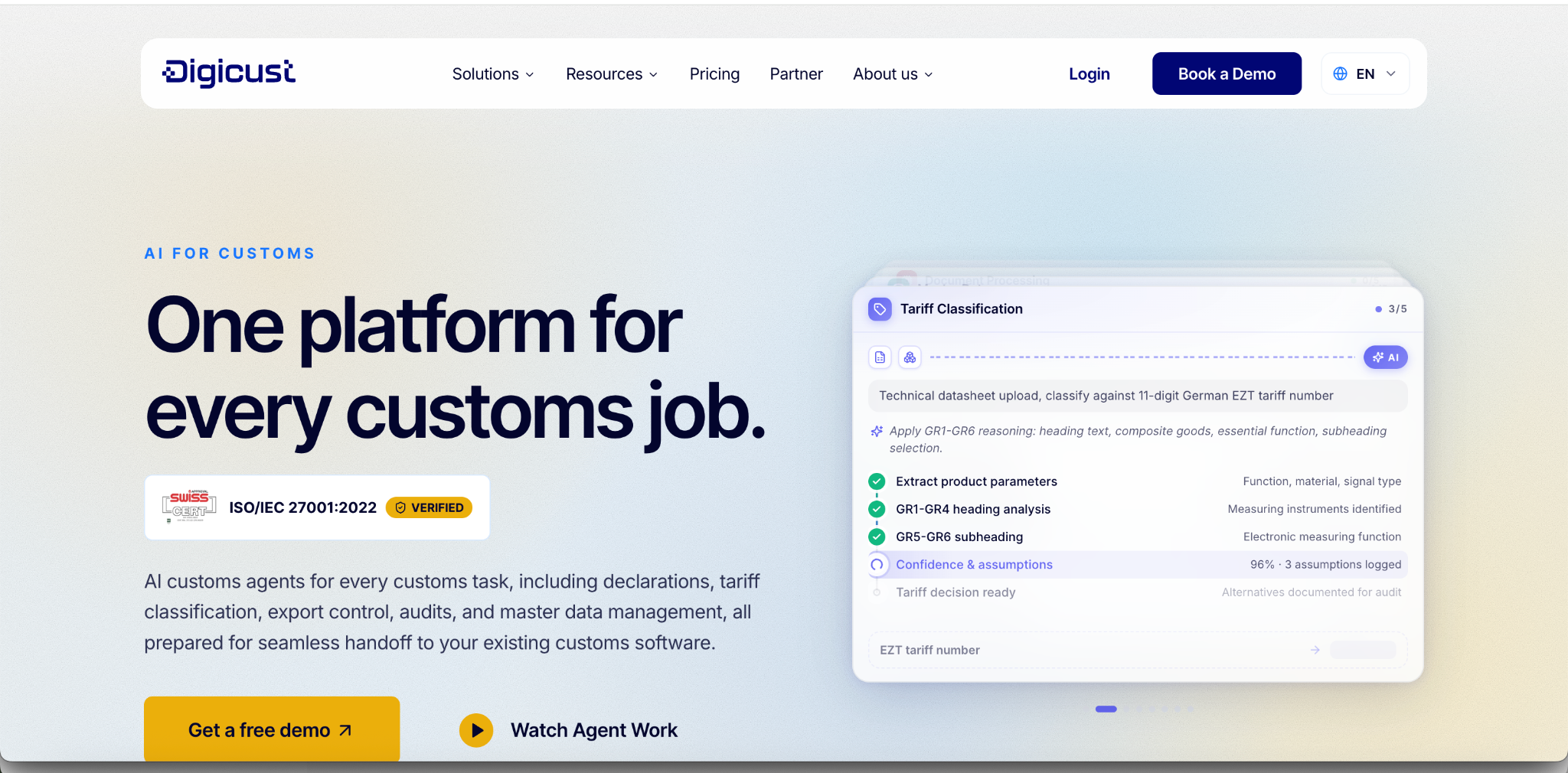
Digicust is an "AI customs agent" that sits in front of existing customs software rather than replacing it, preparing declarations, tariff classifications, and export control checks from documents, emails, and ERP data, then handing off a clean payload to the system a team already files in.
- States IEEE CertifAIed certification for Trustworthy AI, issued by TÜV SÜD (covering algorithmic transparency, bias mitigation, and robustness), plus ISO/IEC 27001:2022 certification, GDPR compliance, and EU-hosted infrastructure.
- Filing scope listed on its site includes UK Customs Declaration Service filings, US AES filings, ASYCUDA declarations, T1/T2/TIR transit movements, EU pre-arrival ENS filings, Poland's PUESC platform, and Mexican LIGIE nomenclature, among others.
- Describes an audit-ready trail and explainable AI decision-making, relevant for teams that want automation without losing audit defensibility. Controls for AI agents acting on regulated filings are covered in guardrails for autonomous AI agents.
- Best fit: multi-jurisdiction operations wanting one AI layer spanning several countries' filing systems, added on top of existing customs software rather than replacing it.
Where Document Extraction Fits, Narrowly
None of the platforms above are document extraction APIs in the sense a general-purpose OCR tool is; they're built around filing, screening, licensing, and compliance workflows specific to trade. The genuine, non-forced connection is upstream: commercial invoices, packing lists, and similar documents need to be accurately digitized and structured before any of these platforms' validation, classification, or filing logic can run on the data.
DeepRead's published invoice extraction benchmark (97.8% accuracy, scored as exact-match field accuracy against a manually verified ground truth) is relevant specifically to that upstream step: structured data extraction from invoices and similar financial and shipping documents, not to customs filing, export licensing, restricted-party screening, or HS classification, none of which are things a general-purpose extraction API does. The benchmark covers invoices generally rather than customs-specific commercial invoices, so test on your own documents. It's a component a trade compliance team's internal tooling might use to get accurate structured data into one of the platforms above, not a substitute for any of them.
What to Evaluate
- Which specific capability you actually need: full-suite trade management, export-specific licensing and AES filing, restricted-party screening, or governance/GRC oversight, since these are genuinely different tools despite overlapping marketing language.
- Multi-jurisdiction coverage. If your operation spans multiple countries' distinct filing systems, confirm a platform genuinely supports the specific jurisdictions you operate in, not just a general "global trade" claim. Several platforms here are strongest in either the US (Descartes products) or the UK and EU (iCustoms, Digicust).
- Whether the platform supports self-filing or requires a broker relationship, a real cost and control tradeoff worth understanding upfront. On the broker side of that choice, the TMS layer many brokers run is compared in freight broker software.
- Restricted-party screening depth, specifically whether fuzzy-logic matching and alias detection are included, given how easily exact-match-only screening misses genuine risk.
- Audit trail and explainability, particularly for AI-driven platforms; confirm decisions and classifications can be traced and explained during a regulatory review, not just executed quickly.
Conclusion
Automated trade documentation tools split into genuinely distinct capabilities: full-suite trade management, export-specific licensing and screening, and governance-focused compliance oversight, and the right fit depends on which of those is your actual bottleneck. e2open and iCustoms cover broad, integrated workflows, with iCustoms strongest in UK and EU systems; Descartes Visual Compliance and Descartes OCR Global EASE focus on US export licensing and AES filing; VComply addresses the governance layer around trade obligations rather than execution; Digicust represents a newer AI-agent approach extending existing systems across multiple jurisdictions. Document extraction has a real but narrow role in this picture, feeding accurate data into whichever platform actually handles filing, screening, and compliance, not replacing any of them.
FAQ
What's the difference between AES and ACE?
AES (Automated Export System) is the joint CBP, Census, BIS, and DDTC system for filing US export shipment data. ACE (Automated Commercial Environment) is CBP's centralized system for processing imports and exports, known as the US "Single Window." AES functionality now runs on the ACE platform, so exporters file through ACE.
Is customs filing the same thing as export licensing?
No, they're related but distinct steps. Customs filing covers the declaration and clearance process for moving goods across a border. Export licensing is a separate authorization process, required before certain controlled goods can be exported at all, submitted to agencies like the Department of Commerce or State. Some platforms cover both; others specialize in one specifically.
Do I need separate tools for customs filing and export licensing?
Not necessarily. Some platforms (e2open, iCustoms) cover both in one suite, while others (Descartes Visual Compliance, Descartes OCR Global EASE) focus on US export licensing, screening, and AES filing. The right choice depends on whether your compliance need spans both import and export sides or concentrates on one.
Who owns Visual Compliance and OCR's Global EASE?
Both are Descartes products. Descartes acquired Visual Compliance, which also operated as eCustoms, in February 2019, and OCR's platform now carries the Descartes OCR name.
What is restricted-party screening, and why does fuzzy logic matter for it?
It's the process of checking counterparties against denied-party lists before a transaction proceeds. Fuzzy-logic matching catches name variations, misspellings, and aliases that an exact-match-only search would miss, which matters given how often denied-party names appear with slight variations across records.
Is a GRC platform like VComply the same as a customs filing tool?
No. GRC platforms address the broader governance and audit-evidence layer, proving an organization can demonstrate compliance across trade obligations, rather than executing shipment filings or generating documents themselves. They're complementary to, not a replacement for, execution-focused trade management tools.
More articles
Rossum Alternatives: 7 Document Processing Platforms Compared
Looking for a Rossum alternative? Compare seven document extraction platforms on price, scope, and verified features, plus what to test before you switch.
Nanonets Alternatives: 7 Document Processing Platforms Compared
Explore 7 Nanonets alternatives with a side-by-side comparison of document extraction, IDP features, pricing.