%20{%20:root%20{%20--deepread-stroke:%20%23E5E7EB;%20}%20}%20.dark%20{%20--deepread-stroke:%20%23E5E7EB;%20}%20%3c/style%3e%3crect%20x='40'%20y='30'%20width='220'%20height='260'%20rx='28'%20ry='28'%20stroke='var(--deepread-stroke)'%20stroke-width='16'%20fill='none'/%3e%3cpath%20d='M180%2030v52c0%2010%208%2018%2018%2018h62'%20stroke='var(--deepread-stroke)'%20stroke-width='16'%20fill='none'/%3e%3cline%20x1='70'%20y1='130'%20x2='200'%20y2='130'%20stroke='var(--deepread-stroke)'%20stroke-width='16'%20stroke-linecap='round'/%3e%3cline%20x1='70'%20y1='165'%20x2='200'%20y2='165'%20stroke='var(--deepread-stroke)'%20stroke-width='16'%20stroke-linecap='round'/%3e%3cline%20x1='70'%20y1='200'%20x2='170'%20y2='200'%20stroke='var(--deepread-stroke)'%20stroke-width='16'%20stroke-linecap='round'/%3e%3c!--%20green%20download%20arrow%20in%20bottom%20right%20corner%20--%3e%3cpath%20d='M210%20202v58'%20stroke='var(--deepread-accent)'%20stroke-width='18'%20stroke-linecap='round'/%3e%3cpath%20d='M195%20245l15%2015%2015-15'%20fill='none'%20stroke='var(--deepread-accent)'%20stroke-width='18'%20stroke-linecap='round'%20stroke-linejoin='round'/%3e%3c/svg%3e)
Automated In-Bond Processing Documentation: A Compliance Guide
Automated in-bond processing explained, CBP requirements, ACE and eBond, deadlines, penalties, and where document extraction fits.
In-bond processing is a specific U.S. Customs and Border Protection mechanism, and it's worth being precise about what it actually means before anything else: it allows imported merchandise to move through the United States, by ocean, rail, truck, or air, without formal customs entry or duty payment, until it reaches its final port of arrival or is exported. This guide covers what CBP's automated in-bond process actually requires, the regulatory deadlines and penalties involved, and where accurate document data extraction fits into meeting them.
Who This Is For
- Customs brokers, carriers, and freight forwarders handling in-bond cargo movements subject to CBP reporting requirements.
- Bonded warehouse operators and container station operators required to obtain and manage CBP-approved bonds for in-bond cargo they handle.
- Compliance teams at importers and logistics companies needing to understand the specific electronic reporting deadlines and penalty exposure tied to in-bond movements.
- Software and operations teams building customs compliance tooling that needs to extract accurate data from Bills of Lading feeding into an in-bond submission.
What In-Bond Processing Actually Is
In-bond cargo is merchandise that hasn't yet been formally entered for consumption, meaning duties haven't been paid or the entry process completed, but is being transported through the US under a CBP-approved bond that covers it during transit. Carriers, warehouses, cartmen, and container stations handling this cargo are required by CBP to hold an appropriate bond, and the movement itself, and its eventual arrival, export, or diversion, must be reported to CBP electronically.
The official guidance on this process, published by CBP's Office of Field Operations as the Automated In-Bond Processing Business Process Document, is explicitly described as a living document, expected to evolve as regulations and the underlying ACE system change, worth checking for the current version directly on CBP.gov rather than relying on a static summary.
CBP's Mandate: Full Automation Through ACE
CBP has been explicit and direct about this: the Office of Field Operations is committed to full automation of the in-bond process, and this isn't aspirational; it's already enforced. Since 2019, CBP no longer accepts paper copies of CBP Form 7512 (the Transportation Entry and Manifest of Goods Subject to CBP Inspection and Permit) to perform arrival and export functionality. CBP announced this specifically through CSMS #38731726, the messaging system notice confirming paper Form 7512 copies would no longer be accepted for arrival and export functionality. Electronic reporting of in-bond transactions became mandatory in August 2018, with enforcement of ACE reporting for exports, arrivals, and diversions beginning July 29, 2019.
Two systems currently handle electronic in-bond applications:
- ACE (Automated Commercial Environment), CBP's primary automated system, which can also be used in conjunction with advance or arriving manifest information for cargo moving by ocean, rail, truck, or air.
- QP/WP, an ABI-hosted in-bond system available to all parties (carriers and non-carriers) as an alternative to ACE, with "QP" handling the application function and "WP" handling arrival and export reporting.
Key Regulatory Requirements and Deadlines
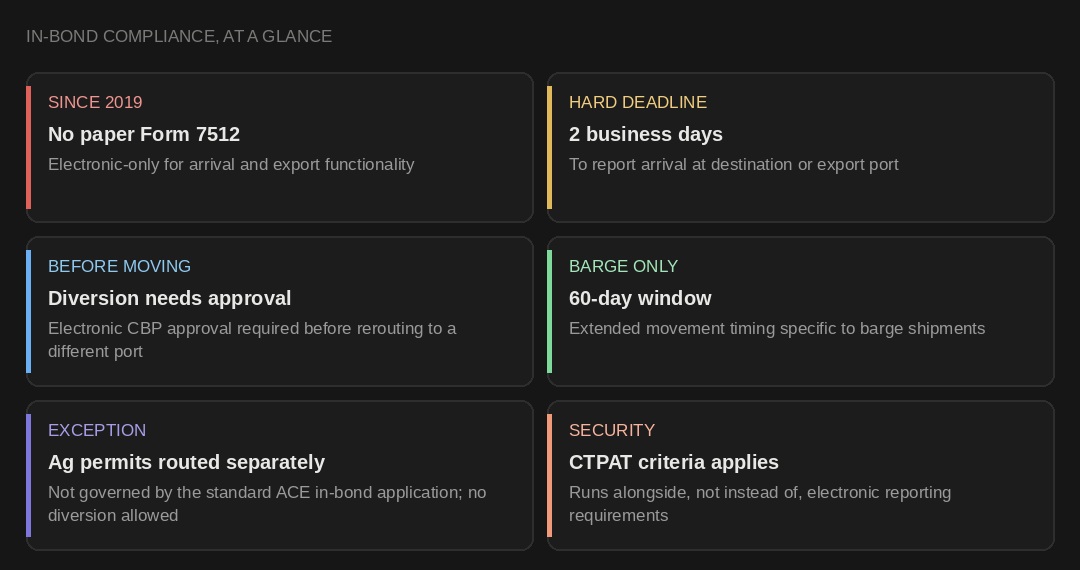
- Two-business-day arrival reporting. Carriers must report the arrival and location of in-bond merchandise within 2 business days of reaching the port of destination or export.
- Electronic diversion approval. Carriers must electronically request and receive CBP's permission before diverting in-bond merchandise from its intended destination port to a different port, rather than diverting first and reporting afterward.
- A 60-day movement window for barge shipments specifically, a distinct timing rule worth knowing if that mode applies to your cargo.
- A separate process for agricultural permits. The in-bond application within ACE does not govern the Agricultural permit process; in-bond movement for agriculture-permitted goods must follow Department of Agriculture routing specifically and may not be diverted outside that process.
- CTPAT security criteria. In-bond shipments are also subject to Customs-Trade Partnership Against Terrorism (CTPAT) minimum security criteria, a voluntary but widely-adopted CBP security program covering supply chain security practices for carriers and other trade parties handling this cargo. Confirm current CTPAT requirements directly if your operation participates in or is evaluating this program alongside in-bond compliance.
- eBond for the underlying customs bond itself. Separate from cargo movement reporting, CBP's eBond system, launched January 3, 2015, replaced the paper CBP Form 301 bond process as part of the broader National Customs Automation Program established under the Mod Act. It handles electronic submission of Single Transaction Bonds, Continuous Bonds, and Bond Riders from a surety or surety agent directly into ACE, with electronic status updates sent to sureties, surety agents, and secondary notify parties.
What Happens When Reporting Is Late or Wrong
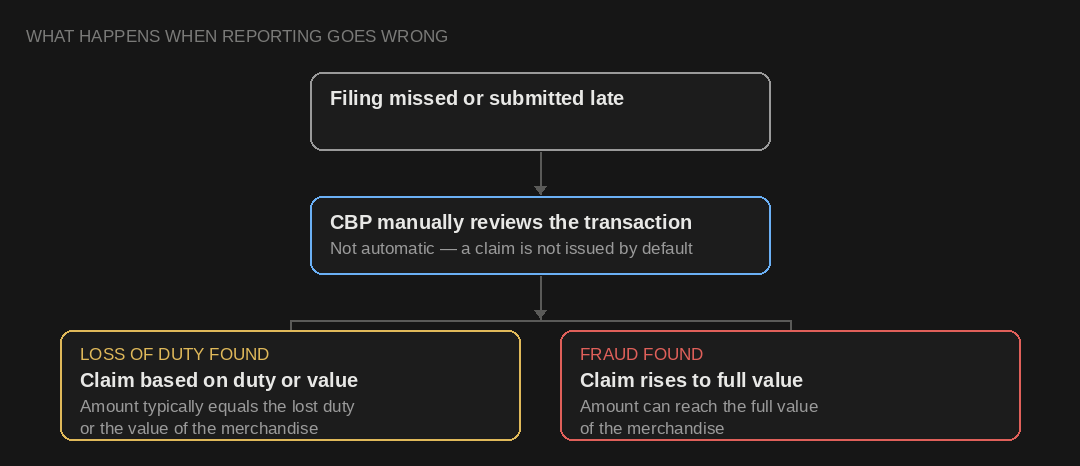
Worth understanding the actual enforcement mechanism, since it's not automatic: if an in-bond filing wasn't submitted, or wasn't submitted on time, a claim isn't automatically issued. CBP manually reviews the transaction to determine whether a claim is actually warranted. If CBP determines there was a loss of duty because the shipment was diverted to domestic use without authorization, the claim amount is typically based on the loss of duty or the value of the merchandise, whichever applies. If CBP determines the violation involved fraud specifically, the claim amount can rise to the full value of the merchandise, a materially higher exposure than a straightforward compliance lapse.
Where Bill of Lading Data Extraction Fits
This is worth stating precisely, since it's directly confirmed in CBP's own technical documentation rather than an inferred connection: all in-bond entry data is derived from the Bill of Lading. The accuracy of the underlying BOL data- carrier, cargo description, weight, port codes, Harmonized Tariff Schedule numbers- directly determines the accuracy of the in-bond entry itself, and given the tight, mandatory reporting windows involved (the 2-business-day arrival deadline, for instance), manual re-keying of BOL data into an in-bond submission is exactly the kind of process where errors or delays create real compliance exposure.
Specific fields CBP's own documentation names as required for an in-bond entry: the Census Schedule D code, the first U.S. port of unlading, foreign port codes, the Schedule K number, the Harmonized Number (HTSUS code), and net weight. These are exactly the kind of structured values a BOL extraction step needs to capture accurately and consistently, since each one maps directly to a required field in the in-bond submission itself.
A document extraction API accurately reading BOL data, vendor, cargo details, weights, port and tariff codes, before it feeds into an ACE or QP/WP submission is a genuine, CBP-relevant application of document automation here, not a stretch.
DeepRead's invoice extraction benchmark (97.8% accuracy) reflects the same category of structured financial/shipping document extraction relevant to BOL processing, though it's worth being precise that this isn't a CBP-specific or in-bond-specific benchmark, and DeepRead is not a customs filing system, ACE interface, or bonded-carrier platform. Its role here is narrow and specific: accurately extracting the BOL data that an in-bond submission depends on, not replacing or connecting directly to ACE, eBond, or QP/WP, which remain CBP's own required systems for the actual filing.
What to Confirm Before Relying on Any Automation Here
- Current CATAIR compliance. Technical guidance for processing electronic in-bonds in ACE lives in the CBP and Trade Automated Interface Requirements (CATAIR) Implementation Guide specifically, not the general business process document alone; confirm any system or integration is current against CATAIR directly.
- Which system your process actually uses. ACE and QP/WP are both valid but distinct; confirm which one your carrier or broker relationship is actually built on before assuming integration compatibility.
- The 2-business-day reporting window is a hard deadline, not a guideline; build any BOL-to-in-bond data pipeline with that timing constraint as a firm requirement, not an aspiration.
- Agricultural permit shipments follow a separate routing process entirely; confirm this doesn't apply before assuming standard ACE in-bond handling covers your cargo.
- CTPAT participation status, if applicable, since security criteria compliance runs alongside, not instead of, the electronic reporting requirements covered above.
Conclusion
Automated in-bond processing is a CBP-mandated, fully electronic requirement, not an optional efficiency upgrade; paper CBP Form 7512 submissions have not been accepted since 2019, and the reporting deadlines (2 business days for arrival, prior approval for diversion) carry real, escalating penalty exposure for non-compliance.
CBP's own documentation confirms in-bond entry data is derived directly from the Bill of Lading, which is exactly where accurate document extraction has a genuine, narrow role to play, feeding correct data into a submission process that still runs through CBP's own required systems (ACE, eBond, QP/WP), not replacing them.
FAQ
What does "in-bond" mean in customs and freight terminology?
It refers to imported merchandise moving through the United States without formal customs entry or duty payment until it reaches its final port of arrival or is exported, covered during transit by a CBP-approved bond.
Can CBP Form 7512 still be submitted on paper?
No, CBP has not accepted paper copies of CBP Form 7512 for arrival and export functionality since 2019, per CSMS #38731726. Electronic reporting through ACE became mandatory in 2018, with enforcement beginning in July 2019.
What happens if an in-bond arrival isn't reported within the required timeframe?
CBP manually reviews the transaction to determine whether a claim is warranted, rather than issuing one automatically. If a loss of duty is found due to unauthorized diversion, the claim is typically based on the loss of duty or merchandise value; if fraud is involved, the claim can rise to the full value of the merchandise.
What's the difference between ACE and QP/WP for in-bond applications?
Both are CBP-recognized electronic systems for submitting in-bond applications. ACE is CBP's primary automated system, usable alongside manifest information. QP/WP is an ABI-hosted alternative available to both carriers and non-carriers, with "QP" handling applications and "WP" handling arrival and export reporting.
What is CTPAT, and how does it relate to in-bond processing?
CTPAT (Customs-Trade Partnership Against Terrorism) is a CBP security program setting minimum supply chain security criteria for carriers and other trade parties. In-bond shipments are subject to these criteria alongside the electronic reporting requirements covered above, worth confirming directly if your operation handles or is evaluating participation in CTPAT.
More articles
Structured Data Extraction: A Technical Guide
How to extract structured data from documents using an AI API, the architecture, grounding, and named tools compared.

Key Features of AI Document Workflow Automation
AI document workflow automation features, governance, prioritization framework, and real examples with measurable benefits for 2026.