%20{%20:root%20{%20--deepread-stroke:%20%23E5E7EB;%20}%20}%20.dark%20{%20--deepread-stroke:%20%23E5E7EB;%20}%20%3c/style%3e%3crect%20x='40'%20y='30'%20width='220'%20height='260'%20rx='28'%20ry='28'%20stroke='var(--deepread-stroke)'%20stroke-width='16'%20fill='none'/%3e%3cpath%20d='M180%2030v52c0%2010%208%2018%2018%2018h62'%20stroke='var(--deepread-stroke)'%20stroke-width='16'%20fill='none'/%3e%3cline%20x1='70'%20y1='130'%20x2='200'%20y2='130'%20stroke='var(--deepread-stroke)'%20stroke-width='16'%20stroke-linecap='round'/%3e%3cline%20x1='70'%20y1='165'%20x2='200'%20y2='165'%20stroke='var(--deepread-stroke)'%20stroke-width='16'%20stroke-linecap='round'/%3e%3cline%20x1='70'%20y1='200'%20x2='170'%20y2='200'%20stroke='var(--deepread-stroke)'%20stroke-width='16'%20stroke-linecap='round'/%3e%3c!--%20green%20download%20arrow%20in%20bottom%20right%20corner%20--%3e%3cpath%20d='M210%20202v58'%20stroke='var(--deepread-accent)'%20stroke-width='18'%20stroke-linecap='round'/%3e%3cpath%20d='M195%20245l15%2015%2015-15'%20fill='none'%20stroke='var(--deepread-accent)'%20stroke-width='18'%20stroke-linecap='round'%20stroke-linejoin='round'/%3e%3c/svg%3e)
Key Features of AI Document Workflow Automation
AI document workflow automation features, governance, prioritization framework, and real examples with measurable benefits for 2026.
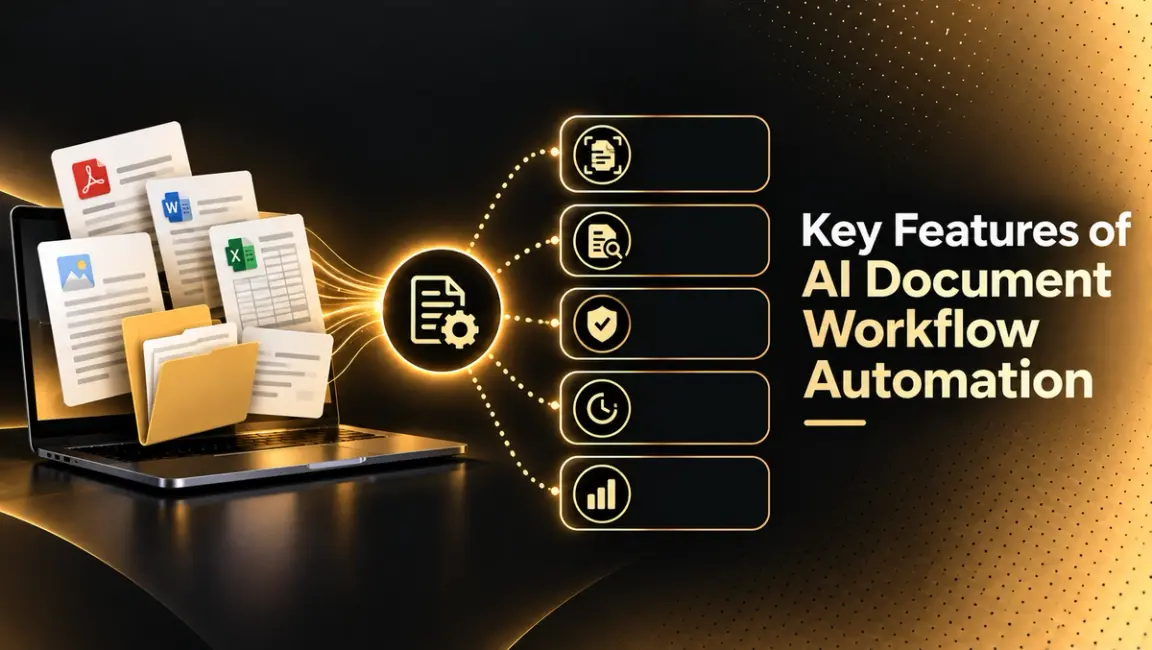
"AI workflow automation" gets used broadly to describe two genuinely different things: general task and project management automation (Jira tickets, Slack notifications, project prioritization) and document-specific automation (routing, classifying, and processing the actual documents a business generates). This guide is about the second one specifically, the features that separate genuine document workflow automation from generic task automation, the AI technologies actually powering those features, how to govern AI-driven decisions responsibly, how to decide which document processes to automate first, and how to measure whether it worked.
Who This Is For
- Operations leaders trying to understand what "AI document workflow automation" actually includes before evaluating a platform.
- Teams with more candidate processes than budget needing a real framework for deciding what to automate first.
- Compliance and risk-conscious teams wanting AI-driven document decisions to remain auditable and explainable, not a black box.
- Anyone confusing general workflow automation tools with document-specific automation, since they solve genuinely different problems despite overlapping marketing language.
Key Features, Organized by the AI Technology Behind Them
Document workflow automation features aren't one undifferentiated capability, they're powered by two genuinely different underlying technologies, worth understanding separately since they solve different problems.
Machine learning powers:
- Smart categorization. Automatically sorting incoming documents by type or priority based on learned patterns, rather than fixed rules.
- Predictive scheduling and bottleneck flagging. Identifying which documents or approvals are likely to miss a deadline based on historical patterns.
- Anomaly detection. Spotting unusual patterns in extracted data, an invoice amount far outside a vendor's typical range, or a document field that doesn't match expected values.
Natural language processing (NLP) powers:
- Data extraction with confidence scoring. Reading and pulling key information from contracts, invoices, and forms, with a confidence score attached to each extracted value so uncertain fields get flagged for review rather than silently accepted or blocking the whole document. DeepRead's extraction API is one example of this specific mechanism, per-field confidence scoring with needs_review flagging, relevant to the extraction step of a broader workflow, though it's a component you'd build a workflow around, not a full workflow automation platform on its own.
- Summarization. Condensing a lengthy contract or report into its key points, rather than requiring a full manual read before a reviewer can act on it.
- Action item extraction. Reading email threads or correspondence and pulling out specific tasks or obligations automatically.
Beyond ML and NLP, the workflow layer itself adds:
- Intelligent routing and approval chains. Documents move automatically to the correct reviewer or approver based on content, value, or business rules.
- Version control and audit trails. Every change and approval step is logged, supporting both dispute resolution and regulatory review.
- E-signature integration. Documents needing a signature move directly into that step as part of the automated flow.
- API and system integration. Connections into existing systems (an ERP, a CRM, an accounting platform) so processed data flows downstream automatically.
A Concrete Example: Document Triage in Practice
To make auto-classification concrete rather than abstract: consider a team managing hundreds of incoming documents weekly- invoices, contracts, and support-related correspondence, mixed together. Manual triage might take hours and produce inconsistent prioritization depending on who's doing it. AI-driven document triage instead analyzes each incoming document, categorizes it by type and urgency, routes it to the person or team with the relevant expertise, and can even predict how long processing is likely to take based on similar past documents, all as one automated step rather than a person manually sorting the queue first.
Governance Principles for Responsible AI-Driven Prioritization
Worth treating as its own section, since AI making decisions about document priority and routing needs guardrails, not just capability:
- Agree upfront which inputs actually drive priority, and which ones shouldn't, before the system starts making decisions based on patterns nobody explicitly approved.
- Set clear limits on what automation can do without human approval. Some decisions (routing a routine document, flagging low-confidence extractions) are reasonable to fully automate; others (final approval on a high-value contract) shouldn't be.
- Require explainability for AI recommendations that affect real outcomes. If a system flags a document as high-priority or routes it a certain way, a person should be able to see why, not just accept the output.
- Audit outputs regularly for drift, bias, and unhelpful patterns. A model's behavior can shift over time as it encounters new document types or edge cases; periodic review catches this before it becomes a systemic problem.
- Assign clear ownership for changes to rules, workflows, and decision logic. Someone specific should be responsible for updating automation rules as processes evolve, not an ambiguous shared responsibility that nobody actually owns.
How to Prioritize Which Document Processes to Automate First
Most organizations have more candidate processes than budget or engineering capacity to automate at once, and the framework is genuinely simple: weigh business impact against ease of implementation, rather than automating whatever's most visible or most requested.
- High impact, easy to implement. Automate these first. A process that's high-volume, error-prone, and technically straightforward (a standardized invoice approval flow, for instance) delivers fast, visible wins that build organizational confidence for the next phase.
- High impact, hard to implement. Worth planning for, not skipping, but sequence these after an early win rather than starting here. Complex, cross-system processes take longer and carry more implementation risk, better tackled once the organization has some automation experience.
- Low impact, easy to implement. Reasonable candidates for later phases, but don't let ease of implementation alone drive prioritization; a quick win that doesn't matter much to the business teaches little and builds limited momentum.
- Low impact, hard to implement. Deprioritize these, or reconsider whether they're worth automating at all relative to other uses of the same engineering effort.
Beyond the impact/effort weighing itself, a few practical steps matter: consult the team working the process before automating it, and involve managers, end-users, and legal or compliance stakeholders early to refine requirements rather than discovering them after building something. Keep that consultation ongoing, not one-time, inviting the project team to surface friction points on a recurring cadence after launch, since issues worth fixing often only surface once a workflow is running in real conditions.
Run small trial projects to validate an approach before committing broader resources. Expand deliberately, one new document type or process per quarter is a reasonable pace for most organizations, rather than attempting several simultaneously and diluting attention across all of them.
How to Measure Success
Track specific, named metrics from day one rather than relying on a general sense that automation "seemed to help":
- Time saved, measured against your actual pre-automation baseline for the specific process, not an industry average.
- Error reduction, tracked by error type where possible, since a reduction in total errors matters less than confirming which specific error types actually declined.
- Workflow efficiency, meaning cycle time from document receipt to final resolution, the metric that most directly reflects whether bottlenecks actually cleared.
- Adjust automation rules and models as your processes evolve. Metrics aren't a one-time report card, they're the ongoing signal for when a rule needs updating or a model needs retraining, tied directly back to the governance principle of assigned ownership above.
Electronic Document Workflow Automation Examples
- Invoice approval routing. An incoming invoice is auto-classified, key fields extracted (vendor, amount, due date), matched against a purchase order, and routed to the correct approver based on amount thresholds, rather than a person manually keying data and forwarding the invoice for sign-off. Benefit: faster approval cycles and fewer missed early-payment discounts from invoices sitting in a manual queue.
- Contract review and approval. A submitted contract is classified by type, key clauses and obligations are extracted, and it's routed to legal review with relevant terms already surfaced, rather than requiring a full manual read-through before anyone can act on it. Benefit: faster turnaround on routine contracts, freeing legal review time for genuinely complex agreements.
- HR onboarding document routing. New-hire paperwork, offer letters, tax forms, benefit enrollments, is automatically routed to the correct downstream system and reviewer, rather than a new hire's documents sitting in a shared inbox waiting for someone to process them individually. Benefit: a smoother, faster onboarding experience and fewer administrative errors during a new hire's first days.
- Expense report approval. Receipts are auto-classified, data extracted, checked against expense policy, and routed for approval only when something falls outside policy, rather than every single expense report requiring the same manual review regardless of how routine it is. Benefit: most routine expense reports clear automatically, concentrating manual review time on the genuinely exceptional cases.
Conclusion
AI document workflow automation is a distinct category from general task and project automation, built around ML-powered classification and prediction, NLP-powered extraction and summarization, and a workflow layer handling routing, approval, and audit trails. Genuine adoption also requires real governance, agreed priority inputs, human-approval boundaries, explainability, and clear ownership, not just capability.
When more processes are candidates for automation than you have capacity to tackle at once, weighing business impact against ease of implementation, starting with high-impact, low-effort wins, and tracking specific, named metrics from day one is a more reliable approach than automating whatever's loudest or most recently requested.
FAQ
What's the difference between AI document workflow automation and general AI workflow automation tools?
General AI workflow automation (Jira, Slack, project management platforms) handles task prioritization, scheduling, and team coordination. AI document workflow automation specifically handles the documents themselves, classification, extraction, routing, and approval chains, a genuinely different technical problem despite similar marketing language.
What AI technologies actually power document workflow automation?
Machine learning powers classification, predictive scheduling, and anomaly detection. Natural language processing powers data extraction, summarization, and action-item extraction from correspondence. Routing, version control, and system integration are workflow-layer capabilities built on top of both.
How should I decide which document process to automate first?
Weigh business impact against ease of implementation. Start with processes that are both high-impact and straightforward to automate, since these deliver fast, visible wins that build organizational confidence before tackling more complex, cross-system processes.
What governance should be in place before letting AI make document routing or priority decisions?
Agree upfront which inputs drive priority, set clear limits on what can happen without human approval, require explainability for recommendations, audit outputs regularly for drift or bias, and assign clear ownership for updating the underlying rules and logic as processes change.
What metrics should I track to know if document workflow automation actually worked?
Time saved against your own pre-automation baseline, error reduction by specific error type, and overall cycle time from document receipt to resolution, adjusted and re-measured over time rather than checked once at launch.
Does DeepRead offer full document workflow automation?
No, DeepRead provides confidence-scored data extraction specifically, one NLP-powered component of a broader document workflow, not classification, routing, approval chains, or e-signature integration. It's relevant to the extraction step a workflow automation system would use, not a substitute for the full workflow platform.
More articles
Structured Data Extraction: A Technical Guide
How to extract structured data from documents using an AI API, the architecture, grounding, and named tools compared.

Automated In-Bond Processing Documentation: A Compliance Guide
Automated in-bond processing explained, CBP requirements, ACE and eBond, deadlines, penalties, and where document extraction fits.