%20{%20:root%20{%20--deepread-stroke:%20%23E5E7EB;%20}%20}%20.dark%20{%20--deepread-stroke:%20%23E5E7EB;%20}%20%3c/style%3e%3crect%20x='40'%20y='30'%20width='220'%20height='260'%20rx='28'%20ry='28'%20stroke='var(--deepread-stroke)'%20stroke-width='16'%20fill='none'/%3e%3cpath%20d='M180%2030v52c0%2010%208%2018%2018%2018h62'%20stroke='var(--deepread-stroke)'%20stroke-width='16'%20fill='none'/%3e%3cline%20x1='70'%20y1='130'%20x2='200'%20y2='130'%20stroke='var(--deepread-stroke)'%20stroke-width='16'%20stroke-linecap='round'/%3e%3cline%20x1='70'%20y1='165'%20x2='200'%20y2='165'%20stroke='var(--deepread-stroke)'%20stroke-width='16'%20stroke-linecap='round'/%3e%3cline%20x1='70'%20y1='200'%20x2='170'%20y2='200'%20stroke='var(--deepread-stroke)'%20stroke-width='16'%20stroke-linecap='round'/%3e%3c!--%20green%20download%20arrow%20in%20bottom%20right%20corner%20--%3e%3cpath%20d='M210%20202v58'%20stroke='var(--deepread-accent)'%20stroke-width='18'%20stroke-linecap='round'/%3e%3cpath%20d='M195%20245l15%2015%2015-15'%20fill='none'%20stroke='var(--deepread-accent)'%20stroke-width='18'%20stroke-linecap='round'%20stroke-linejoin='round'/%3e%3c/svg%3e)
Guardrails for Autonomous AI Agents in Document Processing
Guardrails for autonomous AI agents in document processing, architecture, risk tiers, real breach data, and named systems.
Guardrails for autonomous AI agents are a genuinely different problem than the content-moderation guardrails most people picture when they hear the term. A chatbot's worst failure mode is a bad sentence. An autonomous document-processing agent with access to files, databases, and downstream systems can leak private data, overwrite records, trigger unauthorized external actions, or make a decision with real financial or operational consequences, all without a human reviewing the step. This guide covers what guardrails actually need to do for this category of risk, why some common approaches fail under exactly the conditions they're meant to protect against, and named systems addressing this.
Who This Is For
- Engineering and security teams building or deploying autonomous agents that process documents and take downstream actions, not just extract data.
- Compliance and risk leaders evaluating whether an agentic AI deployment meets audit and regulatory requirements.
- Anyone assuming prompt-level instructions ("don't do X") are sufficient protection, worth understanding why that assumption has a real, documented failure mode.
Why This Is a Different Problem Than Content Moderation
As agents gain access to files, browsers, APIs, terminals, databases, and enterprise applications, safety has to move beyond response filtering. In a chatbot setting, unsafe behavior usually shows up as harmful text. In an agentic workflow, unsafe behavior can mean leaking private data, overwriting files, triggering external side effects, executing untrusted logic, or making an unauthorized decision- real actions with real consequences, not a bad response a human reads and dismisses. The safety problem becomes operational, not purely linguistic.
Agentic AI reasons through goals, selects tools, retrieves data, and takes sequences of actions that produce real-world outcomes: updating a record, processing a transaction, escalating a case, modifying a workflow. The shift from generating content to taking action is the entire reason this category of guardrail exists.
Why Prompt-Level Guardrails Alone Aren't Enough
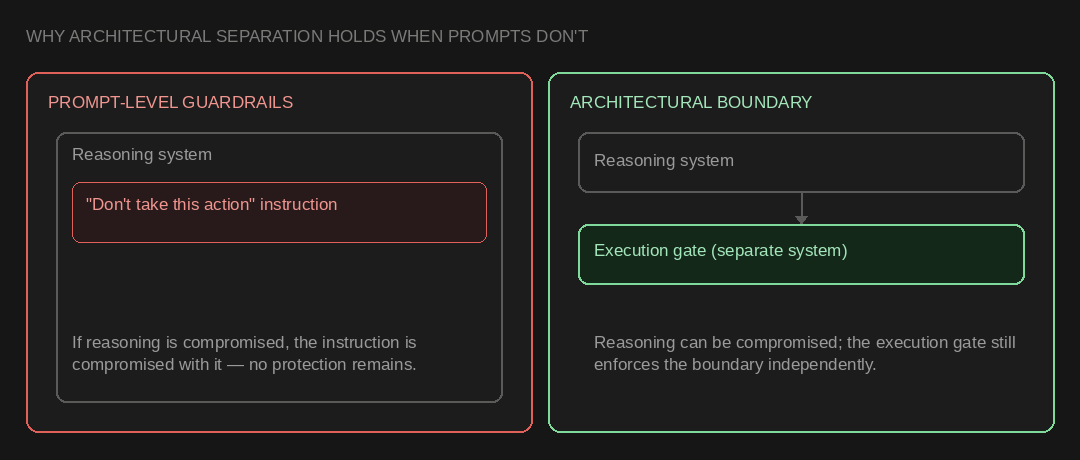
This is worth understanding as a specific, documented architectural finding, not just general caution: the dominant approach to agent safety has relied on prompt-level guardrails, natural language instructions operating at the same abstraction level as the threats they're meant to mitigate.
One academic paper on this specifically makes the point directly: when an agent's reasoning system is compromised, prompt-level guardrails provide effectively no protection, because they exist only within the compromised system itself. An architectural boundary, separating an agent's reasoning from its ability to execute side-effecting actions, holds regardless of whether the reasoning has been manipulated.
The same research reports a tested implementation of this architectural approach blocking 98.9% of adversarial attacks across 280 test cases spanning nine attack categories under a default configuration, and 100% under a maximum-security configuration, worth treating as one study's benchmark result rather than a universal guarantee, but a meaningful, quantified data point for what architectural separation can achieve compared to instruction-only approaches.
Four Guardrail Types Production Systems Need
Worth treating these as distinct categories, since a system can be strong in one and genuinely weak in another:
- Security guardrails enforce identity and access controls; agents should operate under the same, or stricter, identity controls as human users, since without this they can access files, APIs, and data sources far beyond their intended scope.
- Compliance guardrails align agent behavior with internal audit standards and external regulatory frameworks. GDPR Article 22 creates a default prohibition on fully automated decision-making that significantly affects individuals; HIPAA's Security Rule requires access controls, immutable audit trails, and encryption for any system processing protected health information; SOC 2 requires documented access controls and change management for model updates.
- Ethical guardrails address fairness and transparency, detecting disparate treatment before outputs reach users and flagging toxic or misleading content during generation.
- Operational guardrails constrain what actions an agent can actually execute, and at what risk threshold those actions require human review, the category most directly relevant to document processing specifically.
Seven Categories of Agentic AI Guardrails
One security-focused framework breaks this down further into seven specific guardrail categories worth checking for directly in any agentic deployment:
- Identity controls — agents operating under the same, or stricter, access controls as human users, preventing scope creep into files, APIs, or data sources beyond what a specific task requires.
- Data guardrails — preventing agents from inadvertently revealing sensitive information while summarizing content, processing documents, or generating insights across internal systems.
- Action guardrails — controlling which real business-operations actions an agent can take directly (closing tickets, sending communications, deploying code, approving payments) versus which require a human trigger.
- Cascading-failure prevention — since a single agent, acting without proper safeguards, can accidentally or maliciously trigger a chain reaction across connected systems, not just a single, contained mistake.
- Audit and logging controls — a durable record of what an agent did, when, and based on what input, essential for both security investigation and regulatory review after the fact.
- Escalation and human-review paths — defined, not implied, routes for an agent to hand off a decision it isn't authorized to make alone.
- Continuous monitoring — ongoing observation of agent behavior in production, not just a one-time review at deployment, since agent behavior can shift as it encounters new inputs over time.
A Risk-Tiering Framework
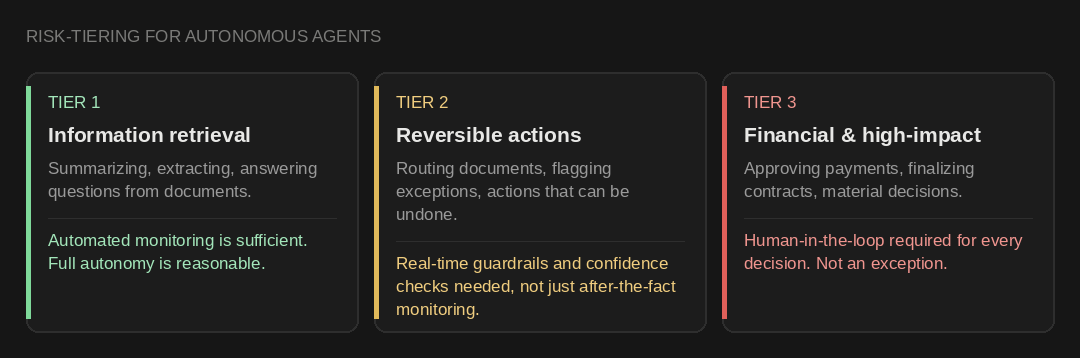
A structured approach to deciding when autonomy is appropriate, worth adapting directly for document processing workflows:
- Tier 1 (information retrieval) — agents summarizing content, extracting data for review, or answering questions from documents. Automated monitoring is sufficient; full autonomy is reasonable here.
- Tier 2 (reversible actions) — agents that route documents, flag exceptions, or take actions that can be undone. Real-time guardrails and confidence-based checks matter here, not just after-the-fact monitoring.
- Tier 3 (financial transactions and high-impact decisions) — agents approving payments, finalizing contracts, or making decisions with material financial or legal consequences. Human-in-the-loop review for every decision is the standard here, not an exception.
One documented enterprise assessment framework names five dimensions worth working through explicitly when deciding which tier a given agent belongs in: identify the agent's capabilities and tool access scope, map potential impact zones covering financial and operational damage, establish risk thresholds for autonomous action, define specific human-in-the-loop trigger conditions, and document the compliance requirements that apply.
Why This Matters Financially, Not Just Operationally
Worth grounding this in current, verified data rather than treating it as an abstract risk: IBM's 2026 Cost of a Data Breach Report (with the Ponemon Institute, based on 602 organizations studied across 17 industries and 16 countries) found the global average cost of a data breach reached a record $4.99 million, a 12% increase over the prior year, reversing a rare dip the year before.
Among organizations that suffered an AI-related breach specifically, 92% lacked proper AI access controls, and those incidents averaged $5.33 million versus $4.70 million for breaches that didn't involve AI. Model inversion and prompt injection were the costliest AI-specific incident types, at $6.07 million and $5.89 million per breach respectively. Shadow AI incidents, unapproved AI tools used without governance oversight, more than doubled from 20% to 43% of breached organizations year over year.
Separately, Deloitte's own 2026 State of AI in the Enterprise research found agentic AI usage is set to rise sharply over the next two years, but oversight is lagging behind it: only one in five companies currently has a mature model for governing autonomous AI agents. The gap between adoption and governance is the actual risk, not agentic AI itself.
Named Systems
LlamaFirewall, deployed in production at Meta, provides three specialized components: PromptGuard 2 for jailbreak detection, Agent Alignment Checks for reasoning inspection, and CodeShield for insecure code prevention, an open-source guardrail system specifically built for agents performing complex tasks like editing production code and orchestrating workflows based on untrusted inputs.
NVIDIA NeMo Guardrails offers a programmable orchestration platform supporting input, dialog, retrieval, execution, and output rails, with integration into LangChain and LlamaIndex, positioned as infrastructure a team builds custom agent guardrails on top of rather than a finished, drop-in solution.
Both of these, and comparable systems, are worth understanding as operating predominantly at the content level, preventing harmful text generation, detecting prompt injection, filtering unsafe outputs, at the boundary between the model and the user. This is a genuinely different, complementary layer to execution governance, the boundary between an agent's action proposals and an enterprise system's actual side-effecting execution, which is where the architectural-separation principle described earlier applies.
How to Implement Guardrails, Step by Step
Rather than a checklist to compare vendors against, this is closer to an implementation sequence worth following in order, since later steps depend on decisions made earlier:
- Start with a policy baseline, defining data, decision, and interaction boundaries before any technical configuration begins.
- Identify all agent types in your environment — autonomous, semi-autonomous, and assisted, since each warrants a different guardrail posture, not one uniform policy applied everywhere.
- Classify accessible data and apply least-privilege rules, ensuring an agent's data access matches what its specific task actually requires, not a broad default grant.
- Enforce permissions through existing IAM infrastructure (identity and access management tools like Okta or Azure AD), rather than building a separate, parallel permission system specifically for agents.
- Add PII masking and redaction rules for both input and output, preventing sensitive data from leaking during an agent's reasoning process, not just from its final output.
- Set explicit autonomy thresholds per risk domain. Low-risk domains (content tagging, summarization) can reasonably operate autonomously; high-risk domains (financial approval, clinical recommendation) should require multi-step verification or human approval, directly matching the risk-tiering framework above.
- Test every policy in a sandbox before production rollout, rather than validating guardrail behavior for the first time against real data and real consequences.
This is described as an ongoing process, not a one-time setup, blending policy, configuration, and runtime enforcement continuously as agents and their access needs evolve.
Where Confidence-Based Routing Fits as a Real, Working Guardrail
This is worth stating directly, since it's a concrete implementation of the operational guardrail category rather than an abstract principle: confidence-threshold routing, covered in more depth in our confidence scoring and fallback logic guide, is a genuine, already-deployable guardrail mechanism specifically for document processing agents. High-confidence extractions proceed automatically; values below a defined threshold route to human review rather than being acted on autonomously, a direct, practical instance of the "define human-in-the-loop trigger conditions" dimension named in the risk-tiering framework above.
DeepRead's extraction pipeline implements this pattern natively: every extracted field returns a per-field confidence score, with uncertain values flagged needs_review rather than passed downstream as if they were certain. This is functionally a Tier 2-appropriate guardrail already built into the extraction layer: uncertain document data doesn't silently flow into an automated downstream action; it's flagged for a person specifically.
Worth being precise about scope: this addresses data-quality-driven risk at the extraction step specifically; it isn't a full agentic guardrail framework covering tool access scope, execution isolation, or multi-step reasoning inspection, which are the broader concerns this article covers. For an agent built on top of DeepRead's extraction output that then takes further autonomous actions, the risk-tiering and architectural-separation principles above still apply to that downstream agent layer.
Conclusion
Guardrails for autonomous AI agents in document processing are an operational problem, not a content-moderation problem; agents take real actions with real consequences, and prompt-level instructions alone provide no protection once an agent's reasoning is compromised. A layered approach- security, compliance, ethical, and operational guardrails together, combined with explicit risk-tiering, a defined implementation sequence, and clear human-in-the-loop trigger conditions- is what current research and production systems both point toward.
Confidence-based routing at the extraction layer is a genuine, already-implementable piece of this, but it addresses one specific risk (uncertain data flowing downstream) within a much larger governance problem that current data suggests most organizations, per Deloitte's own research, haven't yet built mature systems to address.
FAQ
Why aren't prompt-level instructions enough to guardrail an autonomous agent?
Because they exist only within the same reasoning system they're meant to protect. If an agent's reasoning is compromised, through a prompt injection or a manipulated input, prompt-level guardrails provide no protection, since they operate at the same abstraction level as the threat itself. An architectural boundary separating reasoning from execution holds regardless of whether reasoning is compromised.
What's the actual financial risk of ungoverned AI agents?
IBM's 2026 Cost of a Data Breach Report found the global average breach cost reached $4.99 million, with AI-related breaches averaging higher than non-AI breaches, and 92% of organizations that suffered an AI-related breach lacked proper AI access controls at the time.
What is risk-tiering for AI agents?
A framework classifying agents by the consequences of their actions: Tier 1 for information retrieval (automated monitoring sufficient), Tier 2 for reversible actions (real-time guardrails needed), Tier 3 for financial or high-impact decisions (human-in-the-loop required for every decision), used to decide how much autonomy is appropriate for a given agent.
What are the seven categories of agentic AI guardrails?
Identity controls, data guardrails, action guardrails, cascading-failure prevention, audit and logging controls, escalation and human-review paths, and continuous monitoring, a more granular breakdown than the four-type taxonomy (security, compliance, ethical, operational) covered elsewhere in this guide.
Is confidence-based routing the same thing as a full agentic guardrail system?
No, it's one specific, real implementation of operational guardrails, addressing data-quality risk at the extraction step by flagging uncertain values for human review. It doesn't cover tool access scope, execution isolation, or multi-step reasoning inspection, which a broader agentic guardrail framework needs to address separately.
How mature is AI agent governance across enterprises right now?
Not very. Per Deloitte's own 2026 research, only one in five companies currently has a mature model for governing autonomous AI agents, even as agentic AI adoption is expected to rise sharply over the next two years, creating a genuine, current gap between capability and oversight.
More articles
Metrics to Measure the ROI of Document Workflow Automation (2026)
The metrics that measure document workflow automation ROI: baselines, formulas, cost per document, STP rate, payback, and how to read the statistics.
API for Utility Bill and Multi-Service Statement Processing (2026)
How document processing APIs handle utility bills and multi-service statements: how the market splits, schema design, validation, and named options.