%20{%20:root%20{%20--deepread-stroke:%20%23E5E7EB;%20}%20}%20.dark%20{%20--deepread-stroke:%20%23E5E7EB;%20}%20%3c/style%3e%3crect%20x='40'%20y='30'%20width='220'%20height='260'%20rx='28'%20ry='28'%20stroke='var(--deepread-stroke)'%20stroke-width='16'%20fill='none'/%3e%3cpath%20d='M180%2030v52c0%2010%208%2018%2018%2018h62'%20stroke='var(--deepread-stroke)'%20stroke-width='16'%20fill='none'/%3e%3cline%20x1='70'%20y1='130'%20x2='200'%20y2='130'%20stroke='var(--deepread-stroke)'%20stroke-width='16'%20stroke-linecap='round'/%3e%3cline%20x1='70'%20y1='165'%20x2='200'%20y2='165'%20stroke='var(--deepread-stroke)'%20stroke-width='16'%20stroke-linecap='round'/%3e%3cline%20x1='70'%20y1='200'%20x2='170'%20y2='200'%20stroke='var(--deepread-stroke)'%20stroke-width='16'%20stroke-linecap='round'/%3e%3c!--%20green%20download%20arrow%20in%20bottom%20right%20corner%20--%3e%3cpath%20d='M210%20202v58'%20stroke='var(--deepread-accent)'%20stroke-width='18'%20stroke-linecap='round'/%3e%3cpath%20d='M195%20245l15%2015%2015-15'%20fill='none'%20stroke='var(--deepread-accent)'%20stroke-width='18'%20stroke-linecap='round'%20stroke-linejoin='round'/%3e%3c/svg%3e)
Freight Broker Software with OCR Automation (2026)
Comparing freight broker software with OCR automation - full TMS platforms and standalone tools, verified pricing, and brokerage-size fit.
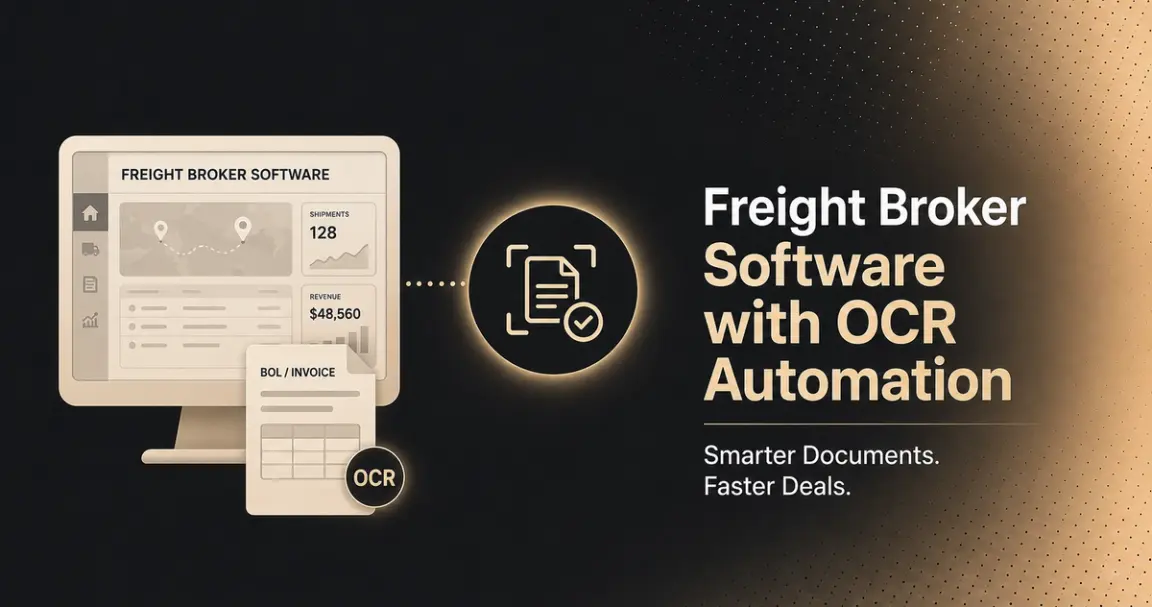
Global trade documentation is a genuinely large, unsolved problem — McKinsey's own analysis finds a single shipment can require up to 50 sheets of paper exchanged with as many as 30 different stakeholders, and the bill of lading alone accounts for 10–30% of total trade documentation costs.
Worth being precise about scope: that figure describes international trade documentation broadly (customs forms, letters of credit, vessel-sharing agreements), not domestic US trucking brokerage specifically — a US freight broker's core document set (BOL, POD, rate confirmation, carrier invoice) is narrower, but it shares the same underlying problem: formats vary by carrier, documents arrive through inconsistent channels, and manual entry is where errors and delays actually happen.
"Freight broker software with OCR automation" covers two different purchases: a full transportation management system (TMS) with document capture built into the platform, or a standalone OCR tool a broker adds on top of an existing TMS that doesn't handle documents well natively. This covers both, verified against official sources with pricing and independent review data, and what to evaluate depending on your brokerage's size.
Who This Is For
- Freight brokers and 3PLs evaluating a new TMS and weighing how much native document automation actually matters in that decision.
- Brokerages on an established TMS with weak document handling, deciding whether to add a standalone OCR tool rather than migrate platforms.
- Ops teams processing BOLs, PODs, rate confirmations, and carrier invoices at volume, where manual data entry and matching documents to the right load is the actual bottleneck.
- Engineering teams at freight tech companies building document automation into their own platform rather than buying a finished one.
What Makes Freight Documents Specifically Hard
- No standard format across carriers. A bill of lading or rate confirmation looks completely different depending on which carrier issued it.
- Documents arrive through inconsistent channels. Email attachments, faxes, driver phone photos, scanned paper handed off at delivery — often folded, annotated, or low-quality.
- Matching a document to the correct load is its own problem. A correctly extracted BOL or POD still needs to be associated with the right shipment record — a genuinely different capability than reading the document itself.
- International and customs documents add another layer. CMR waybills, customs declarations, and international freight paperwork require higher precision, since an error can mean delays at the border, not just a billing correction.
Freight Broker TMS Platforms with Native Document Automation
A note on brokerage size: one industry buyer's guide explicitly recommends against McLeod, Tai, Turvo, or Aljex for smaller brokerages specifically due to implementation weight, pointing instead toward lighter platforms. Worth weighing your team's size and implementation capacity before assuming the most feature-rich platform is the right fit.
McLeod Software
The longest-established name in this category, founded in 1985, with over 900 active carrier and brokerage customers across North America. Product line includes LoadMaster (core TMS) and DocumentPower Enterprise, a dedicated document imaging and workflow product built into the same suite.
- Best fit: established brokerages and carriers wanting a mature, deeply featured platform with document imaging as a long-standing, core capability.
- Best suited to larger, more complex operations that can absorb a heavier implementation process, per independent buyer guidance.
- Worth confirming in a demo: several third-party reviews describe the interface as functional but dated compared to newer competitors.
Tai Software
A sales-focused TMS built specifically for fast-paced freight brokers, with AI woven through both communication and document handling.
- Automatically collects, organizes, and stores shipment documents, with OCR extracting key information and matching each document to the correct load automatically.
- An AI email agent reads shipment request emails, extracts shipment information, creates loads, and drafts communications — document automation extends into inbound communication, not just files.
- Best fit: brokers wanting document capture and matching handled natively as part of a broader AI-driven workflow, though positioned toward teams that can support a heavier implementation, per independent buyer guidance.
Rose Rocket
An AI-native TMS built with AI as foundational architecture rather than bolted onto legacy systems, serving over 100,000 users across brokers, 3PLs, and carriers of all sizes.
- Three named AI agents: TED (a 24/7 email assistant that turns emails into orders and syncs documents from email into the TMS), Rosie (a shipment assistant providing updates and answering questions about active loads), and Rocky (an onboarding and no-code setup assistant)
- Independently rated 4.8/5 across 15 G2 reviews, with 80% of reviewers from small businesses specifically — a genuinely different market segment than Revenova below
- Pricing reported inconsistently across sources (from roughly $233/month to $2,080+/month depending on configuration and source), confirm current published pricing directly on the vendor's own pricing page rather than relying on any third-party figure, including these.
- Best fit: smaller-to-mid-sized brokerages wanting strong ease-of-use and AI-native document sync without a heavy implementation lift.
Revenova
- Entry pricing reported at $2,500/month per company (G2-listed), positioned toward mid-market operations — 51.4% of its G2 reviewer base is mid-market (51–1,000 employees) specifically, a different profile than Rose Rocket's small-business-heavy base.
- Independently rated 4.3/5 across 42 G2 reviews — the largest review sample among the platforms covered here, suggesting a broad, established customer base.
- In head-to-head G2 comparison data, reviewers rated Rose Rocket easier to use, set up, and administer than Revenova, worth validating directly in parallel demos if comparing the two.
Alvys
Combines carrier and brokerage operations in one platform, well-suited for hybrid businesses running both a fleet and brokerage operations side by side.
- Includes document management alongside drag-and-drop dispatching and real-time driver communication via a driver-facing app
- Independently rated 4.7/5 across 17 G2 reviews
- Best fit: hybrid carrier-broker operations wanting one platform that toggles cleanly between both modes
Descartes Aljex
A cloud-based, dashboard-driven TMS commonly positioned for reliability and integration breadth, popular with brokers, 3PLs, and intermodal operators.
- Frequently recommended for automated tendering and broad EDI/integration support
- Best fit: Established brokerages prioritizing platform stability and integration depth, though positioned toward teams that can support a heavier implementation process, per independent buyer guidance.
Turvo
Positioned around "collaborative logistics" — shared visibility and workflow between the brokerage and its customers, including document and update visibility.
- Independently rated 4.4/5 across 20 G2 reviews
- Best fit: brokers running high-touch freight programs where customer-facing visibility is a competitive differentiator, though also positioned toward teams that can support a heavier implementation process.
AscendTMS, DAT Broker TMS, and Transport Pro
All three publish at least one numeric price on their own official pages, per that source's stated methodology — a genuine point of differentiation from vendors like McLeod PowerBroova and Revenova, which reportedly don't publish a standard dollar figure. AscendTMS is independently rated 4.4/5 across 8 G2 reviews. Confirm specific current pricing directly against gotms.com (AscendTMS), and dat.com (DAT), rather than relying on any secondhand figure, including this one.
Standalone OCR and Document Tools for Freight
For brokers whose TMS document handling is weak, or who are building custom freight tooling rather than buying a full platform:
DeepRead
A schema-driven document extraction API with a genuinely relevant, benchmarked fit for freight-specific use cases — not built specifically for freight, but with published accuracy directly applicable to core brokerage documents.
- Invoice extraction benchmarked at 97.8% — directly relevant to carrier invoice processing, one of the highest-volume document types in freight brokerage back-office work
- Driver's License extraction at 96.7% — relevant to driver credential verification during carrier onboarding and compliance checks
- The only platform in this comparison with a fully public, checkable accuracy methodology, measured against named competitors on identical documents against a manually verified ground truth
- Per-field confidence scoring with needs_review flagging, and async processing relevant to batch document intake
- Honest limitation: general-purpose extraction, not a freight-specific tool — no native load-matching logic, no BOL/POD-specific templates out of the box, and no TMS built around it
- Free tier — 2,000 documents/month, no credit card required
Veryfi
Markets bill of lading and customs document OCR specifically, positioned around the real workflow pain of BOLs and customs forms arriving scanned, faxed, folded, and annotated.
- Purpose-marketed for freight and customs documents specifically, not general business documents
- Best fit: teams wanting a financial/logistics-document specialist API rather than a general-purpose extraction tool
Nanonets, ABBYY Vantage, Extend.ai, Lido, Google Document AI
These general-purpose IDP and extraction platforms show up repeatedly in logistics OCR comparisons: Nanonets for trainable, continuously improving extraction; ABBYY Vantage for large enterprises needing broad document-type coverage and RPA integration; Extend.ai for printed BOLs and freight invoices from a stable carrier set; Lido for template-free extraction across carriers, brokers, and 3PLs; Google Document AI for engineering teams building custom pipelines on GCP. None independently verified against their own sites for this specific freight use case — confirm current capability directly.
CargoDoc (Soft Freight Logic)
A proprietary OCR product built specifically to automate data entry into CargoWise — states 99% accuracy with a built-in validator, aimed at freight forwarders and customs brokers already running CargoWise as their core system.
- Best fit: CargoWise-specific operations wanting OCR purpose-built for that ecosystem
Getting Started
- Audit your current document bottleneck specifically — is it capture (documents not getting into the system), extraction (data entry from captured documents), or matching (associating documents with the right load)? These call for different fixes.
- Decide platform-native vs. standalone before shortlisting vendors — if your core TMS otherwise fits but document handling is weak, evaluate standalone tools; if you're choosing a TMS from scratch, weigh native document automation as one criterion among several, not the deciding one alone.
- Match implementation weight to your brokerage's size, using the size-fit guidance above rather than defaulting to the most feature-rich platform.
- Pilot on your actual carrier document mix, not a demo set — carrier format variance is where general accuracy claims tend to break down in production.
- Track specific early KPIs: faster load building, fewer manual check-calls, reduced billing exceptions, and improved load-to-user productivity are the metrics one implementation guide recommends watching in the first weeks after rollout.
Compliance Considerations for Freight Document Automation
- FMCSA recordkeeping requirements apply to core brokerage documentation — confirm any automated system retains records satisfying applicable retention periods, not just makes them searchable.
- Broker bond and licensing documentation needs the same rigor as shipment documents, even at lower volume.
- International and customs documentation carries real regulatory consequences for errors — accuracy on these specific document types deserves more scrutiny than general BOL/POD accuracy.
- Audit trail depth — reconstructing exactly what was extracted, flagged, and matched to which load matters for both internal disputes and regulatory review.
What to Evaluate
- Document-to-load matching, not just extraction accuracy — the capability that actually separates freight-specific tools from generic OCR.
- Accuracy on your actual carrier mix, not a demo set.
- Whether document automation is native to the TMS or a bolt-on integration — confirm directly in a demo.
- Implementation weight relative to your brokerage's size — several platforms in this category are explicitly positioned toward larger operations.
- International/customs document handling, if applicable, given higher error consequences.
- Is the accuracy claim independently checkable? Ask what document set any number was measured against.
Common Challenges
- Assuming a TMS's document management feature is the same as real OCR automation when it's just storage and organization without genuine extraction underneath.
- Underestimating format variance across carriers, especially with a long tail of smaller regional carriers.
- Choosing a platform sized for a larger operation than your brokerage's implementation capacity supports, then stalling mid-rollout.
- No clear ownership of the exception queue for flagged or low-confidence documents.
Conclusion
"Freight broker software with OCR automation" isn't one purchase — it's a full TMS with document capture built in, sized appropriately to your brokerage, or a standalone extraction tool layered onto a TMS that doesn't handle documents well natively. Tai Software and McLeod build document automation and load-matching directly into their platforms; Rose Rocket and Revenova serve genuinely different brokerage sizes despite competing on paper; standalone tools like DeepRead and Veryfi suit brokers wanting to fix document handling specifically without migrating their entire TMS. Whichever direction fits, test accuracy on documents from your actual carrier mix before committing.
FAQ
What's the difference between a TMS with document management and one with real OCR automation?
Document management means storing and organizing documents; OCR automation means extracting structured data from them and matching it to the correct shipment automatically. Confirm this specifically in a demo rather than assuming from feature-list language.
Which freight broker TMS is best for a small brokerage specifically?
Independent buyer guidance points away from McLeod, Tai, Turvo, and Aljex for smaller teams due to implementation weight, toward lighter platforms instead. Rose Rocket's reviewer base skews heavily small-business (80% on G2), a meaningfully different profile than Revenova's mid-market-heavy base.
Do I need to switch TMS platforms to get better OCR, or can I add a standalone tool?
Often the latter — if your core TMS otherwise fits but document handling is weak, a standalone extraction API (DeepRead, Veryfi, or a general-purpose IDP platform) layered on top is usually less disruptive than migrating your entire operation.
Is DeepRead built specifically for freight brokers?
No — it's a general-purpose document extraction API without freight-specific features like load-matching or BOL templates. Its relevance comes from published, checkable accuracy on document types used in freight brokerage: invoices (carrier invoice processing) and driver's licenses (driver credential verification).
What should I check before trusting a freight OCR tool's accuracy claim?
Ask what document set the number was measured against and whether you can test it directly on documents from your own carrier mix — carrier format variance is significant enough that a general accuracy number doesn't reliably predict performance on your specific documents.
More articles
Metrics to Measure the ROI of Document Workflow Automation (2026)
The metrics that measure document workflow automation ROI: baselines, formulas, cost per document, STP rate, payback, and how to read the statistics.
API for Utility Bill and Multi-Service Statement Processing (2026)
How document processing APIs handle utility bills and multi-service statements: how the market splits, schema design, validation, and named options.