%20{%20:root%20{%20--deepread-stroke:%20%23E5E7EB;%20}%20}%20.dark%20{%20--deepread-stroke:%20%23E5E7EB;%20}%20%3c/style%3e%3crect%20x='40'%20y='30'%20width='220'%20height='260'%20rx='28'%20ry='28'%20stroke='var(--deepread-stroke)'%20stroke-width='16'%20fill='none'/%3e%3cpath%20d='M180%2030v52c0%2010%208%2018%2018%2018h62'%20stroke='var(--deepread-stroke)'%20stroke-width='16'%20fill='none'/%3e%3cline%20x1='70'%20y1='130'%20x2='200'%20y2='130'%20stroke='var(--deepread-stroke)'%20stroke-width='16'%20stroke-linecap='round'/%3e%3cline%20x1='70'%20y1='165'%20x2='200'%20y2='165'%20stroke='var(--deepread-stroke)'%20stroke-width='16'%20stroke-linecap='round'/%3e%3cline%20x1='70'%20y1='200'%20x2='170'%20y2='200'%20stroke='var(--deepread-stroke)'%20stroke-width='16'%20stroke-linecap='round'/%3e%3c!--%20green%20download%20arrow%20in%20bottom%20right%20corner%20--%3e%3cpath%20d='M210%20202v58'%20stroke='var(--deepread-accent)'%20stroke-width='18'%20stroke-linecap='round'/%3e%3cpath%20d='M195%20245l15%2015%2015-15'%20fill='none'%20stroke='var(--deepread-accent)'%20stroke-width='18'%20stroke-linecap='round'%20stroke-linejoin='round'/%3e%3c/svg%3e)
Document Workflow Automation at Mid-Sized Companies: Agencies, Platforms, and What Actually Changes by Size
Learn how document workflow automation works for companies with 250–1,000 employees, including agency implementation, costs, and differences for smaller teams.
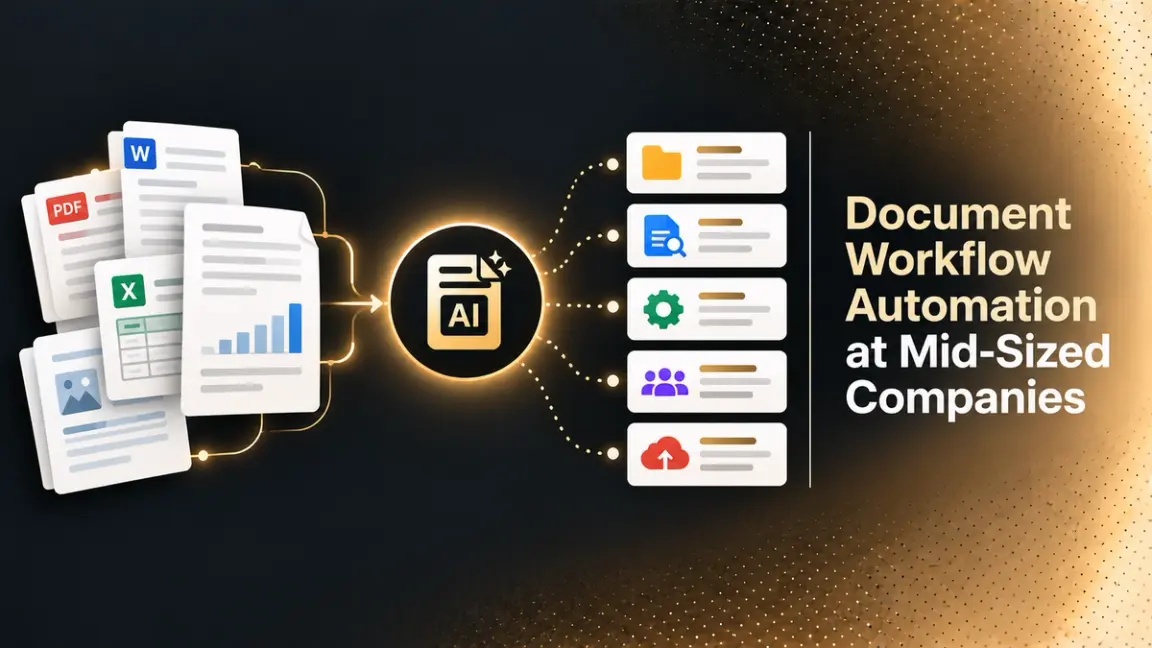
A company with 40 employees can usually get by on a shared inbox and someone's afternoon. A company with 5,000 employees has a procurement process, a security review, and a dedicated IT team to run an RFP. A company in between, roughly 250 to 1,000 employees, has neither luxury: document volume has outgrown manual handling, but there's no dedicated team to run a multi-quarter enterprise evaluation, and budget has to justify itself in months, not fiscal years. Above that range, enterprise-scale document automation software is a different category again, with its own security reviews and phased rollouts.
This is a look at how document workflow automation actually gets implemented at that size, including the path a lot of mid-sized companies take that doesn't get covered elsewhere: hiring an agency or implementation partner to handle it, rather than buying a platform outright or building something in-house. It also covers what changes for smaller teams (roughly 1–249 employees), since the right approach isn't the same at every size inside this range.
Who This Guide Is For
- Ops, finance, or RevOps leads at mid-sized companies (250–1,000 employees) who know manual document handling (invoices, contracts, onboarding paperwork) is costing real time, but don't have a dedicated automation or IT function to own the project.
- Small business owners and ops leads (1–249 employees) trying to figure out whether document automation is even worth it yet at their volume, and what "affordable" actually looks like.
- Anyone evaluating a document workflow automation agency or consultant who wants to know what that engagement actually involves before signing a statement of work.
- Marketing, creative, and agency ops teams dealing with vendor contracts, campaign approvals, and client paperwork, a document volume problem that looks different from AP or HR but follows the same underlying logic.
Small Business vs. Mid-Sized Company: What Actually Changes
"Document workflow automation" means something different depending on which side of roughly 250 employees you're on:
- Document volume and variety. A small business (1–249 employees) is usually automating one or two document types, invoices, maybe contracts, at a volume a single tool can handle out of the box. A mid-sized company (250–1,000) is more often juggling several document types across departments: AP, HR onboarding, vendor contracts, customer paperwork, each with its own format quirks.
- Who owns the decision? At a small business, it's often the owner or a single ops person picking a tool directly. At a mid-sized company, it's more often a function lead (finance, ops, or RevOps) who has to justify the spend and coordinate across whichever systems other departments already use.
- Build, buy, or hire tendency. Small businesses default to buying a self-serve tool directly, there's rarely budget or appetite for anything else. Mid-sized companies are the segment most likely to seriously consider hiring an agency or implementation partner, enough complexity to benefit from outside expertise, not enough internal engineering capacity to build it themselves.
- Integration depth. A small business is usually fine connecting one tool to one accounting system. A mid-sized company more often needs document data flowing into several systems, an ERP-lite platform, a CRM, a project management tool, which is where implementation help starts to matter more than raw tool capability.
None of this means a mid-sized company automatically needs more expensive software; often, the extraction technology itself is the same regardless of company size. What changes is how much help is needed to actually get it running. At this volume the throughput-versus-headcount math starts to matter, and scaling data capture with document AI works through it.
Three Ways Mid-Sized Companies Actually Implement This
Buying a self-serve platform. The fastest path: sign up for a tool, connect it to existing systems, and configure workflows through its UI. Works well when document types are fairly standard, and one or two systems need to connect. The limit shows up when documents are inconsistent across departments or integration needs go beyond what the platform supports natively.
Hiring a document workflow automation agency or implementation partner. This is the path most specific to mid-sized companies: enough complexity to want outside expertise, not enough internal capacity to build or extensively configure something alone. An agency in this space typically handles tool selection, configuration, integration work, and training as a packaged engagement rather than leaving a team to figure out a platform's admin panel alone.
Building on a document extraction API. For teams with some in-house technical capacity, usually a mid-sized company with even a small engineering or RevOps-technical function, building custom workflow logic on top of an extraction API gives more control over schema and integration than a fixed platform template, at the cost of more upfront engineering time.
Most mid-sized companies land on the first two. The third tends to make sense specifically when document formats are unusual enough- freight paperwork, non-standard contracts- that a general-purpose platform doesn't fit well.
How a Document Workflow Automation Agency Actually Works
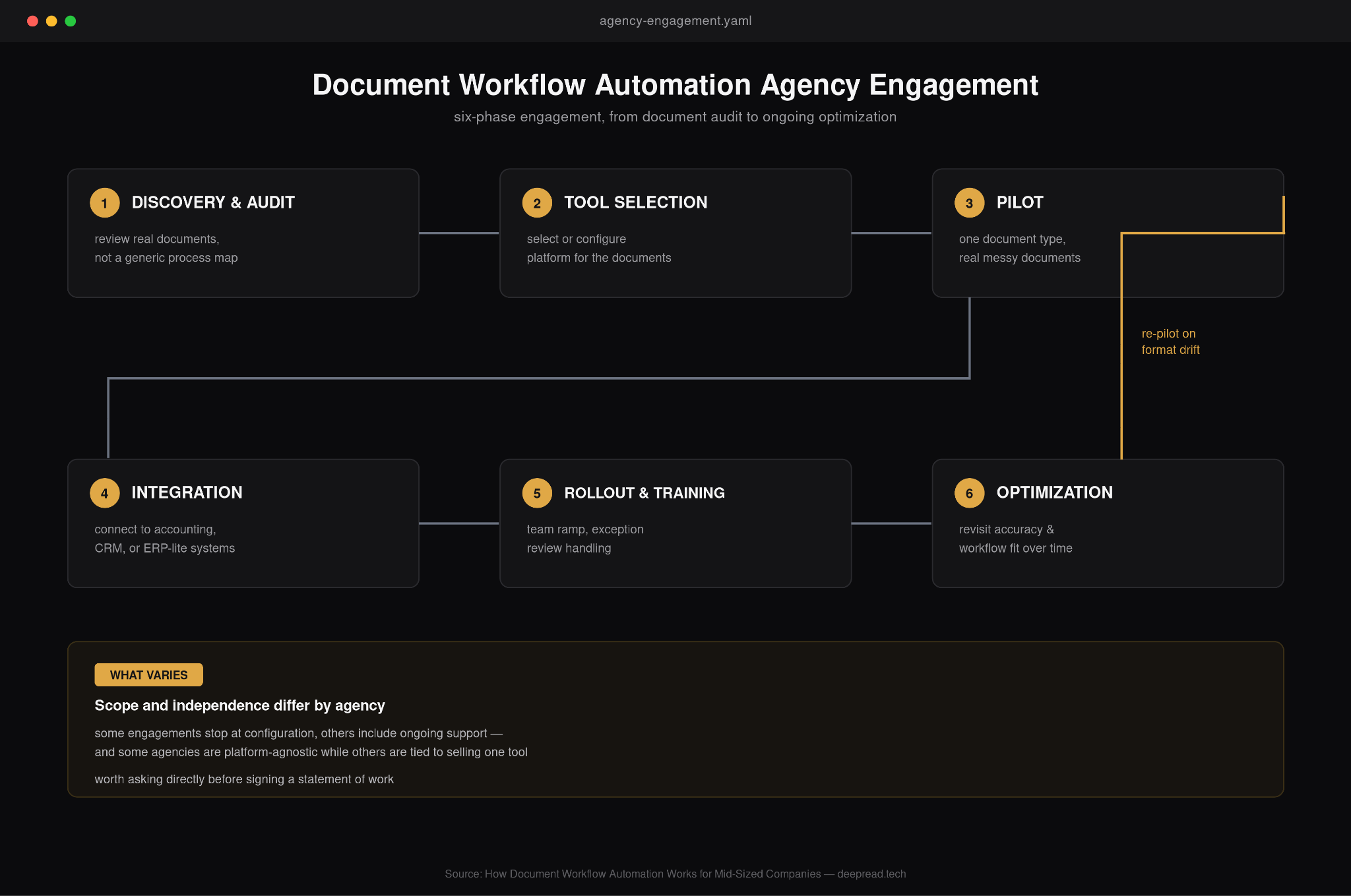
This is the part that's genuinely underexplained: what does hiring an agency or implementation partner for document workflow automation actually involve? The engagement generally runs through the same phases, regardless of which specific agency or tool is involved:
- Discovery and document audit. The agency reviews the actual documents involved- invoices, contracts, forms, not a generic description of the process- to understand format variability, volume, and where errors currently happen.
- Tool selection or configuration. Depending on the agency's model, this means either selecting a platform suited to the documents and systems involved, or configuring an existing platform the company already owns or has been pointed toward.
- A pilot on real documents. A narrow pilot, one document type, one department, before expanding scope. This is also where a reasonable agency will insist on testing against the company's actual messy documents, not a clean sample set, since that's the only way to know real accuracy before committing further.
- Integration with existing systems. Connecting the tool to accounting software, a CRM, an ERP-lite platform, or whatever the company already runs, usually the most time-consuming phase and the main reason companies hire outside help rather than self-configuring.
- Rollout and training. Getting the team that will actually use the system- AP clerks, HR, ops- comfortable with it, including how exceptions and low-confidence extractions get reviewed rather than processed blind.
- Ongoing optimization. Document formats and vendor behavior shift over time; a good engagement includes revisiting accuracy and workflow fit periodically rather than treating the rollout as a one-time project.
What varies between agencies is scope (some only configure a platform, others also handle ongoing support) and whether they're platform-agnostic or tied to selling a specific tool, worth asking directly before signing anything. The pilot-first sequence mirrors how organizations implement AI in document-heavy processes more broadly.
What This Actually Costs
Pricing in this category varies enough by path that a single number isn't useful, but the shape is fairly consistent:
- Self-serve platforms and extraction APIs are the most transparent and lowest-barrier option. Most publish free tiers or usage-based pricing directly on their sites, which is often the cheapest way for a small business or a technically capable mid-sized team to test whether automation is worth pursuing before spending anything.
- Agency and implementation engagements are typically quoted per project based on scope, number of document types, systems to integrate, and training needs, rather than published as a flat rate. Get an itemized scope before committing, not just a total number, so you know what's covered if requirements shift mid-engagement.
- Enterprise platforms with annual contracts and dedicated implementation teams exist in this category too, but they're generally priced and sold for a scale above what most 250–1,000 employee companies need, worth confirming you're not being sold enterprise scope for a mid-market problem.
The honest filter, regardless of path: ask what it costs to test accuracy on your own documents before committing to the full engagement or contract. A vendor or agency confident in the fit will make that easy.
Where This Shows Up at This Size
The specific documents differ by department, but the underlying pattern- high volume, inconsistent formats, and a real cost to doing it by hand- is the same:
- Accounts payable — vendor invoices that vary by supplier, still often keyed in by hand at this size.
- HR and onboarding — offer letters, ID verification, benefits paperwork, especially painful during hiring pushes.
- Vendor and client contracts: inconsistent formats across different counterparties, a common bottleneck for ops and legal-adjacent teams without dedicated contract software. The legal side of this is covered in AI in legal document automation.
- Marketing and agency operations — campaign briefs, vendor and freelancer contracts, client approval paperwork; for agencies and marketing-heavy mid-sized companies, the win is usually speed (fewer days lost waiting on manual approval routing) and fewer errors making it into a campaign or invoice, not a completely different category of problem than AP.
- Customer-facing paperwork — intake forms, applications, or onboarding documents, depending on the business.
What to Look for in a Tool or Agency at This Size
A few things matter more at 1–1,000 employees than they do for an enterprise buyer, and a few matter less:
- Accuracy tested on your own documents, not a demo, before committing budget either way.
- Transparent, usage-based pricing where possible; long annual contracts are harder to justify without a dedicated budget owner.
- Integration with tools you already use (QuickBooks, Xero, Google Workspace, common CRMs) rather than requiring a new core system.
- A realistic implementation timeline, weeks, not quarters, is a reasonable expectation at this size.
- Clear handling of uncertain extractions, flagged for review rather than processed silently, since a small team doesn't have the bandwidth to catch errors after the fact.
- No requirement for dedicated IT or compliance staff to operate it day to day, enterprise-grade security options are fine to have available, but shouldn't be a precondition to get started.
Why the Extraction Layer Still Decides the Outcome
However the implementation happens, agency-led, self-serve, or custom-built, the accuracy of the underlying extraction is what the rest of the workflow depends on. A platform or agency can build excellent routing and approval logic on top of extraction that's wrong often enough to matter, and the workflow just moves the error around faster.
For teams testing this directly, whether that's a small business trying it before buying anything, or an agency running a pilot before recommending a direction to a client, DeepRead is a usage-based extraction API with 2,000 free pages a month and no card required to start. Every field comes back with its own confidence score, so anything the model isn't sure about is marked needs_review instead of passed along silently, and the accuracy behind that is laid out at deepread.tech/benchmarks, checked against named competitors on shared document sets, not just stated.
Conclusion
Document workflow automation doesn't look the same at every company size, and the biggest practical difference for mid-sized companies isn't the technology; it's whether to buy a platform directly, hire an agency to handle configuration and integration, or build on an API with in-house technical capacity. Small businesses usually default to the first option by necessity; mid-sized companies are the segment most likely to genuinely benefit from the second, enough complexity to want expert help, not enough scale to need a full enterprise rollout.
Whichever path fits, the same test applies regardless of company size: confirm accuracy on your own documents, understand what happens to the ones that don't process cleanly, and get a realistic cost and timeline before committing budget to any of it.
FAQ
How do document workflow automation agencies actually work?
Most run through the same phases: a document audit to understand real volume and format variability, tool selection or configuration, a pilot on a narrow scope, integration with existing systems (accounting, CRM, or similar), rollout and training, and ongoing optimization as document formats shift over time. Scope varies by agency; some stop at configuration, others include ongoing support, worth clarifying upfront.
Is document workflow automation actually affordable for small businesses?
Yes, for the self-serve path specifically. Most extraction APIs and platforms publish usage-based pricing with a free tier, making it possible to test accuracy and fit before spending anything. Agency engagements and enterprise platforms are a different cost category, generally not the right fit for a 1–249 employee business unless document complexity genuinely requires it.
What's the real difference between automating for a 50-person company versus a 500-person company?
Mostly document variety, integration needs, and who owns the decision. A 50-person company is usually automating one document type connected to one system, picked and configured by a single person. A 500-person company more often has several document types across departments needing to connect to multiple systems, which is where outside implementation help starts to pay for itself.
Should a mid-sized company hire an agency or build it themselves?
Depends on in-house technical capacity and how standard the documents are. If formats are fairly standard and a platform fits well, an agency or self-serve platform is usually faster and cheaper than building. If documents are unusual enough that no platform template fits, teams with some engineering capacity are often better served building on an extraction API directly.
How are enterprises automating document workflows differently in 2026?
Mostly in degree, not kind: enterprises deal with multi-entity structure, deeper compliance and audit requirements, and longer procurement and implementation timelines that mid-sized companies generally don't need to plan around. The underlying extraction and workflow logic isn't fundamentally different, just the governance, integration depth, and contract terms wrapped around it.
What should I ask a document workflow automation agency before signing a contract?
Ask for an itemized scope (not just a total price), what happens if document formats or volume change mid-engagement, whether they're tied to selling a specific platform or agnostic about tooling, and whether they'll test accuracy on your actual documents before the engagement officially starts.
More articles
Automated Trade Documentation Tools: A 2026 Guide
Automated trade documentation tools compared, customs filing, export licensing, restricted-party screening, and named platforms.
Rossum Alternatives: 7 Document Processing Platforms Compared
Looking for a Rossum alternative? Compare seven document extraction platforms on price, scope, and verified features, plus what to test before you switch.