%20{%20:root%20{%20--deepread-stroke:%20%23E5E7EB;%20}%20}%20.dark%20{%20--deepread-stroke:%20%23E5E7EB;%20}%20%3c/style%3e%3crect%20x='40'%20y='30'%20width='220'%20height='260'%20rx='28'%20ry='28'%20stroke='var(--deepread-stroke)'%20stroke-width='16'%20fill='none'/%3e%3cpath%20d='M180%2030v52c0%2010%208%2018%2018%2018h62'%20stroke='var(--deepread-stroke)'%20stroke-width='16'%20fill='none'/%3e%3cline%20x1='70'%20y1='130'%20x2='200'%20y2='130'%20stroke='var(--deepread-stroke)'%20stroke-width='16'%20stroke-linecap='round'/%3e%3cline%20x1='70'%20y1='165'%20x2='200'%20y2='165'%20stroke='var(--deepread-stroke)'%20stroke-width='16'%20stroke-linecap='round'/%3e%3cline%20x1='70'%20y1='200'%20x2='170'%20y2='200'%20stroke='var(--deepread-stroke)'%20stroke-width='16'%20stroke-linecap='round'/%3e%3c!--%20green%20download%20arrow%20in%20bottom%20right%20corner%20--%3e%3cpath%20d='M210%20202v58'%20stroke='var(--deepread-accent)'%20stroke-width='18'%20stroke-linecap='round'/%3e%3cpath%20d='M195%20245l15%2015%2015-15'%20fill='none'%20stroke='var(--deepread-accent)'%20stroke-width='18'%20stroke-linecap='round'%20stroke-linejoin='round'/%3e%3c/svg%3e)
Scaling Data Capture with Document AI
How to scale document data capture without scaling headcount - classification, throughput architecture, metadata standards.

A document AI pipeline that works on a thousand documents a month and one that works on a million are not the same system. The model is usually the only part that carries over.
Teams that hit this wall tend to diagnose it as an accuracy problem, because accuracy is the number vendors publish and the thing that feels technical. It rarely is. The pipeline that fails at volume fails on unclassified inputs, timeouts, retry storms, schema drift, exception queues nobody drains, and metadata that was never designed to be queried. Those are architecture and governance problems, and no model upgrade fixes them.
The promise of document AI at scale is processing more without hiring proportionally more people. That promise is real, but it is contingent on the pipeline around the model, and the part of the system that determines whether you get it is usually the part nobody scoped. The same failure modes show up in unstructured document pipelines generally, as covered in scaling unstructured document processing.
Who This Is For
- Engineering leads and CTOs re-architecting a document pipeline that worked in pilot and is now failing under production volume.
- Operations and IT leaders carrying the business case for document automation, who need the throughput-versus-headcount arithmetic rather than a vendor promise.
- Teams whose extracted documents feed a search index, records system, or RAG pipeline, where metadata quality determines whether any of the captured data stays usable.
- Anyone adding new document types faster than their schema and validation practice can absorb them.
What "scale" actually means here
Three things scale independently, and they break different parts of the system.
Volume is documents per unit time. It breaks throughput: timeouts, rate limits, queue depth, cost.
Variety is the number of distinct document types. It breaks onboarding cadence — every new type needs a schema, possibly a trained model, and validation rules.
Variability is how much documents of the same type differ from each other. It breaks accuracy in ways averages hide. Fifty banks means fifty statement layouts, and the ones that fail will be your smallest, most annoying institutions rather than the ones you tested on.
Most teams plan for volume and get ambushed by variability. A pilot that ran on documents from your three largest partners tells you almost nothing about the long tail.
Data capture and metadata extraction are different jobs
These two terms get used interchangeably and shouldn't be. The distinction determines how you design schemas, who consumes the output, and what a failure costs.
Data capture pulls values from inside the document. Invoice total, account number, policy effective date, line items. The consumer is a business system, an ERP, a decision engine, a ledger. A wrong value produces a wrong action. Failure is expensive and immediate.
Metadata extraction describes the document itself. What type it is, when it was created, who issued it, which entity or matter it belongs to, what retention class applies, which jurisdiction governs it, what confidentiality level it carries. The consumer is a repository, a search index, a records system, or a retrieval layer feeding a model. A wrong value produces a document nobody can find, or one retained past its legal deadline. Failure is cheap individually and severe in aggregate.
Most teams build the first and neglect the second. Two years later they have twelve million extracted documents and no reliable way to answer "show me every contract governed by New York law that expires this quarter," because document type was inferred inconsistently and jurisdiction was never captured at all.
Both jobs can run off the same extraction pass. They should be designed separately.
Classification and separation come before extraction
At pilot scale, you usually know what each document is, because you uploaded it yourself into a folder named after its type. At production scale, documents arrive mixed — email attachments, scanner output, portal uploads, multi-document PDFs where a loan file contains an ID, two payslips and a bank statement in one 40-page bundle.
Extraction cannot start until three questions are answered:
- Where does one document end and the next begin? Splitting bundles is a distinct problem from reading them, and getting it wrong corrupts everything downstream — fields from document two land in document one's record.
- What type is each document? Classification determines which schema applies. A misclassification is worse than a failed extraction, because it produces a confidently populated record against the wrong template.
- Is this document processable at all? Blank pages, upside-down scans, photographs of screens, password-protected files, and duplicates all need routing to exception handling rather than into the extraction queue.
Classification should be constrained to a fixed vocabulary of known types with an explicit unknown outcome. A classifier forced to choose the nearest known type will always choose one, and "nearest" is not "correct." Unknown is a legitimate, useful answer that routes to a human; a wrong guess is neither. Automated categorization is one of the core capabilities covered in key features of AI document workflow automation.
What breaks at volume
- Synchronous calls
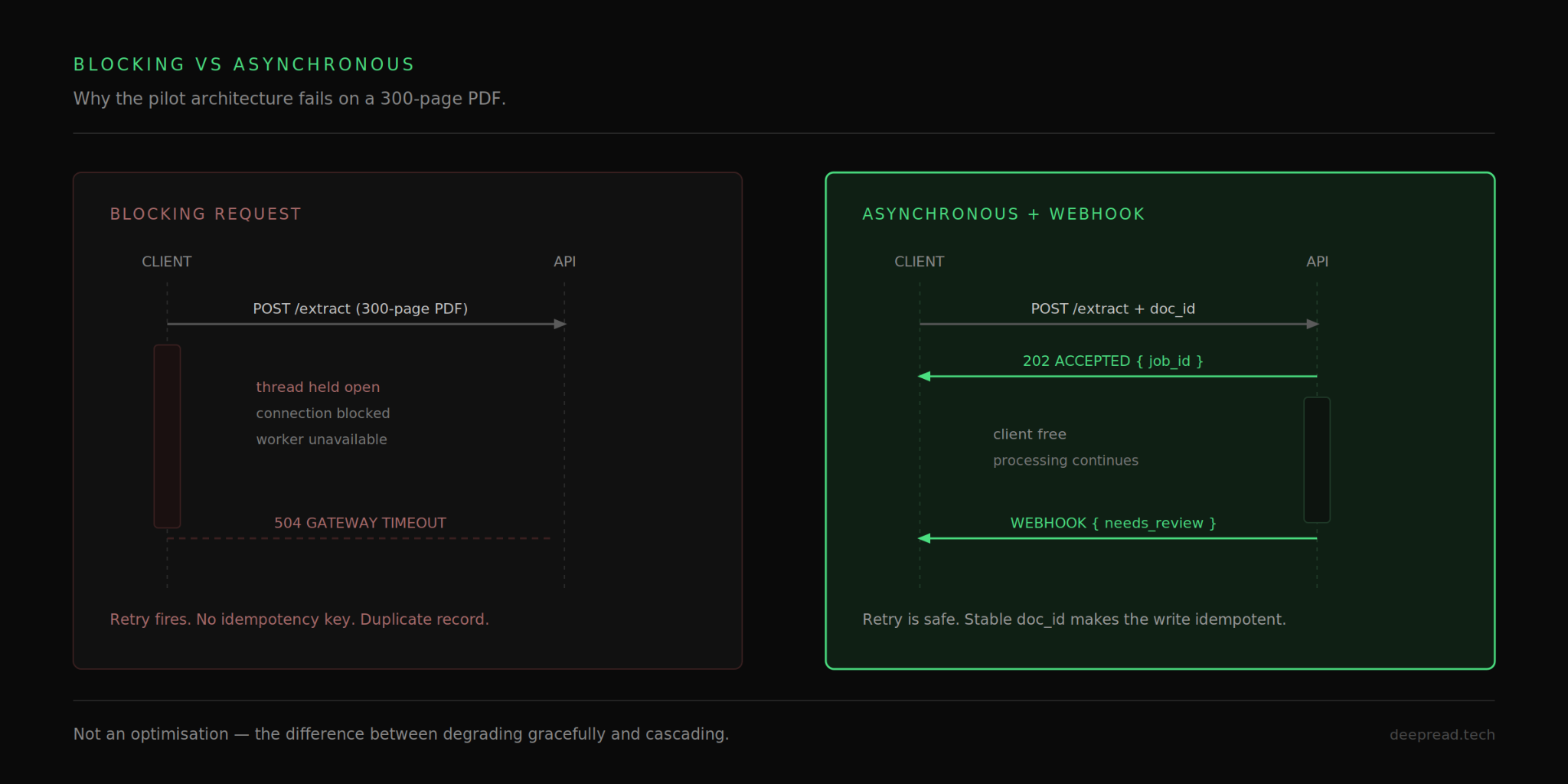
The most common pilot architecture is a blocking HTTP call: upload document, wait, receive JSON. It works fine at low volume with small files. It fails predictably in production, because a 300-page PDF takes longer to process than any reasonable HTTP timeout, and because a request-response model couples your application's availability to the processing service's latency.
The fix is asynchronous processing: submit the document, receive a job ID, get notified on completion via webhook, or poll if your network posture doesn't allow inbound calls. This is not an optimisation. It is the difference between a pipeline that degrades gracefully under load and one that cascades.
- Retries without idempotency
When a webhook delivery fails, or a worker crashes mid-job, something retries. Without idempotency keys, retries produce duplicate extractions, duplicate records, and — in financial pipelines, duplicate transactions. Assign a stable document identifier at ingestion, before any processing, and make every downstream operation idempotent against it.
- No backpressure
A batch upload of 50,000 documents at month-end will saturate your processing budget, the vendor's rate limits, or your review team. Queue depth needs to be visible and bounded, with defined behaviour when the bound is hit. "Process everything as fast as possible" is not a policy; it is the absence of one.
- Silent schema drift
A vendor changes an invoice template. A bank adds a column to its statement. Your extraction keeps returning valid JSON with a null where a value used to be, and nothing alerts, because null is a legal value.
Field-level null rates and distribution shifts need monitoring the way you monitor error rates. A field that was 99% populated last month and is 71% populated this month is an incident, even though nothing threw. This is the single most common cause of quality degradation that goes unnoticed for a quarter.
Some extraction APIs are designed around these constraints, and some aren't, and it's worth checking before you commit. DeepRead, for instance, processes asynchronously (you submit a job and poll for status on every plan, with webhook callbacks on Standard and Enterprise), so large files and batch loads don't block the caller. It takes a schema-driven approach that doesn't require training a model per document type, and it returns each field with its page, bounding box, and source text plus a review flag with a reason, so uncertain values come back marked needs_review rather than as silent nulls. It doesn't return a numeric confidence score. Its changelog describes reading an incomplete model reply again instead of letting it turn into silent nulls. Page limits per document are 50 on Free, 1,000 on Standard, and 2,000 on Enterprise, and a longer document is refused up front with a 400 page_count_exceeded error instead of failing mid-job; the details are on its pricing page. It handles the capture layer only; everything in the metadata and governance sections below sits outside its scope.
The economics: Scaling volume without scaling headcount
This is the actual business case, and it is worth doing the arithmetic honestly rather than assuming automation removes people from the process.
Document AI does not eliminate human involvement. It changes what humans do, from keying every document to adjudicating the subset the system is unsure about. Whether that is a good trade depends entirely on numbers you control.
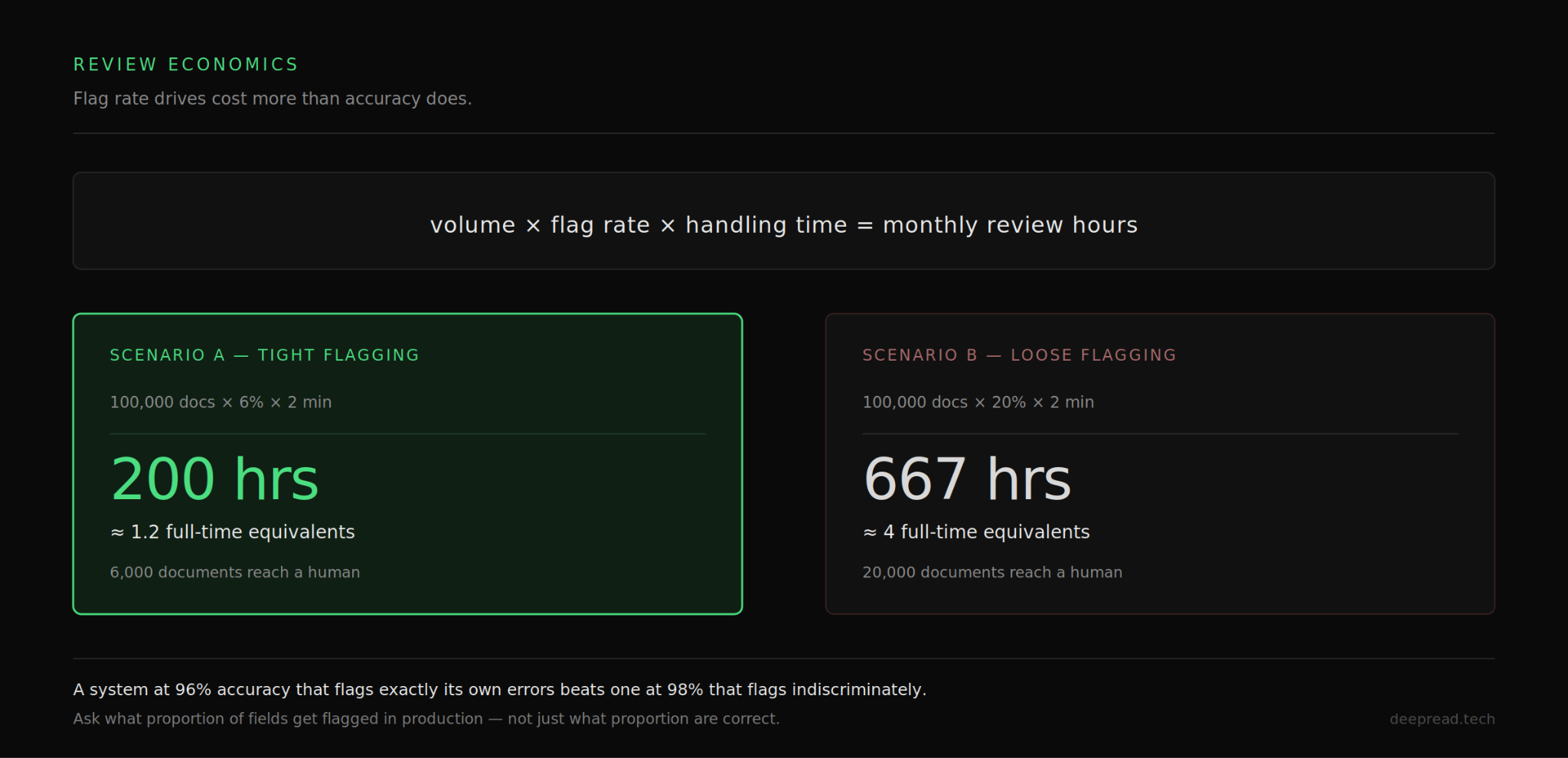
The governing equation is straightforward. Monthly review hours equal volume, times flag rate, times average handling time. At 100,000 documents a month with a 6% flag rate and two minutes per exception, that is roughly 200 hours, about 1.2 full-time equivalents. At a 20% flag rate, it is four FTEs and the business case starts to wobble.
Three consequences follow.
Flag rate matters more than accuracy. A system at 96% accuracy that flags exactly the 4% it got wrong is operationally excellent. A system at 98% accuracy that flags 25% of documents indiscriminately costs you six times the review labour. Ask vendors what proportion of fields get flagged in production, not just what proportion are correct.
Review capacity is a hard constraint, not a variable. Size it before launch. If projected review volume exceeds the team you have, adjust confidence thresholds deliberately and accept a known error rate, rather than letting a backlog accumulate until someone declares bankruptcy on it and bulk-approves the queue. That moment arrives in most under-planned pipelines within about six months.
Validation is cheaper than review. Deterministic rules catch a meaningful share of errors before any human is involved: line items that don't sum to the invoice total, a date of birth in the future, a routing number failing checksum, a policy end date preceding its start date. Every error caught here is one that never consumes review time. This layer costs days to build and is the highest-return component in the pipeline.
The honest version of the headcount claim is not "automation removes the team." It is that volume and staffing stop being coupled; you can triple throughput without tripling the ops function, provided flag rate and validation are engineered rather than inherited. The full set of formulas and baselines for building this case is in document workflow automation ROI metrics.
Designing the extraction schema
At scale, the schema is the contract between the document layer and everything downstream. Treat it with the discipline of a database migration. How schema-driven extraction works is covered in structured data extraction.
Version it explicitly. Every extraction result should carry the schema version that produced it. Without this, you cannot tell whether a field is missing because the document lacked it or because it was extracted before that field existed.
Distinguish absent from unextracted. null because the document genuinely has no PO number is a different state from null because extraction failed. Collapsing them destroys your ability to measure quality later.
Keep required fields genuinely required. If a field is marked required and the system fills it with a guess to satisfy the schema, you have built a machine that manufactures plausible wrong answers. Prefer explicit nulls with confidence scores over forced completeness.
Prefer additive changes. Adding an optional field is safe. Renaming, retyping, or repurposing a field breaks every consumer that reads it. When a breaking change is unavoidable, run both versions in parallel through a migration window.
One architectural question is worth resolving early: whether adding a new document type requires training a model. Systems that need per-type training add a data collection and labelling step to every expansion, fine if your document types are stable, painful if they aren't.
Schema-driven systems, where you define the fields you want and extraction adapts, shift that cost from labelling to schema design. Neither is universally better, but the answer sets how quickly you can onboard a new type, and at scale that cadence matters more than a point of accuracy.
Metadata standards that make automation reliable
This is the part teams skip, and the reason document repositories become unsearchable.
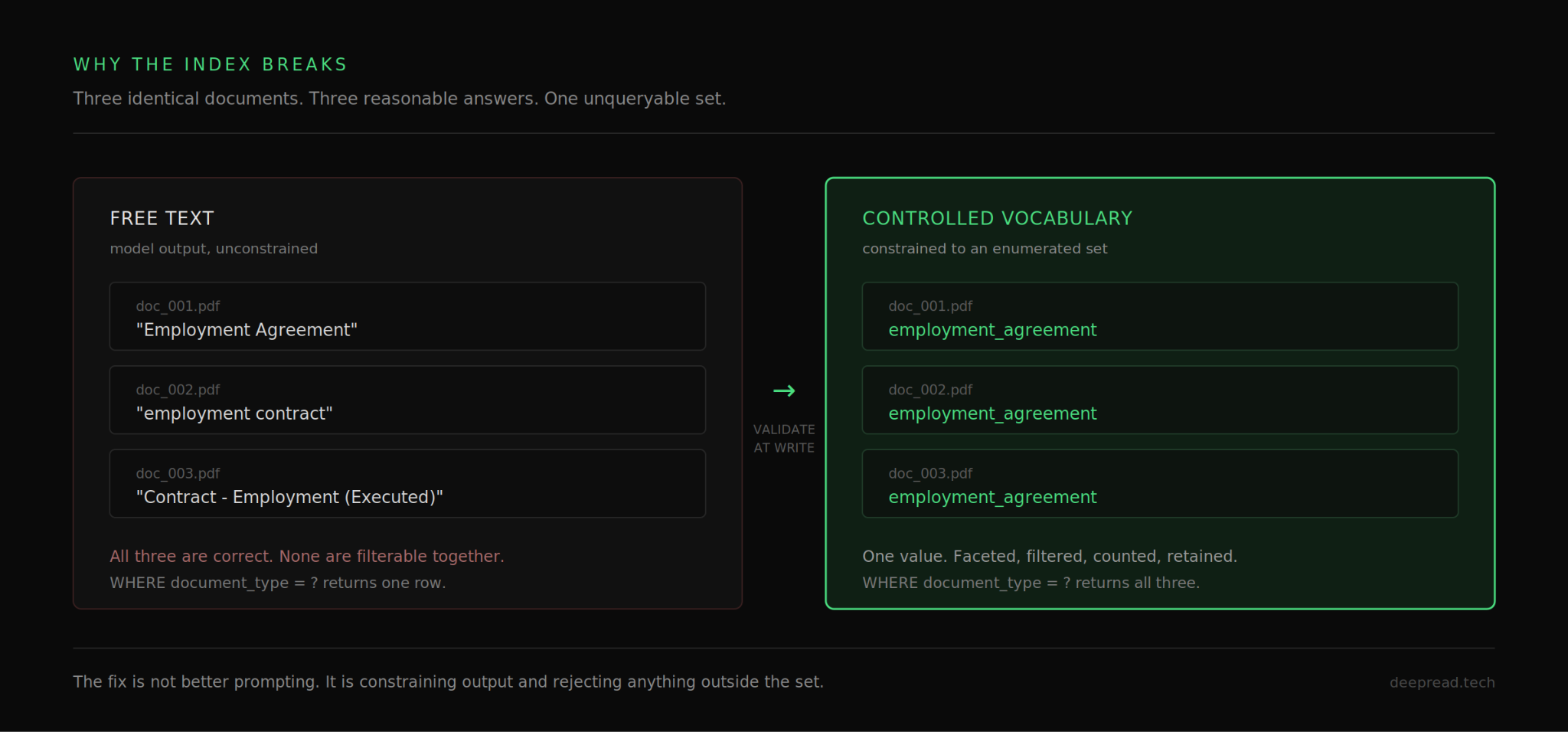
The core problem: AI-generated metadata is free text by default. Ask a model to classify a document, and it returns "Employment Agreement" for one file, "employment contract" for the next, and "Contract - Employment (Executed)" for a third. All three are reasonable. None are queryable as a set. At a thousand documents, this is an annoyance. At a million, it is an unusable index.
The fix is not better prompting. It is constraining output to a controlled vocabulary and validating against it.
Start from an established element set
Dublin Core is the most widely used base. It establishes fifteen core elements for cross-domain resource description — title, creator, subject, description, publisher, date, rights and others, maintained by the Dublin Core Metadata Initiative and standardised as ISO 15836-1:2017. Its deliberate limitation is that it provides no implementation guidelines; the elements are meant to be used within an application profile that constrains them for a specific context.
That application profile is the thing you actually have to design, and it is where the value sits. Dublin Core gives you the shape. Your profile specifies that the document type must be drawn from your fifteen-value list, that the date refers to execution date rather than upload date, and that rights map to your three confidentiality tiers.
Add records management metadata where retention matters
If documents are records, anything subject to retention schedules, legal hold, or regulatory audit, descriptive metadata alone is insufficient. ISO 23081 covers metadata for managing records. Its framework is designed to enable standardised description of records and their contextual entities, and to support interoperability of records between organisational systems over time.
The practical implication: capture not just what the document says but its context of creation and custody, who sent it, when, through which channel, under what authority, and what happens at end of life. Document AI can populate some of this from content. The rest comes from the ingestion pipeline, which means the pipeline has to record it rather than discard it.
Catalogue centrally, and record lineage
Metadata scattered across the systems that happened to generate it cannot support search, audit, or retention enforcement. A central catalogue gives you one place to answer questions about what you hold, where it came from, who owns it, and what quality it is.
Lineage is the part most often missing. For any given field value, you should be able to reconstruct: which document it came from, which extraction run produced it, under which schema version, at what confidence, and whether a human subsequently corrected it. This is what separates an index that survives an audit from one that merely contains data.
Metadata is what makes retrieval work
If extracted documents feed a RAG pipeline or any AI assistant, metadata stops being a filing concern and becomes a correctness concern. Semantic search over a large document set returns plausible passages from the wrong document with no difficulty at all. Metadata filters — restrict to this entity, this document type, this date range, this jurisdiction, exclude superseded versions- are what constrain retrieval to the right candidate set before ranking ever happens.
Retrieval quality over a large corpus is usually bounded by metadata quality rather than by embedding quality. Teams tune chunk sizes and rerankers for weeks when the actual problem is that half the corpus has no reliable document type and no effective date.
Best practices that hold up at volume
- Controlled vocabularies over free text for any field you will filter or facet on. Enumerate allowed values and reject anything outside the set.
- Validate at write time, not at read time. A malformed value that reaches the index costs far more to fix than one rejected at ingestion.
- Normalise formats aggressively. Dates to ISO 8601, currencies to ISO 4217, country codes to ISO 3166. Models will happily return "March 3rd, 2026" and "03/03/26" from two documents that mean the same thing.
- Record provenance per field. Which extraction produced this value, at what confidence, under which schema version.
- Separate inferred from asserted. Metadata a model guessed, and metadata a human or authoritative system supplied should never be indistinguishable in storage.
- Embed as well as index. Metadata held only in an external database detaches the moment a file is copied, exported, or migrated. Embedding in the file itself — XMP is the common mechanism for PDFs and images- keeps description and object together.
- Design for the query you will run, not the fields the document contains. Start from the questions the repository must answer in two years and work backwards.
A reference shape
A capture pipeline that survives volume usually looks like this:
- Ingest — assign a stable document ID, capture provenance (source, channel, timestamp, submitting entity) before any processing
- Split — separate bundled documents into individual records
- Classify — determine type against a controlled vocabulary, route unknown to exception handling rather than guessing
- Extract — submit asynchronously against a versioned schema for that type; receive structured fields plus per-field confidence
- Validate — schema conformance, vocabulary membership, format normalisation, cross-field arithmetic and logic checks
- Route — high confidence to downstream systems, low confidence to a bounded review queue
- Index — write content data and document metadata together, with provenance and schema version attached
- Monitor — field-level null rates, confidence distributions, queue depth, review throughput, per-type accuracy sampling
Steps 2 and 5 are the ones most often missing, and both are cheap relative to what they prevent.
Conclusion
Scaling document AI is mostly not a modelling problem. It is splitting and classifying before extracting, asynchronous processing so large jobs don't block, idempotency so retries don't duplicate, versioned schemas so consumers don't break silently, validation rules that catch errors before humans do, controlled vocabularies so the index stays queryable, and field-level monitoring so degradation surfaces as an alert.
The metadata layer pays back slowest and matters longest. Documents captured without consistent, validated, provenance-tagged metadata are documents you will re-process later, under time pressure, at greater cost than doing it properly the first time.
FAQ
What is the difference between data capture and metadata extraction?
Data capture pulls values from inside the document for use by business systems. Metadata extraction describes the document itself — type, date, source, retention class — for use by repositories, search, and retrieval. They come from the same processing pass but serve different consumers and need separate schema design.
How do companies automate metadata extraction from documents?
The reliable pattern constrains output to a controlled vocabulary rather than accepting free text. Define an application profile over an established element set such as Dublin Core, enumerate allowed values for every filterable field, validate at write time, normalise formats to standards, and record provenance and confidence per field so the index stays auditable.
Which document metadata standards should we follow?
Dublin Core (ISO 15836-1) is the common base for descriptive metadata. ISO 23081 applies where documents are records subject to retention or audit. Neither prescribes implementation, so the substantive work is defining an application profile that constrains them for your context.
What is the main bottleneck when scaling document AI?
Rarely model accuracy. More often it is unclassified or bundled inputs reaching extraction, synchronous architecture that times out on large files, exception queues sized beyond available review capacity, and schema changes that break downstream consumers silently.
Does document AI reduce headcount?
It decouples volume from staffing rather than eliminating the function. Humans move from keying every document to adjudicating flagged exceptions. Whether that produces savings depends on flag rate, validation coverage, and handling time — calculate it before committing to a business case.
How much human review should we plan for?
Multiply expected flag rate by monthly volume by average handling time. If the result exceeds available capacity, adjust thresholds deliberately rather than allowing a backlog to accumulate.
More articles
Document Workflow Automation at Mid-Sized Companies: Agencies, Platforms, and What Actually Changes by Size
How document workflow automation actually works for companies with 250–1,000 employees, including how implementation agencies operate.
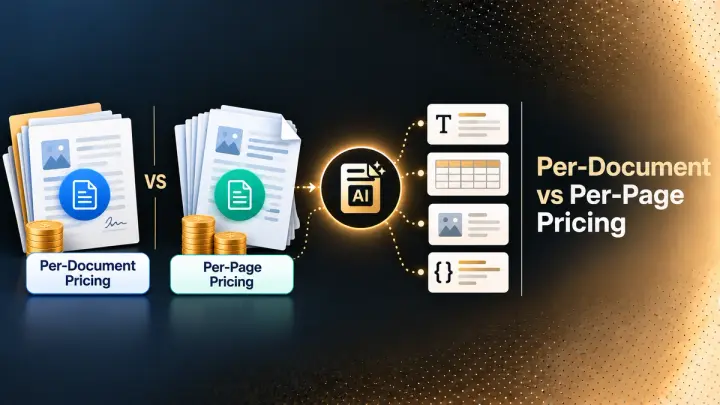
Per-Document vs Per-Page Pricing in AI Extraction Services (2026)
Per-document vs per-page pricing for AI extraction: Google Document AI 2026 invoice and form parser rates, per-document vendors, and cost-by-length math.