%20{%20:root%20{%20--deepread-stroke:%20%23E5E7EB;%20}%20}%20.dark%20{%20--deepread-stroke:%20%23E5E7EB;%20}%20%3c/style%3e%3crect%20x='40'%20y='30'%20width='220'%20height='260'%20rx='28'%20ry='28'%20stroke='var(--deepread-stroke)'%20stroke-width='16'%20fill='none'/%3e%3cpath%20d='M180%2030v52c0%2010%208%2018%2018%2018h62'%20stroke='var(--deepread-stroke)'%20stroke-width='16'%20fill='none'/%3e%3cline%20x1='70'%20y1='130'%20x2='200'%20y2='130'%20stroke='var(--deepread-stroke)'%20stroke-width='16'%20stroke-linecap='round'/%3e%3cline%20x1='70'%20y1='165'%20x2='200'%20y2='165'%20stroke='var(--deepread-stroke)'%20stroke-width='16'%20stroke-linecap='round'/%3e%3cline%20x1='70'%20y1='200'%20x2='170'%20y2='200'%20stroke='var(--deepread-stroke)'%20stroke-width='16'%20stroke-linecap='round'/%3e%3c!--%20green%20download%20arrow%20in%20bottom%20right%20corner%20--%3e%3cpath%20d='M210%20202v58'%20stroke='var(--deepread-accent)'%20stroke-width='18'%20stroke-linecap='round'/%3e%3cpath%20d='M195%20245l15%2015%2015-15'%20fill='none'%20stroke='var(--deepread-accent)'%20stroke-width='18'%20stroke-linecap='round'%20stroke-linejoin='round'/%3e%3c/svg%3e)
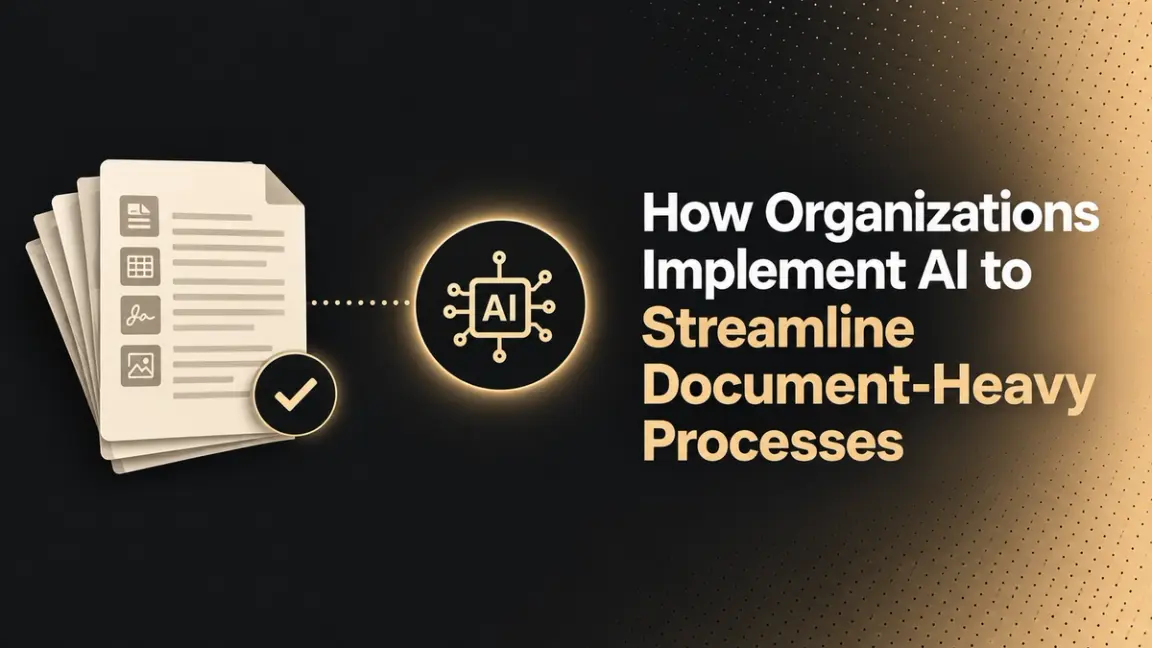
How Organizations Implement AI to Streamline Document-Heavy Processes
How organizations actually implement AI to streamline document-heavy processes - the real adoption gap, phased rollout, and what works.
Adoption and successful implementation are two different things, and the gap between them is larger than most AI coverage acknowledges. McKinsey's own 2025 Global Survey — 1,993 respondents surveyed between June and July 2025- found that 88% of organizations now use AI in at least one business function, up from 78% the year before. But only about 7% report AI fully scaled across their organization, with roughly a third having begun to scale at all. The rest remain in pilot or experimentation phases.
This is a guide to how organizations actually move past that gap for document-heavy processes specifically, the phased approach that works, the organizational obstacles that stall most implementations (not the technical ones), and real, verified examples of what successful implementation looks like.
Who This Is For
- Operations and IT leaders planning an AI implementation for document-heavy workflows, not just evaluating a tool.
- Executives sponsoring an AI initiative who need to understand why most pilots stall before reaching scale.
- Teams that already piloted AI document processing and are trying to understand why it hasn't produced the expected impact.
The Real Differentiator Isn't the Technology
Worth stating this plainly before anything else, since it reframes the whole implementation question: McKinsey's own 2025 State of AI research found that organizations achieving meaningful financial impact from AI (measured by EBIT contribution) are nearly three times more likely to have redesigned their actual workflows around AI capabilities than typical organizations. The tools themselves—the extraction engine, the OCR accuracy, the model choice —matter less than whether the surrounding process was rebuilt to use AI output, rather than AI being bolted onto an unchanged manual process.
A separate data point reinforces the same conclusion from another direction: IBM's own Institute for Business Value research found 92% of executives agreed their organization's workflows would be digitized and AI-enabled by 2025. The expectation was directionally right — near-universal digitization did happen. What didn't follow automatically was scaled impact, which is exactly McKinsey's finding: broad use, narrow depth.
This matters specifically for document-heavy workflows because they're often where organizations start their AI journey. This spans genuinely different document types and use cases across departments — structured forms and invoices alongside unstructured emails and correspondence, with specialized models increasingly handling multilingual content for organizations with cross-border operations.
That range is part of why document-heavy processes show up as a starting point across such different functions: HR onboarding (offer letters, tax forms, benefit enrollments), customer onboarding and KYC, contract lifecycle management, and audit documentation all fall under the same broad category despite looking like unrelated initiatives. But starting there doesn't guarantee success if the implementation stops at "we automated the extraction step" without redesigning what happens to the data afterward.
A Phased Approach That Actually Works
- Start with one high-impact, well-defined process — not a company-wide rollout. A specific document type and workflow, chosen for volume and clear ROI measurement potential, not the most technically impressive use case available. Include a concrete ROI calculation from the start, not just directional confidence: (Annual Cost Savings + Productivity Gains – Automation Investment) ÷ Automation Investment × 100. Having this number before you begin, and re-measuring it after the pilot, is what actually supports the case for expanding — a vague "this seemed to help" doesn't survive budget scrutiny at the scaling decision point.
- Redesign the surrounding workflow, not just the extraction step. This is the piece most implementations skip, and it's precisely the gap McKinsey's research identifies as the real differentiator — automating data capture without changing what happens to that data downstream captures a fraction of the available value.
- Involve IT, compliance, and the actual business users early, not sequentially. Cross-functional planning from the start avoids the common failure mode of a technically successful pilot that stalls because operational or compliance requirements were discovered too late.
- Measure both technical and organizational outcomes. Processing speed and accuracy are necessary but not sufficient — track adoption, user satisfaction, and whether the redesigned workflow is actually being used as intended, not just whether the technology works in isolation.
- Expand deliberately, using pilot learnings, rather than assuming what worked for one document type or department transfers automatically to the next.
On timelines: these vary meaningfully by complexity, and it's worth setting that expectation upfront rather than assuming a single rollout speed. Simple, well-defined workflows can go live within weeks; complex, cross-system use cases spanning multiple departments or legacy integrations take considerably longer. Cloud-based platforms specifically tend to support a genuine "start small, expand over time" pattern, which is part of why the phased approach above is realistic rather than aspirational.
Common Implementation Obstacles, and What Actually Addresses Them
- Legacy system integration. Older systems weren't built to connect with modern AI tools directly. What helps: middleware, APIs, or a phased migration approach that connects old and new systems incrementally rather than requiring a full legacy replacement before AI can be introduced at all.
- User resistance and change fatigue. Employees who've been through prior "transformation" initiatives that fizzled are reasonably skeptical of the next one. What helps: early, honest communication, visible leadership support (not just a memo), and actually involving affected teams in pilot feedback rather than presenting a finished system for adoption.
- Data quality and silos. AI automation applied to inconsistent, siloed, or poor-quality source data just automates the inconsistency faster. What helps: data cleansing before deployment, not after, plus ongoing data governance rather than a one-time cleanup treated as sufficient.
- Compliance and security review, treated as an afterthought. Document-heavy processes routinely involve financial, legal, or personal data, and a security or compliance review discovered late in a pilot can stall it entirely. What helps: involving compliance from the start (already named as a principle above) specifically around encryption, access controls, audit logging, and any industry- or region-specific requirements — the same standards a document automation tool itself should be evaluated against.
- Stalling in pilot mode indefinitely. A pilot is a controlled experiment; scaling means operating in real, messier conditions. What helps: defining upfront what "ready to scale" actually looks like, specific success criteria, not an open-ended pilot that never graduates.
Real Implementation Examples
Coca-Cola Beverages Florida, using Nintex's AI-enhanced workflow tools, automated document approvals and compliance reporting, reportedly resulting in a 60% reduction in process cycle times and a significant drop in administrative overhead. Worth noting this is reported via a third-party industry write-up rather than a primary case study published directly by Coca-Cola Beverages Florida or Nintex, directionally credible, not independently verified at the level of detail a primary source would provide.
Deloitte implemented an NLP-based solution to streamline audit documentation and compliance checks, using the models to automatically extract and summarize key information from large audit files — reported to improve review accuracy and reduce manual effort. Same sourcing caveat applies: this is reported secondhand, not from Deloitte's own published case study.
IBM Consulting's DocuFlow-AI, built with AWS and listed on AWS Marketplace, is a more concretely verifiable example of what a modern implementation actually looks like: an agentic AI solution where business subject-matter experts configure what to extract, how to validate it, and what actions to take, using plain language rather than rigid templates or custom code. It's built specifically for complex, mixed document-type workflows (invoices, contracts, claims, statements, onboarding forms) and is designed to scale either as a standalone application or as a pipeline embedded in other business systems.
This is a useful concrete illustration of the "redesign the workflow, not just the extraction" principle in practice — business users configuring workflow logic directly, rather than IT building a narrow, single-purpose automation.
Where Error Reduction Fits
Reduced errors are a genuine, real benefit of document-heavy AI implementation — but the mechanics of how AI actually reduces different categories of error (data entry mistakes, misfiling, misrouting, compliance failures) are covered in depth in our two companion guides: how automation reduces data entry errors and how AI minimizes human error across document handling more broadly.
Rather than repeat that mechanism-level detail here, the implementation-relevant point is this: error reduction is one of several outcomes that depends on the same workflow-redesign principle covered above — a validation step bolted onto an otherwise-unchanged manual process catches fewer errors than one designed as part of a genuinely redesigned workflow from the start.
Conclusion
The gap between AI adoption and AI impact is real and well-documented — 88% of organizations use AI somewhere, but only a small fraction have scaled it meaningfully, and McKinsey's own research points to workflow redesign, not tool selection, as the actual differentiator.
For document-heavy processes specifically, that means the implementation question isn't "which extraction tool is most accurate" so much as "has the surrounding process actually been rebuilt to use AI output, with cross-functional involvement, clear success criteria, realistic timeline expectations, and a plan for the organizational obstacles (legacy integration, change resistance, data quality, compliance review) that stall most initiatives before technology ever becomes the limiting factor."
FAQ
Why do most AI implementations for document processing stall before reaching scale?
McKinsey's research points to organizational factors, not technical ones: workflows that were never redesigned to use AI output, insufficient cross-functional planning; and lack of clear stakeholder ownership are more common causes of stalled implementations than the underlying technology being inadequate.
What percentage of organizations have actually scaled AI successfully?
Per McKinsey's 2025 Global Survey, 88% of organizations use AI in at least one business function, but only about 7% report it fully scaled across the organization — a significant gap between broad adoption and genuine enterprise-wide deployment.
What's the single biggest factor separating organizations that get real value from AI?
Workflow redesign. McKinsey found that organizations achieving meaningful EBIT impact from AI are nearly three times more likely to have redesigned their actual workflows around AI capabilities than typical organizations — more predictive than which specific tools or models they use.
How do I calculate ROI for a document processing AI pilot?
(Annual Cost Savings + Productivity Gains – Automation Investment) ÷ Automation Investment × 100. Calculating this before the pilot and re-measuring after gives you a concrete number to support (or reconsider) a scaling decision, rather than a vague sense that automation "seemed to help."
How long does an AI document processing implementation actually take?
It varies significantly by complexity, simple, well-defined workflows can go live within weeks, while complex use cases spanning multiple systems or departments take considerably longer. Cloud-based platforms tend to support a genuine start-small, expand-over-time approach rather than requiring a single large rollout.
Should we start with a company-wide AI rollout or a narrow pilot?
A narrow pilot on one high-impact, well-defined process, chosen for measurable ROI potential rather than technical impressiveness, the research consistently shows phased rollouts with clear success criteria outperform broad, simultaneous deployments.
How is this different from your guide on reducing document handling errors?
This guide focuses on organizational implementation, how to actually roll out AI successfully across a process, department, or organization. The error-reduction guides focus on the specific technical mechanisms (confidence scoring, validation rules) that reduce different categories of document error. They're complementary, not duplicates.
More articles
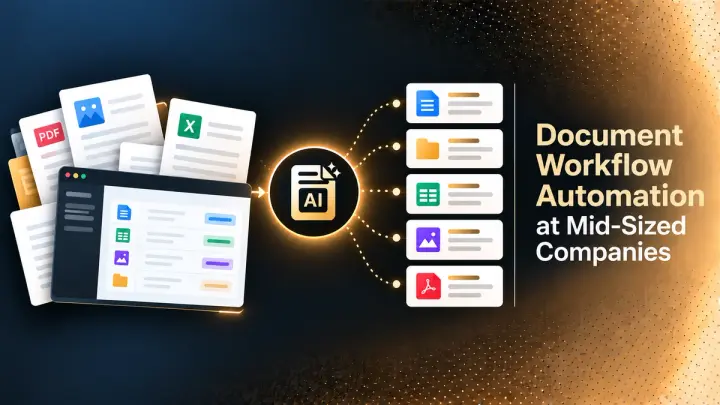
Document Workflow Automation at Mid-Sized Companies: Agencies, Platforms, and What Actually Changes by Size
How document workflow automation actually works for companies with 250–1,000 employees, including how implementation agencies operate.
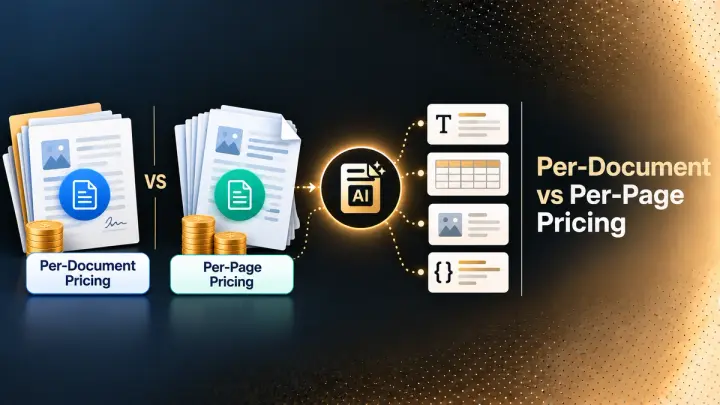
Per-Document vs Per-Page Pricing in AI Extraction Services (2026)
Per-document vs per-page pricing for AI extraction: Google Document AI 2026 invoice and form parser rates, per-document vendors, and cost-by-length math.