%20{%20:root%20{%20--deepread-stroke:%20%23E5E7EB;%20}%20}%20.dark%20{%20--deepread-stroke:%20%23E5E7EB;%20}%20%3c/style%3e%3crect%20x='40'%20y='30'%20width='220'%20height='260'%20rx='28'%20ry='28'%20stroke='var(--deepread-stroke)'%20stroke-width='16'%20fill='none'/%3e%3cpath%20d='M180%2030v52c0%2010%208%2018%2018%2018h62'%20stroke='var(--deepread-stroke)'%20stroke-width='16'%20fill='none'/%3e%3cline%20x1='70'%20y1='130'%20x2='200'%20y2='130'%20stroke='var(--deepread-stroke)'%20stroke-width='16'%20stroke-linecap='round'/%3e%3cline%20x1='70'%20y1='165'%20x2='200'%20y2='165'%20stroke='var(--deepread-stroke)'%20stroke-width='16'%20stroke-linecap='round'/%3e%3cline%20x1='70'%20y1='200'%20x2='170'%20y2='200'%20stroke='var(--deepread-stroke)'%20stroke-width='16'%20stroke-linecap='round'/%3e%3c!--%20green%20download%20arrow%20in%20bottom%20right%20corner%20--%3e%3cpath%20d='M210%20202v58'%20stroke='var(--deepread-accent)'%20stroke-width='18'%20stroke-linecap='round'/%3e%3cpath%20d='M195%20245l15%2015%2015-15'%20fill='none'%20stroke='var(--deepread-accent)'%20stroke-width='18'%20stroke-linecap='round'%20stroke-linejoin='round'/%3e%3c/svg%3e)
Invoice OCR with Machine Learning: A Technical Guide
Invoice OCR with machine learning explained: key information extraction, graph neural networks, layout variety, and named benchmarks.
Invoice OCR with machine learning is actually two distinct problems stacked on top of each other. The first is recognition: reading the characters on the page. The second, and the harder one, is key information extraction: understanding which recognized text is a value, which field it belongs to, and how it relates to everything else on the invoice. This guide is about the second problem, since it's where most invoice extraction research and engineering effort actually goes.
The recognition layer itself, how CNNs, LSTMs, and transformers read characters off a page, is covered in machine learning algorithms for OCR. This piece picks up from there.
Who This Is For
- ML engineers and researchers building or evaluating invoice extraction systems, not just OCR text recognition.
- Developers comparing invoice OCR vendors who want to understand what's actually happening underneath an accuracy percentage.
- Anyone who's read a key information extraction paper and wants the model families explained plainly.
Why Key Information Extraction From Invoices Is Genuinely Hard
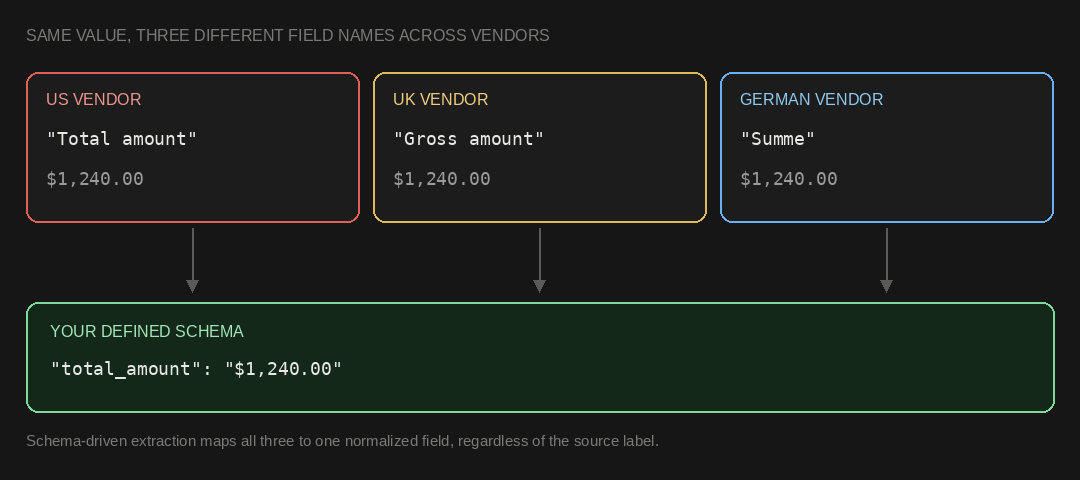
An invoice presents most of its important information as key-value pairs: a label and a value, positioned somewhere on the page. Reading the text correctly doesn't tell you which label goes with which value, or which field a given value represents.
- Layout carries meaning that plain text loses. A total sitting in the bottom-right corner, in a specific position relative to a subtotal and tax line, is meaningful because of where it sits, not just what it says. Flatten an invoice into a single stream of text and that positional information disappears.
- Format varies enormously by vendor. There's no shared template across invoices from different companies, unlike a standardized form.
- The same field gets named differently across vendors and languages. A total amount field might be labeled "Total amount" on one invoice, "Gross amount" on another, and "Summe" on a German invoice, all representing the same underlying concept. A system extracting raw key-value pairs without semantic mapping returns three different field names for the same thing. The usual fix is to define the output schema up front so every variant maps to one field.
- Extraction without context is unreliable. Some OCR pipelines struggle to correctly interpret an extracted value without understanding the surrounding context it appeared in.
One figure circulating in vendor content claims manual invoice processing takes 17 days on average, expressed oddly as "75% of a month." That framing, and the fact that no other source in this research corroborates a figure anywhere near it, is enough reason to leave it out entirely rather than repeat it.
How the Field's Thinking Evolved
Worth understanding the actual research lineage, since each generation of approach solved a real limitation in the one before it:
Sequence-based NER (treating invoice text as one-dimensional)
An early approach, CloudScan, modeled key information extraction as a named entity recognition problem, concatenating all invoice text into a single one-dimensional sequence and classifying entities within it, without using the two-dimensional spatial layout of the page at all. This worked for some fields but discarded exactly the positional information that makes an invoice readable to a human in the first place. A related early approach specifically combined word-level BiLSTM sequence modeling with an ensemble of visual and textual features, rather than relying on text alone, an intermediate step between pure sequence-based NER and the fully spatial, graph-based approaches that followed.
Object detection
A different early approach treated field extraction as an object detection problem, borrowing directly from computer vision. Deep convolutional networks originally built for detecting objects in photos (Faster R-CNN, SSD, and their variants) were applied to locate and classify regions of an invoice image, then a separate step used natural language processing to work out key-value relationships between the detected text.
Graph neural networks (bringing spatial layout back in)
This is the approach most current systems build on. Graph convolutional networks (GCNs) represent an invoice as a graph rather than flat text or isolated detected regions: each word or text line becomes a node, and edges connect each node to its nearest neighbors (left, right, top, bottom) with the relative distance between them. This preserves exactly the spatial relationship information the sequence-based approach discarded, letting the model learn that a value sitting directly to the right of a label is likely that label's corresponding value, the same way a human reads the layout intuitively.
Nanonets' own technical explanation of this approach is a genuinely clear reference: transforming a document image into a graph, annotating key fields (company name, date, address, total) as key-value pairs, and letting the graph structure carry the spatial reasoning a flat sequence model can't. A separately named model, CUTIE (Convolutional Universal Text Information Extractor), took a related but architecturally distinct approach, applying convolutional networks directly to a document's structure to extract key information, part of the same broader shift away from treating invoice text as a flat, one-dimensional sequence.
Multi-modal transformers
More recent approaches (ViBERTgrid is one named example) combine visual and textual representations jointly in a single 2D document representation, rather than processing layout and text as separate stages. This reflects the same underlying insight as graph-based approaches, layout and content need to be understood together, implemented through a different architecture.
Current hybrid systems
The most recent published research names its components separately rather than treating "deep learning" as one undifferentiated layer: OCR for text recognition, convolutional networks specifically for table detection, graph-based reasoning for spatial relationships, and large language models specifically assigned to entity extraction and cross-vendor terminology mapping, resolving exactly the "Gross amount" versus "Summe" problem described above by reasoning about what a field means rather than just where it sits.
One recent paper reports its OCR layer reaching 92-95% character accuracy across varied invoice templates, with the deep learning and graph layers specifically improving table detection and key-value pair extraction on top of that. Table detection matters most for the line-item rows, which are a problem of their own; approaches to invoice line-item extraction cover them in more depth.
The Problem Most Benchmarks Miss: Layout Variety
Worth flagging directly, since it's a specific, documented gap in the research: graph-based approaches were largely validated on datasets with low variety in invoice layout, meaning most published results describe how well a model performs when invoices are reasonably similar to each other. One paper, addressing this gap directly, frames its own contribution as an initial attempt to extend graph-based extraction to genuinely varied, multi-vendor invoice layouts, not a claim that the layout-variety problem is solved.
It reports effective results on that harder dataset (an overall F-measure of 0.93 across up to 27 extracted entities) without requiring a template or per-vendor configuration, a meaningful step, but one the original authors themselves frame as a starting point rather than a finished answer. (This paper and the ViBERTgrid model referenced earlier were both identified through a separate benchmark paper's citation list, not read directly, worth knowing if you want to verify the primary sources yourself.)
This matters directly for evaluating any real invoice OCR system: a model's published accuracy is only as meaningful as how varied the layouts in its test set actually were, and a system validated on a narrow layout range may not generalize to your actual invoice mix.
Named Benchmarks and Datasets
- WildReceipt is a named dataset built specifically for key information extraction research, distinguishing both key categories ("Total key," meaning the label text itself) and value categories ("Total value," the corresponding amount), a distinction the dataset's creators found improves classification performance on the value side when the model also learns to recognize the label.
- DocILE is a more recent, broader benchmark specifically for document information localization and extraction, reflecting the field's continued focus on this exact problem.
Named Vendor: Nanonets
Nanonets is one of the vendors whose own technical writing on graph-based invoice and receipt extraction is genuinely detailed and worth reading directly rather than taking secondhand. Its own explanation covers the graph construction process concretely: converting a scanned document into a graph where each detected word or line becomes a node, with edges to nearest neighbors capturing spatial relationships, then using that graph structure (rather than flat OCR text) as the input to the extraction model. This is a direct, practical illustration of the graph-based approach covered above, not just a conceptual description.
A broader look at where Nanonets sits among its peers is in this roundup of OCR APIs for invoice processing.
How Invoice OCR Accuracy Actually Gets Benchmarked
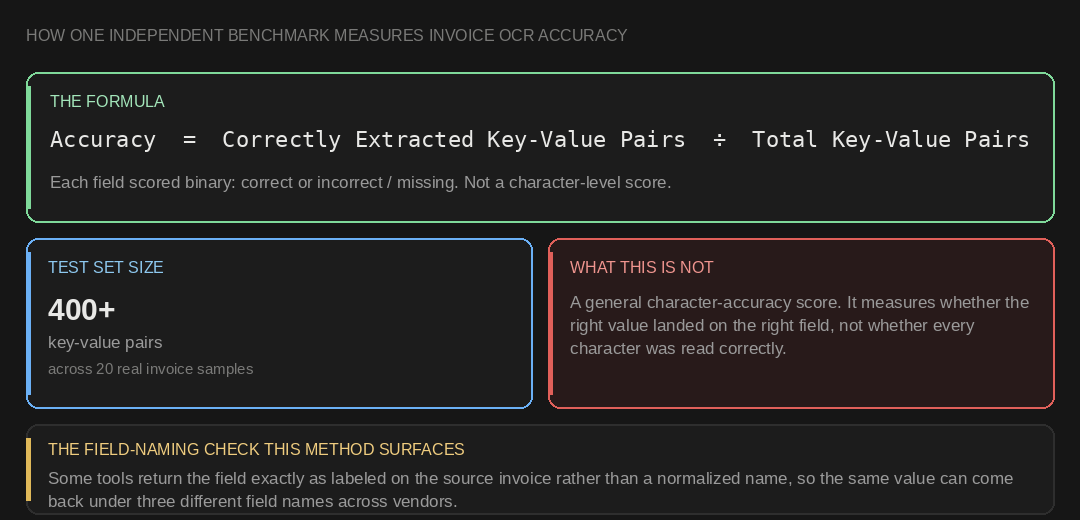
Worth understanding the actual measurement methodology, since "accuracy" means different things across different published claims: one independent benchmark defines accuracy specifically as correctly extracted key-value pairs divided by total key-value pairs present, evaluated as a binary correct-or-incorrect classification per field, tested against more than 400 key-value pairs across 20 real invoice samples. This is a meaningfully more specific methodology than a general "character accuracy" claim, since it measures whether the right value ended up mapped to the right field, not just whether characters were read correctly.
The same benchmark makes the field-naming point directly and concretely: different invoice vendors label the same concept differently (as covered above), and some extraction tools return the field exactly as labeled on the source document rather than mapping it to a consistent, normalized field name, meaning the same underlying value can come back under three different field names across three different vendors' invoices. This is worth checking directly when evaluating any invoice extraction tool: ask whether it returns normalized, consistent field names or the vendor's raw label as written.
Where DeepRead Fits
This is a case where the connection is direct rather than adjacent: invoice extraction is one of DeepRead's eight published, benchmarked document types, with accuracy measured at 97.8%, against named competitors on identical documents, against a manually verified ground truth.
DeepRead's schema-driven design, where you define the specific fields you want rather than relying on a fixed template, is a practical answer to exactly the field-naming inconsistency problem described above: you specify the normalized field name your application expects (a consistent total_amount, for instance), and extraction maps to that schema regardless of whether the source invoice itself labels the field "Total," "Gross Amount," or "Summe."
Per-field confidence scoring, with uncertain values flagged needs_review, is the practical mechanism for handling the layout-variety and low-quality-image cases that even strong graph-based and hybrid systems still don't resolve with full certainty. Full benchmark methodology is published on DeepRead's benchmarks page.
What to Evaluate
- Whether accuracy is measured at the character level or the key-value-pair level. These are genuinely different claims, and a strong character-accuracy number doesn't guarantee correct field mapping.
- How varied the test set was that produced a published accuracy number. A model validated on low-layout-variety invoices may not generalize to a genuinely multi-vendor mix.
- Whether extracted fields come back normalized or as the vendor's raw label. This determines how much downstream field-mapping work your own application needs to do.
- Whether the system handles spatial layout at all, or processes invoice text as a flat sequence, a real architectural difference with real accuracy consequences on invoices with non-trivial layout.
- Confidence scoring on extracted fields, so uncertain values are flagged for review rather than silently trusted at the same level as high-confidence ones.
Conclusion
Invoice OCR with machine learning is fundamentally two problems: reading text, and understanding what that text means and where it belongs on the page. The field's real progress has come from bringing spatial layout back into the model, moving from flat sequence-based NER to graph neural networks and multi-modal transformers that treat an invoice's layout as information, not noise to discard.
The genuine, still-unresolved challenge is layout variety across real-world, multi-vendor invoice sets, which is exactly where a published accuracy number needs scrutiny rather than blind trust, and exactly where DeepRead's schema-driven, confidence-scored approach to invoice extraction is directly, not adjacently, relevant.
FAQ
What's the difference between OCR text recognition and key information extraction for invoices?
Text recognition reads the characters on the page. Key information extraction is the separate, harder problem of understanding which recognized text is a value, which field it belongs to, and how it relates spatially to the rest of the invoice, work that happens after recognition, not as part of it.
Why do graph neural networks work well for invoice extraction?
They represent an invoice as a graph, with each word or text line as a node connected to its spatial neighbors, preserving the positional layout information a flat text sequence discards. This lets the model learn spatial relationships (a value sitting next to its label) the way a human reads a page intuitively.
Why is invoice layout variety a bigger problem than it sounds?
Most published research on graph-based extraction was validated on datasets with relatively similar invoice layouts. A model's accuracy on that kind of dataset doesn't guarantee the same accuracy on a genuinely varied, multi-vendor real-world invoice mix, which is the actual condition most production systems face. Even the research specifically addressing this treats its own results as a starting point, not a finished solution.
Why do different invoice OCR tools return different field names for the same value?
Because some tools return the field exactly as labeled on the source invoice (which varies by vendor and language: "Total," "Gross Amount," "Summe") rather than mapping it to one consistent, normalized field name. Schema-driven extraction tools solve this by letting you define the field name your application expects upfront.
How is invoice OCR accuracy actually measured in independent benchmarks?
One independent benchmark defines accuracy as correctly extracted key-value pairs divided by total key-value pairs, evaluated per field as correct or incorrect, rather than a general character-level accuracy score. This measures whether the right value landed on the right field, a more specific and meaningful claim than character accuracy alone.
Is DeepRead's invoice benchmark directly relevant, or just adjacent?
Directly relevant. Invoice extraction is one of DeepRead's eight published, benchmarked document types (97.8% accuracy), and its schema-driven design specifically addresses the field-naming inconsistency problem this article covers, by letting you define normalized field names rather than relying on a fixed template.
More articles
Due Diligence Platforms with Automated Document Indexing: How They Work and How to Choose (2026)
Compare due diligence platforms with automated document indexing: what each automates, pricing, pros and cons, VC compliance tools, and how to run a pilot.
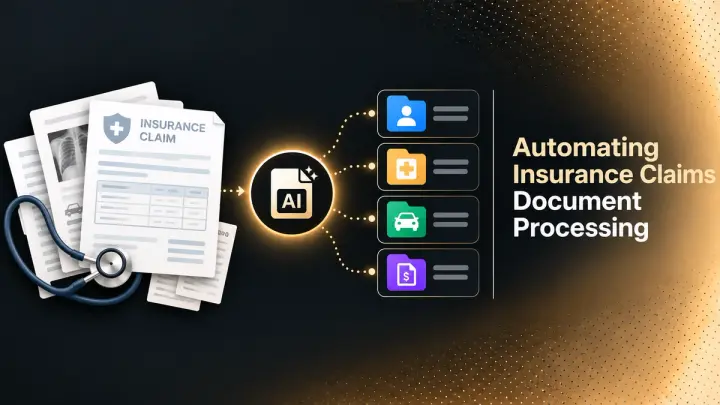
Automating Insurance Claims Document Processing: Pipeline, RAG, and Platforms (2026)
How to automate claims document processing: pipeline, RAG for claim document analysis, platform comparison with pricing, compliance, KPIs, and a pilot plan.