%20{%20:root%20{%20--deepread-stroke:%20%23E5E7EB;%20}%20}%20.dark%20{%20--deepread-stroke:%20%23E5E7EB;%20}%20%3c/style%3e%3crect%20x='40'%20y='30'%20width='220'%20height='260'%20rx='28'%20ry='28'%20stroke='var(--deepread-stroke)'%20stroke-width='16'%20fill='none'/%3e%3cpath%20d='M180%2030v52c0%2010%208%2018%2018%2018h62'%20stroke='var(--deepread-stroke)'%20stroke-width='16'%20fill='none'/%3e%3cline%20x1='70'%20y1='130'%20x2='200'%20y2='130'%20stroke='var(--deepread-stroke)'%20stroke-width='16'%20stroke-linecap='round'/%3e%3cline%20x1='70'%20y1='165'%20x2='200'%20y2='165'%20stroke='var(--deepread-stroke)'%20stroke-width='16'%20stroke-linecap='round'/%3e%3cline%20x1='70'%20y1='200'%20x2='170'%20y2='200'%20stroke='var(--deepread-stroke)'%20stroke-width='16'%20stroke-linecap='round'/%3e%3c!--%20green%20download%20arrow%20in%20bottom%20right%20corner%20--%3e%3cpath%20d='M210%20202v58'%20stroke='var(--deepread-accent)'%20stroke-width='18'%20stroke-linecap='round'/%3e%3cpath%20d='M195%20245l15%2015%2015-15'%20fill='none'%20stroke='var(--deepread-accent)'%20stroke-width='18'%20stroke-linecap='round'%20stroke-linejoin='round'/%3e%3c/svg%3e)
White-Label Document Processing APIs for SaaS
White-label document processing APIs for SaaS: what it means, real benefits, integration models, and what to evaluate.
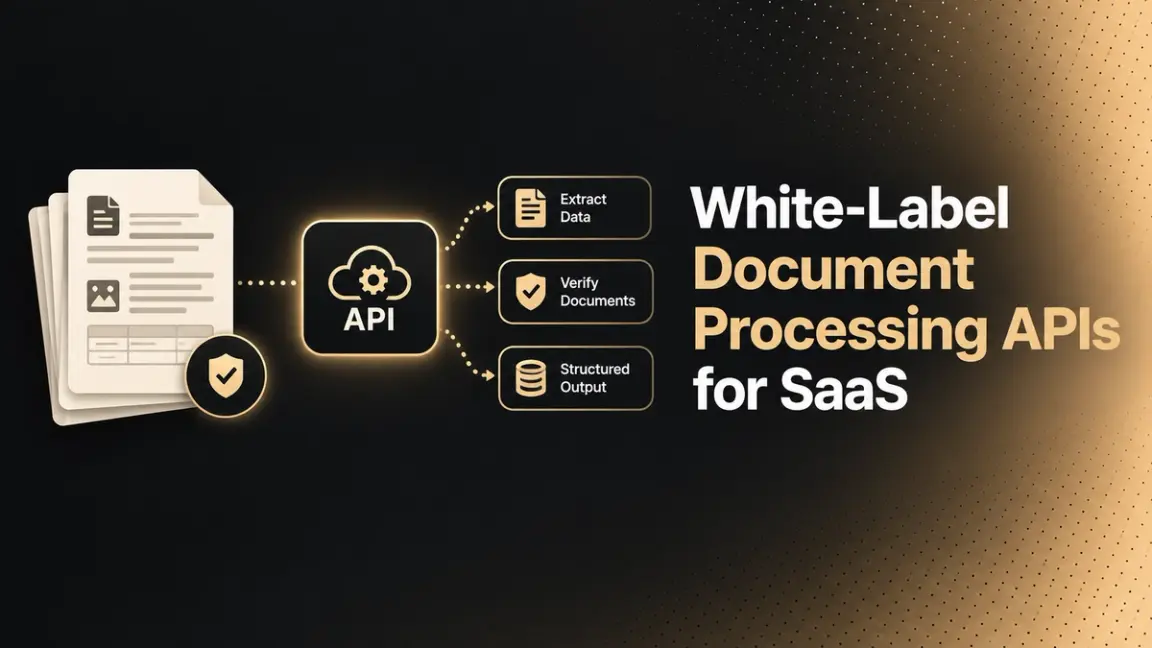
"White-label" gets used to describe several genuinely different technical situations in document processing, and conflating them leads to evaluating the wrong things. This guide separates them clearly, covers what white-label API integration actually means, its real benefits, and a specific framework for evaluating any provider you're considering.
Who This Is For
- SaaS founders and product teams wanting to add document processing (extraction, OCR, data capture) to their own product without building it from scratch.
- Engineering teams evaluating build vs. buy for document processing specifically, where the output needs to appear as a native part of their own product.
- Agencies and platform providers planning to resell or embed document processing capability across multiple client brands.
A few concrete scenarios this applies to: an accounting or bookkeeping SaaS platform embedding receipt and invoice extraction so customers never leave the product to digitize expenses. A legal tech platform embedding contract OCR so document review happens natively inside its own case-management interface. An expense management tool embedding receipt capture directly into its mobile app rather than linking out to a third-party scanner.
What Is White-Label API Integration?
White-label API integration means embedding a third-party service into your own product so completely that your end customers never know it exists as a separate provider. The API does the underlying work, document extraction, in this context, while your application owns the entire experience: the interface, the branding, and the relationship with the customer. The provider behind the API is invisible by design.
This is different from a standard third-party integration, where you might visibly credit or link out to the underlying service. White-label specifically means the provider's identity is stripped from the customer-facing experience entirely, whether that means removing their logo from a dashboard you've licensed, or simply building your own interface on top of a headless API that never had a branded interface to begin with.
For document processing specifically, this means your SaaS product can offer OCR, data extraction, and document understanding as a native feature, without your customers ever knowing which underlying engine is doing the actual extraction work, and without you building that extraction technology in-house.
Benefits of White-Label API Integration
- Faster time to market. Building accurate document extraction from scratch, especially across varied formats and document types, is a genuinely deep technical undertaking. Integrating an existing API lets a SaaS team ship the feature in weeks rather than the months or years a comparable in-house build would take.
- No need to build or maintain deep document AI expertise in-house. OCR, layout understanding, and confidence scoring are specialized fields; white-labeling lets a product team focus engineering resources on their actual core product rather than becoming a document AI company themselves.
- A native, cohesive product experience for your customers. Because the underlying provider is invisible, the feature feels like a first-party part of your platform rather than a bolted-on third-party tool, which matters for both perceived product quality and customer trust in your brand specifically.
- A genuine revenue opportunity, not just a cost center. Document processing can be marked up, bundled into a premium tier, or resold on a usage basis, turning what would otherwise be a pure infrastructure cost into a feature that contributes to your own revenue.
- Flexibility to serve multiple customer verticals from one integration, provided the underlying API is built for it. A schema-driven extraction API, where you define the specific fields you need rather than relying on the vendor's fixed, pre-trained document templates, lets one integration serve genuinely different use cases (invoices for one customer segment, contracts for another) without waiting on the vendor to ship a new template each time your product expands into a new vertical.
- Reduced long-term maintenance burden. The underlying provider handles model updates, accuracy improvements, and infrastructure scaling, work you'd otherwise own indefinitely if you built the capability yourself.
Three Ways to Integrate White-Label Document Processing
- Raw API integration. A headless REST API returns structured data to your backend, and you build all of the UI yourself. This offers maximum control at the cost of maximum engineering effort: you're responsible for the interface, the error handling, and the user experience end to end.
- SDK or widget embedding. A pre-built UI component (a drag-and-drop upload widget, an extraction review screen) ships from the vendor, and you skin it with your own colors and branding rather than building it from scratch. It requires less engineering effort than a raw API integration and offers less control; a real middle ground worth knowing exists rather than treating "API" and "full platform" as the only two options.
- Full white-labeled dashboard. An entire pre-built application, document upload, processing, review, export, configured to display your branding throughout, including, on the strongest implementations, a custom domain and white-labeled authentication flow.
Which model fits depends on how much of the document processing experience needs to feel native to your product, weighed against how much engineering capacity you have to build it yourself.
The Layered Architecture Worth Understanding
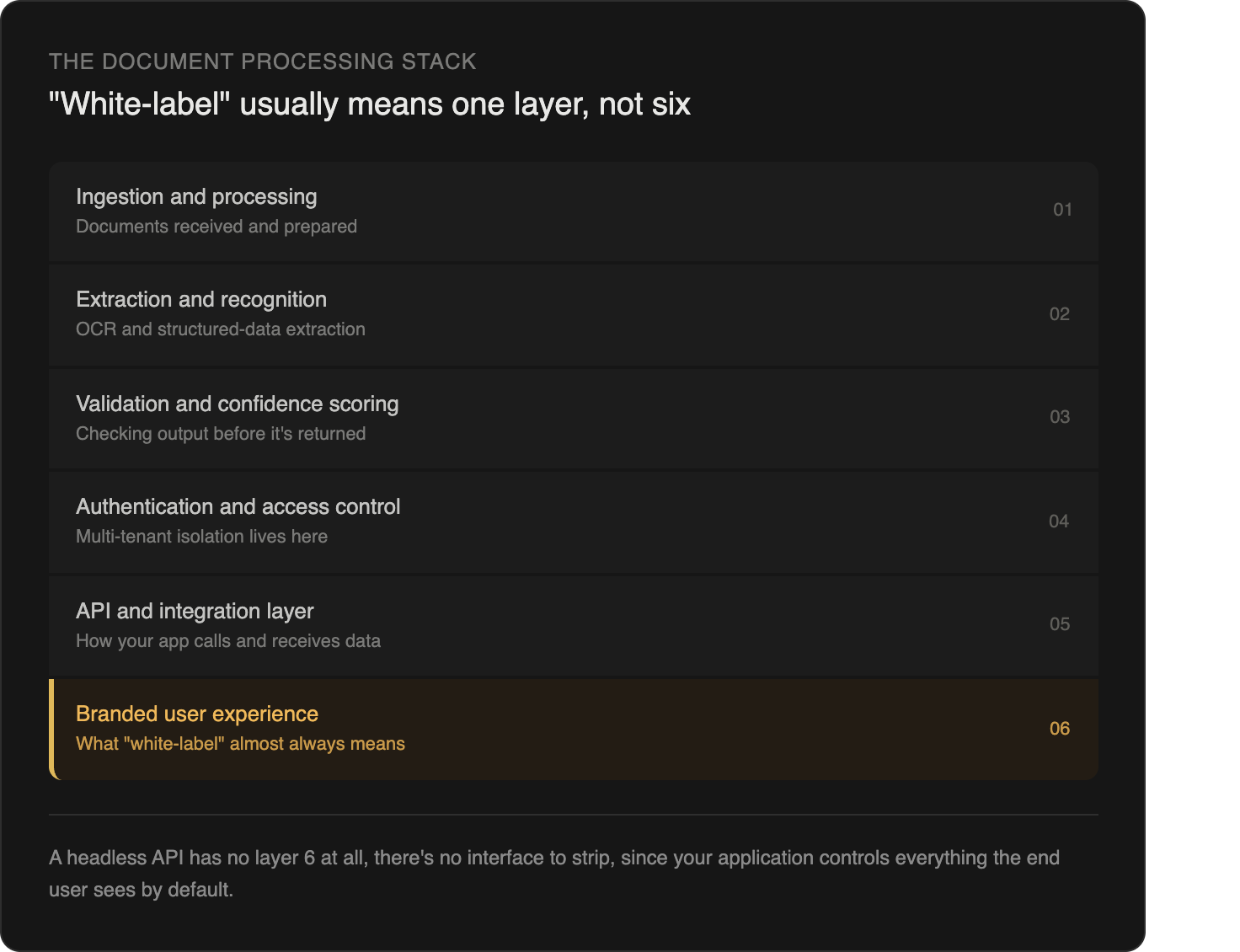
Regardless of which model you're evaluating, it helps to understand the stack a document processing capability is actually built from, since "white-label" claims can apply narrowly to just one layer:
- Ingestion and processing, where documents are received and prepared for extraction.
- Extraction and recognition, the actual OCR and structured-data extraction layer.
- Validation and confidence scoring, checking extracted data before it's returned.
- Authentication and access control, including multi-tenant isolation if you're serving multiple end customers.
- API and integration layer, how your application actually calls and receives data from the service.
- Branded user experience, the part your end customers actually see: your widget, your dashboard, your app.
A vendor's white-label claim might genuinely apply to layer 6 alone (stripping their logo from a dashboard) while layers 1 through 5 remain entirely their infrastructure. Worth confirming exactly what's covered rather than assuming "white-label" means everything is customizable.
A concrete illustration of why architecture matters more than marketing language here:
A schema-driven, headless extraction API DeepRead is one real example; it has no layer 6 at all in the sense described above. There's no vendor-branded interface to strip, because the API returns structured JSON directly to your backend, and your application controls 100% of what an end user sees. That's not a special "white-label feature" the vendor added; it's inherent to being a headless API in the first place.
The schema-driven design (defining the exact fields you need, rather than relying on the vendor's fixed pre-trained templates) is also directly relevant to the multi-vertical benefit named above, since one integration can flex across different document types your SaaS product needs to support as it grows into new customer segments. Worth being precise about the limits of this example, though: this illustrates the architecture that makes white-labeling straightforward, not a confirmed claim that DeepRead specifically markets itself as a white-label solution.
A formal reseller program, multi-tenant isolation guarantees, and an explicit data-training policy on customer documents aren't something I've confirmed for DeepRead, and any SaaS team considering it, or any API like it, for a white-label use case should raise those questions directly before committing, not assume they're covered because the API happens to be headless.
What to Evaluate
This framework applies specifically to embedding document processing into a multi-tenant SaaS product:
- Branding scope, for full-UI platforms specifically. Can vendor branding be fully removed, not just partially reduced? Is custom-domain support included or an add-on?
- Multi-tenant data isolation. If you're serving multiple end customers through one integration, does the underlying platform support genuinely isolated environments per tenant, or is this something you have to build yourself on top of a single-tenant API?
- Whether your customers' data is used for model training. This is a specific, answerable question that matters more in a white-label context than almost anywhere else, since your end customers are trusting your brand, not the underlying vendor's, and they have no visibility into this unless you confirm and disclose it yourself.
- Data processor vs. controller responsibility. In most vendor relationships, the underlying platform acts as a data processor for the content you send it, while you, and sometimes your own end client, act as the controller responsible for lawful basis, privacy notices, and data-subject requests. This allocation of responsibility should be explicit in your contract, not assumed.
- Retention and deletion terms, confirmed directly rather than assumed from general compliance marketing.
- Subprocessors, meaning which additional third parties the vendor itself relies on, since their subprocessors become part of your own data-handling chain whether disclosed prominently or not.
- Reliability and SLA commitments. Once embedded, the underlying provider's uptime becomes your uptime from your end customers' perspective. Check documented SLAs and uptime track record, not just feature coverage, since an outage on their end shows up as an outage in your product.
- Commercial terms for resale specifically, if you intend to resell or embed the capability across client brands. Not every API pricing structure is built for a reseller model, and this needs explicit confirmation rather than inference from standard per-seat or per-call pricing.
How SaaS Companies Monetize White-Labeled Document Processing
- Subscription markup, bundling document processing into an existing subscription tier at a price that covers the underlying vendor cost plus margin, without itemizing it as a separate line item to your customer.
- Usage-based reselling, charging your own customers per document or per page processed, at a markup over what you pay the underlying provider, common when usage varies significantly across your customer base.
- Bundled into a higher-tier plan, positioning document processing as a premium feature that justifies upgrading from a lower tier, rather than charging for it directly.
- Implementation and consulting fees, for agencies specifically, charging for the setup, configuration, and ongoing management of a white-labeled capability on a client's behalf, separate from any usage-based cost.
Whichever model you use, the underlying vendor's pricing structure needs to actually support it. Confirm directly whether a provider's terms permit resale at all, and whether their pricing scales in a way that leaves room for your own margin at your expected volume.
Conclusion
White-label API integration means embedding a third-party capability so completely that your end customers never see it as separate from your own product, and for document processing specifically, this depends more on architecture than marketing language: a headless, schema-driven API is inherently brand-neutral by design, while a full-UI platform requires the vendor to explicitly support branding removal and multi-tenancy. Whichever integration model fits your product, the data-training, subprocessor, and resale-terms questions matter more here than in most vendor evaluations, precisely because your end customers are trusting your brand without visibility into what's actually running underneath it.
FAQ
What's the difference between white-labeling a platform and embedding a headless API?
White-labeling a platform means removing a vendor's existing UI branding and replacing it with yours, which requires the vendor to explicitly support this. Embedding a headless API means integrating a service with no UI of its own. There's nothing to white-label, since the calling application controls all of what end users see.
What's the difference between an SDK/widget and a full white-label dashboard?
An SDK or widget is a pre-built UI component you drop into your existing product and skin with your own branding, requiring less engineering effort than building your own interface from scratch. A full white-label dashboard is an entire pre-built application, upload through export, configured to look like your product throughout, often including a custom domain.
Why is schema-driven extraction particularly useful for white-label SaaS specifically?
A SaaS platform serving multiple customer verticals (accounting, legal, expense management) has different extraction needs for each. A schema-driven API, where you define the fields you need rather than relying on fixed pre-trained document types, lets one integration serve all of them without waiting for the vendor to build a new template per use case.
Why does it matter whether my customers' data trains the vendor's AI models?
Because your end customers are trusting your brand, not the underlying vendor's, and have no visibility into this relationship unless you disclose it. Confirming and being transparent about this directly is a real diligence step, not a formality, in a white-label context specifically.
Who's responsible for compliance in a white-label document processing relationship, me or the vendor?
Typically the underlying platform acts as a data processor for content you send it, while you, and sometimes your own end client, act as the controller responsible for lawful basis, privacy notices, and data-subject requests. This should be explicit in your contract rather than assumed from the vendor's general compliance certifications.
How do SaaS companies actually make money from white-labeled document processing?
Common models include marking up an existing subscription tier to cover the cost, charging customers usage-based fees per document processed, bundling it as a premium feature in a higher-tier plan, or charging implementation and consulting fees for setup and ongoing management, particularly common among agencies.
More articles

Automated In-Bond Processing Documentation: A Compliance Guide
Automated in-bond processing explained, CBP requirements, ACE and eBond, deadlines, penalties, and where document extraction fits.
Automated ID Document Verification with Scanning
Automated ID document verification with scanning, what it is, benefits, use cases, and the technical mechanisms behind it.