%20{%20:root%20{%20--deepread-stroke:%20%23E5E7EB;%20}%20}%20.dark%20{%20--deepread-stroke:%20%23E5E7EB;%20}%20%3c/style%3e%3crect%20x='40'%20y='30'%20width='220'%20height='260'%20rx='28'%20ry='28'%20stroke='var(--deepread-stroke)'%20stroke-width='16'%20fill='none'/%3e%3cpath%20d='M180%2030v52c0%2010%208%2018%2018%2018h62'%20stroke='var(--deepread-stroke)'%20stroke-width='16'%20fill='none'/%3e%3cline%20x1='70'%20y1='130'%20x2='200'%20y2='130'%20stroke='var(--deepread-stroke)'%20stroke-width='16'%20stroke-linecap='round'/%3e%3cline%20x1='70'%20y1='165'%20x2='200'%20y2='165'%20stroke='var(--deepread-stroke)'%20stroke-width='16'%20stroke-linecap='round'/%3e%3cline%20x1='70'%20y1='200'%20x2='170'%20y2='200'%20stroke='var(--deepread-stroke)'%20stroke-width='16'%20stroke-linecap='round'/%3e%3c!--%20green%20download%20arrow%20in%20bottom%20right%20corner%20--%3e%3cpath%20d='M210%20202v58'%20stroke='var(--deepread-accent)'%20stroke-width='18'%20stroke-linecap='round'/%3e%3cpath%20d='M195%20245l15%2015%2015-15'%20fill='none'%20stroke='var(--deepread-accent)'%20stroke-width='18'%20stroke-linecap='round'%20stroke-linejoin='round'/%3e%3c/svg%3e)
Automated ID Document Verification with Scanning
Automated ID document verification with scanning, what it is, benefits, use cases, and the technical mechanisms behind it.
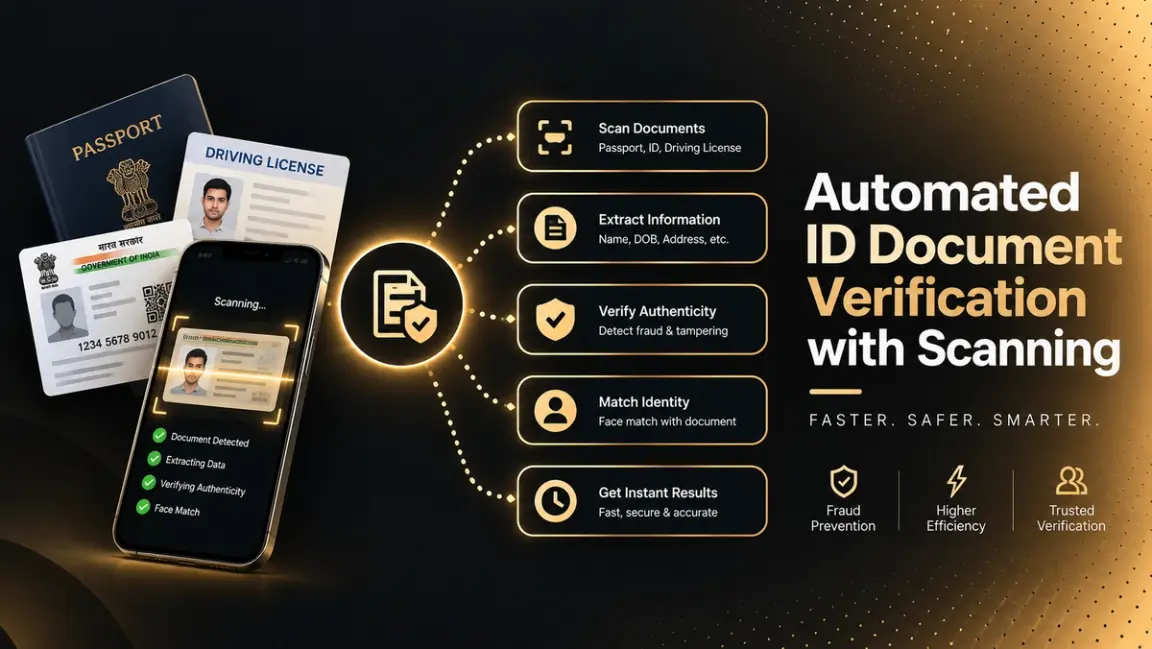
Automated ID document verification isn't just "scan it and see if it passes." Underneath a pass/fail result sits a specific set of technical checks, machine-readable zone analysis, chip verification, document template validation, image quality detection, and increasingly, an analytics layer that tracks how the whole system is performing over time, not just individual results. This guide covers what it is, why organizations adopt it, where it's actually used, and the technical mechanisms underneath.
Who This Is For
- Fraud and compliance teams wanting to understand what's actually happening technically inside an ID verification check, not just the result.
- Product and engineering teams evaluating ID verification approaches on real capability, not just accuracy claims.
- Operations leaders needing a framework for measuring whether an ID verification system is actually performing well, beyond a single approval-rate number.
What Is Automated ID Document Verification?
Automated ID document verification is the use of AI, computer vision, and structured data validation to confirm that an identity document (a passport, driver's license, national ID card) is genuine, current, and being presented by the person it actually belongs to, without requiring a person to manually inspect every submission. It replaces the manual equivalent, someone visually comparing a document against known security features, checking expiration dates by hand, and squinting at a photo to judge whether it matches the person in front of them, with a system that performs the same checks consistently, at scale, in seconds rather than minutes.
It's built from the specific technical mechanisms covered below (MRZ analysis, chip verification, template validation, quality detection) working together, not one single "authenticity" check. The output is typically a decision (approve, reject, or escalate to human review) along with a confidence score and, in the better implementations, a clear reason for that decision, not just a binary pass or fail with no explanation.
Benefits of Automated ID Document Verification
- Consistency at scale. Automation applies the same fraud detection rules to every document, removing the natural variability that comes from different reviewers applying slightly different judgment on different days.
- Speed. Automated checks commonly complete in 30 to 60 seconds, compared to the minutes-to-hours a manual review can take, directly affecting onboarding completion rates and customer experience.
- Lower cost per verification at volume. Manual review requires proportionally more staff as application volume grows; automated verification breaks that linear relationship, handling volume spikes without a matching increase in headcount.
- Reduced false positives when combined with behavioral signals. Standard fraud screening alone can flag a large share of legitimate applicants; layering document verification with behavioral analytics meaningfully reduces how often genuine users are incorrectly flagged.
- Built-in audit trails. Every check, result, and decision is logged automatically, supporting regulatory defensibility in a way that reconstructing a manual review process after the fact rarely can.
- Global document coverage. Modern platforms recognize thousands of document types across many countries, a scale of format variety no manual review team could realistically maintain expertise across on their own.
Use Cases of Automated ID Document Verification
Financial Services Onboarding
Opening a bank account, applying for a loan, or signing up for a fintech product, where identity verification is both a regulatory requirement and the first real interaction a customer has with the institution.
- Directly tied to KYC and AML compliance obligations, not optional
- Often the first point where a poor verification experience causes applicant drop-off
Age Verification
Confirming a user meets a minimum age requirement for alcohol delivery, age-restricted content, or gambling platforms, where the document check itself is the primary control, not one step among several.
- The document's date of birth field carries more weight here than in a broader KYC flow, since it's often the single decision point
- Speed matters directly, since this frequently happens at the point of purchase or delivery, not during a longer onboarding flow
Rental and Sharing-Economy Platforms
Car sharing, short-term property rentals, and equipment rental services verifying a renter's identity before handing over access to a physical asset.
- Verification here protects against real physical and liability risk, not just account fraud
- Often paired with a driver's license check specifically, given the vehicle and equipment rental use case
Event and Venue Access
Ticketed events or venues requiring ID verification at check-in, often needing to process large volumes of documents in a short window.
- Throughput matters more here than in most other use cases, given the compressed timeframe of an event entry window
- Typically a simpler check (document authenticity, age, name match) rather than a full KYC flow
Telecom and Utility Account Setup
Opening a new phone plan or utility account, where identity verification helps prevent account fraud and unauthorized service setup.
- A common target for synthetic identity fraud specifically, given the recurring billing relationship an account creates
- Usually a lighter-weight check than financial services onboarding, but still a real fraud control point
Cryptocurrency Exchange Compliance
Onboarding for crypto platforms specifically, where regulatory scrutiny and fraud risk are both elevated relative to most other consumer onboarding flows.
- Frequently requires broader document coverage and jurisdiction-specific compliance flows given the international, less-regulated user base
- Often paired with continuous monitoring rather than a one-time check, given the higher ongoing risk profile.
The Technical Checks Behind an ID Document Verification
A genuine automated check runs through several distinct technical mechanisms, not one generic "is this real" evaluation:
- OCR field extraction and verification. Text is read from the document (name, date of birth, document number) and cross-checked for internal consistency.
- MRZ (Machine-Readable Zone) analysis. The machine-readable strip on passports and many ID cards is checked for correct alignment, valid checksums, proper syntax, and whether the classifier itself reads it with confidence, a specific, structured verification distinct from general OCR.
- NFC/chip verification. For passports and NFC-enabled ID cards, the embedded chip data can be read and verified directly, a higher-assurance check than visual inspection alone since it's far harder to forge than the printed document.
- Document template and model validation. The document is compared against official templates for its country and type, including checking whether the specific document model itself (an older version of a national ID format, for instance) has expired according to official template lifecycles, not just whether the individual document has expired.
- Image and document quality detection. Academic research in this space uses signal-processing techniques (frequency-domain feature extraction, for one documented approach) to distinguish a genuine scanned document from a screen recapture or a forged reproduction, a technical quality check distinct from simply confirming the image is in focus.
- Photo verification. The document's embedded photo is checked for conformity to standards and proper positioning, separate from the biometric liveness/selfie-matching step that happens later in a full KYC flow.
Key Features of Automated ID Document Verification Solutions
Beyond the individual technical checks, a genuine automated ID verification solution typically bundles a specific set of product-level features worth checking for directly:
- Broad document type and country coverage. Recognition of thousands of document types (passports, national IDs, driver's licenses, residence permits) across a wide range of countries, since a solution tuned narrowly on one country's formats won't generalize to a genuinely international applicant base.
- Liveness detection and biometric matching. A selfie or short video matched against the document photo, with liveness checks confirming a real person is present, distinct from the document-only checks covered earlier.
- Human review integration. A structured queue for cases that don't auto-approve or auto-reject, showing the reviewer exactly what was flagged and why, rather than a raw document dump requiring re-review from scratch.
- White-label and branding options. The ability to present the verification screen under your own branding rather than the vendor's, relevant for reducing drop-off during onboarding.
- Analytics and reporting dashboards. Visibility into success rates, failure reasons, document trends, and country-level statistics over time, the specific capability that separates a system you can actively manage and improve from one you can only react to.
- Compliance certifications and audit logging. SOC 2, GDPR, and equivalent certifications, paired with detailed, tamper-evident logs of every check performed, supporting regulatory defensibility rather than just operational efficiency.
A Framework for Measuring Verification Performance
Worth tracking across four distinct dimensions, since a single approval-rate number hides real problems:
- Manual review efficiency. Approval rates, rejection rates, retry rates, and escalation volumes, before and after any change to the system, tracking not just fewer reviews but more consistent review quality.
- Conversion and customer experience. Completion rates, time to verify, first-pass success rates, and drop-off by device, geography, and onboarding channel. A vendor that blocks more fraud but meaningfully increases abandonment isn't automatically creating positive business value.
- Compliance and audit readiness. Whether identity controls are actually lowering regulatory exposure and improving recordkeeping, not just processing documents faster.
- Document and fraud trend analytics. Success rates, failure reasons, document trends, and country-level statistics over time- the specific analytics layer that lets a team spot a rising fraud pattern or a declining approval rate for a specific document type before it becomes a larger problem.
Real Numbers Behind the Accuracy Claims
Worth being specific and appropriately hedged here, since this varies significantly by source: commercial identity verification solutions commonly report 99% to 99.7% accuracy on data extraction, while research-based systems tested on separate validation datasets report closer to 92% accuracy, a real gap worth understanding rather than assuming the higher, vendor-reported figure applies universally.
One vendor reports typical automated approval rates around 95%, with the remaining share routed to manual review, and reports implementation timelines in the 7-to-16-week range, a useful planning benchmark even if your specific implementation varies.
A frequently cited figure worth treating with real caution: false positive rates in standard AML screening are commonly reported in the 90-95% range (meaning the large majority of flagged cases turn out not to be genuine fraud), dropping to single digits when document verification is combined with behavioral analytics, directionally useful context for why layering multiple techniques matters, though this specific figure comes from vendor-published material rather than independent research.
A Pricing Distinction Worth Knowing
Beyond the general pay-as-you-go versus enterprise-contract split covered in our dedicated pricing guide, one specific model distinction matters here: some vendors charge per verification attempt, while others charge only per approved verification. Paying per attempt can meaningfully reduce cost for use cases where retries are common (poor camera quality, inconsistent lighting causing initial failures), since you're not paying full price for every retry a legitimate user needs before succeeding. Confirm which model a specific vendor actually uses, since the difference can be substantial depending on your applicant population's typical retry rate.
Where General-Purpose OCR Fits, and Where It Doesn't
Worth repeating the distinction that applies across this entire category: field extraction and document verification are different capabilities. OCR reads what's on a document; verification confirms the document is genuine, current, and belongs to the person presenting it, through MRZ analysis, chip verification, template validation, and quality detection, none of which a general-purpose extraction API performs.
DeepRead's published driver's license extraction benchmark (96.7% accuracy) is relevant specifically to the OCR field-extraction component described above, reading name, date of birth, and address correctly, not to MRZ checksum verification, NFC chip reading, template lifecycle validation, or quality/liveness detection, none of which are things DeepRead does. It's a reasonable component for the extraction sub-step of a system you're building, not a substitute for a genuine ID verification platform.
Conclusion
Automated ID document verification with scanning depends on specific technical mechanisms most discussions skip past: MRZ analysis, chip verification, document template validation, and signal-processing-based quality detection, layered together rather than one generic authenticity check. Measuring whether the system is actually working well requires tracking manual review efficiency, conversion and customer experience, compliance readiness, and document/fraud trend analytics together, not just an overall approval rate.
Whichever platform you evaluate, confirm the specific technical checks it actually performs and the analytics it surfaces, and be precise about whether a general-purpose OCR tool's role is field extraction specifically, not full verification.
FAQ
What is MRZ analysis in ID document verification?
MRZ (Machine-Readable Zone) analysis checks the machine-readable strip on passports and many ID cards for correct alignment, valid checksums, proper syntax, and classifier confidence, a specific structured verification distinct from general OCR field extraction.
Why does NFC or chip verification matter for ID documents?
Chip data embedded in passports and NFC-enabled ID cards is far harder to forge than the printed document itself, making chip verification a higher-assurance check than visual inspection alone for documents that support it.
What's the difference between per-attempt and per-approved-verification pricing?
Per-attempt pricing charges for every verification try, including failed retries. Per-approved-verification pricing charges only when a check ultimately succeeds. Per-attempt pricing can be significantly cheaper for populations with meaningful retry rates from poor camera quality or lighting, since you're not paying full price for every retry a legitimate user needs.
How should I measure whether an ID verification system is actually performing well?
Track four dimensions together: manual review efficiency (approval, rejection, retry, escalation rates), conversion and customer experience (completion rate, time to verify, drop-off by device and geography), compliance and audit readiness, and document/fraud trend analytics over time. A single approval-rate number hides real problems in any one of these areas.
Does DeepRead perform ID document verification?
No, DeepRead performs OCR field extraction, relevant to reading data off an ID document accurately, but it doesn't perform MRZ analysis, chip verification, document template validation, or quality/liveness detection, all of which a genuine ID verification platform requires.
More articles
Structured Data Extraction: A Technical Guide
How to extract structured data from documents using an AI API, the architecture, grounding, and named tools compared.

Key Features of AI Document Workflow Automation
AI document workflow automation features, governance, prioritization framework, and real examples with measurable benefits for 2026.