%20{%20:root%20{%20--deepread-stroke:%20%23E5E7EB;%20}%20}%20.dark%20{%20--deepread-stroke:%20%23E5E7EB;%20}%20%3c/style%3e%3crect%20x='40'%20y='30'%20width='220'%20height='260'%20rx='28'%20ry='28'%20stroke='var(--deepread-stroke)'%20stroke-width='16'%20fill='none'/%3e%3cpath%20d='M180%2030v52c0%2010%208%2018%2018%2018h62'%20stroke='var(--deepread-stroke)'%20stroke-width='16'%20fill='none'/%3e%3cline%20x1='70'%20y1='130'%20x2='200'%20y2='130'%20stroke='var(--deepread-stroke)'%20stroke-width='16'%20stroke-linecap='round'/%3e%3cline%20x1='70'%20y1='165'%20x2='200'%20y2='165'%20stroke='var(--deepread-stroke)'%20stroke-width='16'%20stroke-linecap='round'/%3e%3cline%20x1='70'%20y1='200'%20x2='170'%20y2='200'%20stroke='var(--deepread-stroke)'%20stroke-width='16'%20stroke-linecap='round'/%3e%3c!--%20green%20download%20arrow%20in%20bottom%20right%20corner%20--%3e%3cpath%20d='M210%20202v58'%20stroke='var(--deepread-accent)'%20stroke-width='18'%20stroke-linecap='round'/%3e%3cpath%20d='M195%20245l15%2015%2015-15'%20fill='none'%20stroke='var(--deepread-accent)'%20stroke-width='18'%20stroke-linecap='round'%20stroke-linejoin='round'/%3e%3c/svg%3e)
Receipt Data Extraction SDK: A 2026 Comparison
Comparing receipt data extraction SDKs and APIs - Azure, Mindee, AWS Textract, Veryfi, with verified pricing and independent benchmark data.
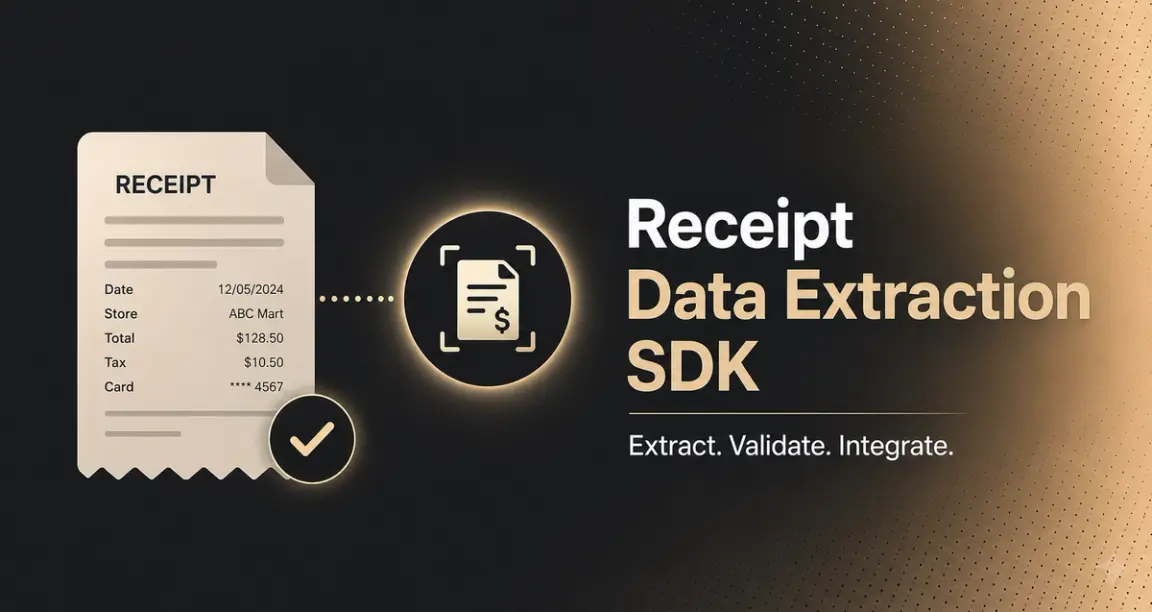
Receipt data extraction SDKs and APIs split by how you actually integrate them, not just by accuracy. Cloud provider prebuilt models plug into infrastructure you may already run. Dedicated receipt-specific APIs prioritize fast, single-purpose integration over broader platform coverage. Mobile-capture SDKs are built specifically for camera-based field use. Open-source options trade cost for engineering effort. This guide compares all four categories with verified pricing and real, independently-tested accuracy data.
For the consumer/bookkeeping side of this category — expense apps, non-technical scanning tools, see our receipt scanning OCR software guide, which covers that ground. This piece is specifically for developers integrating receipt extraction into their own product or pipeline.
Who This Is For
- Developers building expense management, fintech, or bookkeeping products who need receipt extraction as an SDK or API, not a finished consumer app.
- Engineering teams already on a cloud platform (AWS, Azure, GCP) evaluating whether the prebuilt receipt model there is sufficient, or whether a dedicated receipt API is worth adding.
- Teams building mobile-first expense capture, where camera-based scanning quality matters as much as extraction accuracy.
- Logistics and freight teams processing delivery and proof-of-delivery receipts, a genuinely different extraction problem than retail purchase receipts.
- Anyone doing bulk or batch receipt processing, where pricing model and rate limits matter as much as per-receipt accuracy.
Cloud Provider Prebuilt Models
Azure AI Document Intelligence (Receipt Model)
- Combines OCR with deep learning specifically trained on receipts, extracting merchant name, merchant phone number, transaction date, tax, and transaction total into structured JSON
- Handles both printed and handwritten receipts, across varying formats and quality
- The current model (v4.0, generally available) adds ReceiptType, tax net amount/description/rate breakdowns, country/region detection, and VAT table extraction specifically for hotel receipts — genuinely deeper structured output than a basic total/tax/merchant extraction
- A free pricing tier (F0) is available to test the service before committing
- Best fit: teams already running Azure infrastructure, or needing the strongest multi-language coverage — one independent test found Azure leads specifically on multi-language receipt support (80+ languages) and international format handling
AWS Textract (AnalyzeExpense)
- Amazon's dedicated expense/receipt analysis API, priced at $10 per 1,000 pages, confirmed on AWS's own pricing page
- One independent, disclosed-methodology test (100 real receipts across five categories — supermarket, restaurant, fuel station, pharmacy, hardware store) found AnalyzeExpense delivered the highest combined accuracy among the APIs tested: 93% field-level and 89% line-item extraction, with the strongest structured output of the group
- Best fit: teams already on AWS wanting the strongest tested accuracy among major cloud providers, willing to build the surrounding validation and workflow logic themselves
Google Document AI
- One independent test found Google's receipt parsing nearly matched AWS Textract on field accuracy (92%), while offering the most generous free tier among cloud providers tested (1,000 pages/month)
- Best fit: teams standardized on Google Cloud, or specifically prioritizing a larger free tier for testing and low-volume use before committing to paid usage
Dedicated Receipt-Specific APIs
Mindee
- A dedicated Receipt OCR API — not a general-purpose document API with a receipt mode bolted on — built to crop and isolate individual tickets and extract totals, VAT, merchant details, and line items into validated JSON
- Adapts automatically to languages, currencies, and multi-page documents without requiring templates, and supports handwritten receipt styles specifically
- Lets you customize the extraction schema to only the fields you actually need, rather than returning a fixed field set — directly relevant if you're building a specific downstream integration rather than wanting everything the API can extract
- Pricing, confirmed directly: credit-based, with single-page documents (an invoice, receipt, or utility bill) counting as one credit, and multi-page documents counting proportionally (a five-page document costs five credits) — no upcharges for document complexity and no hidden processing fees. A 14-day free trial is available. Enterprise volume pricing is quote-based, with discounted per-credit rates at higher volume.
- One independent test specifically praised Mindee's integration speed — under 30 minutes from API key to working extraction, with a clean REST API requiring no SDK, cloud platform setup, or IAM configuration
- Best fit: teams wanting the fastest possible integration for receipt extraction specifically, without needing broader document-type coverage or cloud platform lock-in
Mobile-Capture SDKs
Veryfi
One independent pricing comparison specifically recommends Veryfi over general document AI APIs for a particular use case: mobile receipt/expense capture. Veryfi is purpose-built for camera-based capture with a dedicated mobile SDK, positioned as a stronger fit than a general document AI API specifically when the use case is field teams photographing receipts on phones, rather than processing already-digitized files.
- Best fit: expense management or fintech products where the primary capture method is a phone camera, not scanned or uploaded files
Delivery Receipt OCR: A Distinct Sub-Type
Delivery and proof-of-delivery receipts are a genuinely different extraction problem than retail purchase receipts, worth naming separately rather than assuming general receipt OCR transfers cleanly. Retail receipts are relatively standardized around merchant/total/tax; delivery receipts typically carry different core fields — recipient signature or confirmation, delivery date and time, carrier or driver identifier, package or tracking reference, and condition notes, and arrive through logistics-specific channels (a driver's handheld scanner output, a photographed signed slip) rather than a point-of-sale printer.
None of the receipt-specific APIs covered above market themselves specifically for this sub-type; a schema-driven, general-purpose extraction API where you define the exact fields you need is often the more practical fit here than a receipt API pre-trained on retail formats specifically.
Open-Source and Self-Hosted
Tesseract (with Python)
- Free, but the independent test cited above found matching cloud API accuracy requires significant custom development — preprocessing, field extraction logic, validation, and multi-format handling all need to be built rather than coming out of the box
- Genuinely worth it for prototyping, academic projects, and cost-sensitive applications with real engineering resources; the development effort to reach cloud-API-level accuracy typically exceeds the cost of using a paid API once volume passes roughly 100,000 scans a month, per that same test
- Common in Python-based receipt extraction pipelines specifically, often paired with a custom-trained layout or field-detection model on top of raw OCR output
- Best fit: teams with the engineering capacity to build the structured-extraction layer themselves, or academic/research contexts rather than production-volume commercial use
A Note on Independent Benchmark Testing
Worth being direct about sourcing here: the specific accuracy figures above (93%/89% for AWS, 92% for Google, strongest multi-language for Azure) come from one independent test — 100 real-world receipts across five categories, comparing field-level accuracy, line-item extraction rate, latency, and cost.
That's a disclosed, testable methodology, which is more than most vendor-stated accuracy claims offer, but it's still one test on one document set, not a universal truth. If receipt accuracy is a deciding factor for your specific use case, running the same kind of test on your own representative receipts, not just trusting either the vendor claims or this one third-party test- is worth the time before committing.
Separately, academic research in this space has its own established benchmark: the ICDAR Robust Reading Challenge on Scanned Receipts OCR and Information Extraction (SROIE) is a well-known dataset and competition specifically for this task, worth knowing if you're evaluating a research-oriented or custom-trained approach rather than a commercial API.
What Actually Matters for Bulk Processing
- Pricing model at real volume, not the free-tier number — credit-based (Mindee), per-page (AWS, Azure, Google), and volume-discounted enterprise tiers all behave differently once you're processing thousands of receipts monthly.
- Rate limits and batch support, since bulk vendor receipt processing (expense reports, vendor reconciliation) needs to handle real concurrent volume, not just single-receipt latency.
- Whether line items are extracted reliably across varying formats, not just header totals. This is a harder problem than it looks: a grocery receipt, a restaurant check, and a hardware store receipt each structure line items differently — some with SKU codes, some with quantity-times-unit-price shown explicitly, some with neither. An API tested well on one receipt category (per the independent test cited above, which spanned five categories specifically for this reason) doesn't guarantee the same line-item accuracy on a category it wasn't tested against. Confirm line-item performance specifically on your dominant receipt category, not just an aggregate accuracy figure.
- Schema customization, if you only need specific fields — Mindee's customizable schema approach avoids parsing a larger response than you actually need.
- SDK vs. raw REST API, depending on your team's preference — some APIs (Mindee) work with a clean REST call and no SDK required; others (AWS, Azure, Google) are typically integrated via their respective cloud SDKs (boto3 for AWS, the Azure SDK, Google Cloud client libraries), which matters for Python-specific integration work.
What to Evaluate
- Test on your own receipts, not a vendor demo or even this article's cited benchmark — receipt format variety by merchant and region means results vary meaningfully by document mix.
- Confirm line-item extraction specifically, not just header field accuracy, if line-level data matters to your use case.
- Check multi-language and multi-currency support directly if your receipt volume is international — this varies significantly between providers.
- Understand real per-unit cost at your expected volume, not the free tier or lowest advertised rate.
- Confirm handwritten receipt handling if that's part of your document mix — not every API handles this equally well despite similar marketing language.
- Confirm downstream integration with your actual expense platform (Concur, Expensify, QuickBooks, or similar), if corporate expense management is the end use case — extraction accuracy alone doesn't guarantee a clean sync into the system your finance team actually works in.
Conclusion
Receipt data extraction SDKs split cleanly by integration model: cloud provider prebuilt models for teams already in that ecosystem, dedicated APIs like Mindee for fast, focused integration, mobile-capture SDKs like Veryfi for camera-based field use, and open-source options like Tesseract for cost-sensitive, engineering-heavy projects. Delivery receipts deserve separate consideration from retail purchase receipts, since none of the named receipt-specific APIs here are tuned for that sub-type specifically.
One independent test found real accuracy differences worth knowing (AWS Textract's AnalyzeExpense leading on combined field and line-item accuracy, Google offering the most generous free tier, Azure leading on multi-language support), but treat any single test, including that one, as a starting point rather than a final answer, and validate against your own receipt mix before committing to production volume.
FAQ
What's the difference between a cloud provider's receipt model and a dedicated receipt API like Mindee?
Cloud provider models (Azure, AWS, Google) are part of a broader document AI platform, useful if you're already using that cloud's infrastructure. Dedicated receipt APIs like Mindee specialize specifically in receipts, often with faster integration and more receipt-specific output (customizable schemas, tighter line-item cropping) at the cost of broader document-type coverage.
Which receipt OCR API is actually the most accurate?
Based on one independent, disclosed-methodology test (100 real receipts across five categories), AWS Textract's AnalyzeExpense scored highest on combined field and line-item accuracy (93%/89%), with Google Document AI close behind on field accuracy (92%). Treat this as one data point, not a universal ranking, test against your own receipt mix before deciding.
Is there a good Python library for receipt OCR?
Most major providers (Mindee, AWS, Azure, Google) offer official Python SDKs or client libraries for their APIs. For a fully open-source Python approach, Tesseract is the standard OCR engine, though extracting structured receipt fields from its raw text output requires building custom parsing logic on top.
What is SROIE, and why does it matter for receipt data extraction?
SROIE (Scanned Receipts OCR and Information Extraction) is an established academic benchmark dataset and competition from the ICDAR Robust Reading Challenge, used in research contexts for evaluating receipt OCR and extraction models — relevant if you're building or evaluating a custom-trained model rather than using a commercial API.
How is delivery receipt OCR different from retail receipt OCR?
Delivery receipts carry different core fields — recipient signature, delivery date/time, carrier or driver ID, tracking reference, condition notes, arriving through logistics-specific channels rather than a point-of-sale printer. None of the retail-focused receipt APIs in this comparison are specifically tuned for this sub-type; a schema-driven, general-purpose extraction API is often a better fit here.
Should I use a mobile SDK or a general document AI API for expense receipt capture?
If your primary capture method is a phone camera in the field, a purpose-built mobile SDK like Veryfi is generally a better fit than a general document AI API. If you're processing already-digitized or uploaded receipts, a general document AI API or dedicated receipt API is usually sufficient.
More articles
Metrics to Measure the ROI of Document Workflow Automation (2026)
The metrics that measure document workflow automation ROI: baselines, formulas, cost per document, STP rate, payback, and how to read the statistics.
API for Utility Bill and Multi-Service Statement Processing (2026)
How document processing APIs handle utility bills and multi-service statements: how the market splits, schema design, validation, and named options.