%20{%20:root%20{%20--deepread-stroke:%20%23E5E7EB;%20}%20}%20.dark%20{%20--deepread-stroke:%20%23E5E7EB;%20}%20%3c/style%3e%3crect%20x='40'%20y='30'%20width='220'%20height='260'%20rx='28'%20ry='28'%20stroke='var(--deepread-stroke)'%20stroke-width='16'%20fill='none'/%3e%3cpath%20d='M180%2030v52c0%2010%208%2018%2018%2018h62'%20stroke='var(--deepread-stroke)'%20stroke-width='16'%20fill='none'/%3e%3cline%20x1='70'%20y1='130'%20x2='200'%20y2='130'%20stroke='var(--deepread-stroke)'%20stroke-width='16'%20stroke-linecap='round'/%3e%3cline%20x1='70'%20y1='165'%20x2='200'%20y2='165'%20stroke='var(--deepread-stroke)'%20stroke-width='16'%20stroke-linecap='round'/%3e%3cline%20x1='70'%20y1='200'%20x2='170'%20y2='200'%20stroke='var(--deepread-stroke)'%20stroke-width='16'%20stroke-linecap='round'/%3e%3c!--%20green%20download%20arrow%20in%20bottom%20right%20corner%20--%3e%3cpath%20d='M210%20202v58'%20stroke='var(--deepread-accent)'%20stroke-width='18'%20stroke-linecap='round'/%3e%3cpath%20d='M195%20245l15%2015%2015-15'%20fill='none'%20stroke='var(--deepread-accent)'%20stroke-width='18'%20stroke-linecap='round'%20stroke-linejoin='round'/%3e%3c/svg%3e)
How AI Automation Minimizes Human Error in Document Handling
How AI automation reduces human error across document handling - misfiling, routing, retention, and review, with real case study evidence.
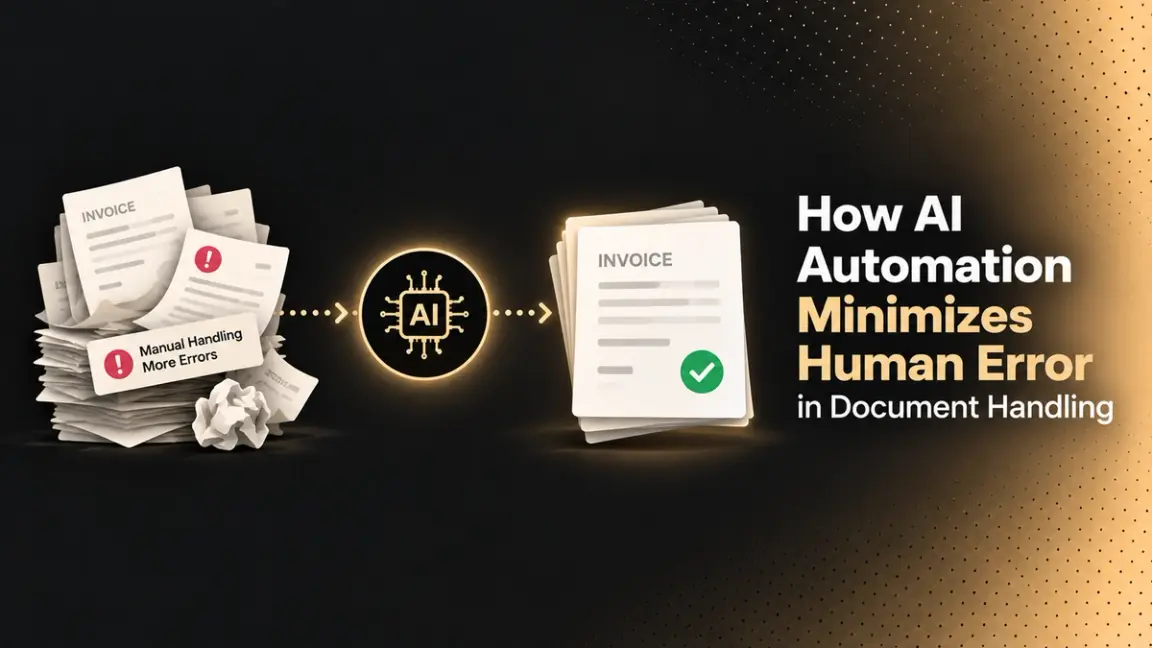
Human error in document handling isn't limited to typos and mistyped fields — it shows up as a misfiled record nobody can find months later, a document routed to the wrong department, a retention policy applied inconsistently across a filing system, an approval stuck for weeks in a manual review queue, or sensitive information accessible to someone who shouldn't have seen it. Each of these is a distinct category of error with a distinct cause, and AI automation addresses them differently, not through one blanket mechanism.
This is a guide to the document-handling error categories beyond data entry specifically, how AI automation addresses each, and real evidence behind the claims — including two academic case studies with named, quantified results. For the mechanics of data entry errors specifically — transposed numbers, missing fields, misapplied codes — see our companion guide on how automation reduces data entry errors, which covers that ground in depth.
Who This Is For
- Operations and records management leaders dealing with errors that show up after the fact — a document that can't be located, a compliance gap discovered during an audit.
- Compliance and risk teams concerned with retention, routing, and access errors specifically, not just data accuracy.
- Teams evaluating document management or workflow automation wanting to understand which specific error categories a given platform actually addresses, backed by real evidence rather than headline percentages.
Document Handling Errors Go Well Beyond Data Entry
Worth separating these into distinct categories, since each has a different cause and a different fix:
- Misfiling and retrieval errors — a document stored under the wrong category, name, or location, effectively lost even though it technically still exists somewhere in the system.
- Routing and misdelivery errors — a document sent to the wrong recipient or department, a genuinely common failure mode when routing depends on a person manually deciding where something goes.
- Retention and lifecycle errors — documents kept past their required retention period, or disposed of before they should be, both carrying real compliance exposure.
- Review and approval bottlenecks — documents stalled in a manual review queue, not an error exactly, but oversight-dependent processes are genuinely vulnerable to delay and inconsistent standards.
- Access and security errors — the wrong person able to see sensitive information, a mistake about who has access to what, not about data accuracy at all.
The Real Financial Weight of Human Error in Document Handling
The scale of this problem is easy to underestimate, since most of the cost surfaces well downstream of the actual mistake, a misfiled record or a misrouted document rarely announces itself as an error at the moment it happens.
From IBM's 2025 Institute for Business Value report:
- 43% of chief operations officers now name data quality issues as their single most significant data priority
- Over a quarter of organizations estimate losing more than $5 million annually to poor data quality
- 7% report losses of $25 million or more
- IBM's own framing is worth repeating directly: this damage rarely surfaces at the point of failure — it shows up later as lost revenue, inefficiency, compliance exposure, and decisions made on faulty information
From Forrester's own research:
- More than a quarter of data and analytics professionals surveyed report losses exceeding $5 million annually tied to poor data quality — an independent finding that corroborates IBM's figures
- Forrester warns these losses could scale into the billions as AI adoption accelerates without a parallel investment in data quality and governance
From McKinsey Global Institute's own analysis:
- Work occupying 45% of employee time — across roughly 2,000 work activities studied throughout the US economy, could be automated using technology already available or demonstrated at the time of the study
- Data collection and processing activities represent a disproportionate share of that automatable work
- This matters directly here: these are exactly the tasks most vulnerable to the kind of routine, repetitive human error this article is about
The pattern across all three sources is the same: the real cost isn't the error itself, it's how long it stays invisible before someone finds it.
How AI Automation Addresses Each Category
Misfiling and retrieval: intelligent search and automated tagging classify documents based on content rather than relying on a person choosing the right folder or filename by hand, with underlying models improving at this over time as they learn from usage patterns — directly addressing the "technically exists, functionally lost" problem.
Routing and misdelivery: automated workflow routing directs documents to the correct recipient or department based on content and rules, removing the point where a person manually decides where something goes. One academic study of automated request processing in logistics found this specifically eliminates a category of error tied to incorrect task distribution, since routing decisions apply consistently by rule rather than being individually judged each time.
Retention and lifecycle management: automated archival and disposal based on predetermined retention policies removes dependency on someone remembering or correctly applying a retention schedule manually — a real, compliance-relevant error category that gets less attention than data accuracy but carries similarly real regulatory consequences.
Review and approval bottlenecks: automated routing to the correct reviewer, combined with confidence-based escalation (covered below), reduces delays caused by documents sitting unnoticed in someone's queue, without removing human judgment from cases that genuinely need it.
Access and security: rule-based, automated access controls reduce the chance of a manual permissions mistake granting access that shouldn't exist, and anomaly detection in access patterns can flag unusual activity before it becomes a real security incident.
Common Types of Data Entry Errors
Worth a brief, standalone summary here even though data entry errors are one category among the broader document-handling errors this guide covers — a reader landing on this piece specifically may not have seen our companion guide, and the two problems are related enough that leaving this out entirely would be a gap.
- Transposed numbers — digits swapped during manual entry, a mechanical mistake distinct from a judgment error.
- Missing or blank fields — a required value skipped, often under time pressure or during high-volume batches.
- Misapplied codes or categories — the wrong classification, GL code, or category applied, usually from inconsistent judgment rather than carelessness.
- Inconsistent formatting — dates, currencies, and identifiers entered differently across records, causing downstream matching and merging failures between systems.
- Duplicate entries — the same record entered more than once, common at high volume and a frequent cause of the "duplicate invoice" or "duplicate claim" problems that show up in AP and insurance workflows specifically.
- Fatigue-driven degradation — accuracy dropping over the course of a shift or large batch, a genuine, physiological cause distinct from carelessness.
The Confidence Score Mechanism
Worth explaining directly, since it's the specific mechanism that determines whether a document gets processed automatically or routed to a person. Intelligent document processing systems assign a confidence score to each processed document or field, based on the quality of the input — a clear, well-formatted document scores high confidence; a smudged scan, an obscured field, or unrecognized handwriting scores lower.
When confidence drops below a set threshold, the system routes that specific case to a person for review rather than either guessing or blocking the entire workflow. This is what allows automation to handle the routine, high-confidence majority of cases at scale while still catching genuinely uncertain ones before they become errors, the mechanism doing the real work behind most of the error-reduction claims in this category.
DeepRead's extraction API implements this directly at the field level: every extracted value returns a confidence score, and anything uncertain is flagged needs_review rather than returned silently alongside confident values. This is a concrete, checkable example of exactly the review-bottleneck fix this guide describes conceptually: it lets a document move through automatically when the system is genuinely confident, while routing only the specific fields that actually need a person's attention, rather than either blocking the whole document or letting an uncertain value pass through unflagged.
Real Evidence: Two Academic Case Studies
Worth leaning on these specifically, since they're peer-reviewed or preprint academic sources with named organizations and quantified results, rather than vendor marketing claims.
A four-stage expense processing system, studied at a major Korean enterprise:
- Combined OCR/IDP recognition of receipts, policy-driven automated classification, generative AI-based exception handling, and human-in-the-loop final decision-making with continuous system learning
- Reported over 80% reduction in processing time for paper receipt expense tasks
- Reported decreased error rates and improved compliance
- Found traditional rules-based RPA alone insufficient, given how much unstructured data and exception handling the process required — exactly why the generative AI layer was added rather than relying on rules-based automation alone
Crowley Maritime and the Port of Los Angeles, studied in an academic analysis of AI's effectiveness in reducing human error in transportation request processing:
- Crowley Maritime's automated invoice processing system reduced document errors by 30%
- Crowley's documentation processing time dropped from 12 minutes to 4 minutes after implementation in 2022
- The Port of Los Angeles's automated document processing, paired with delay-prediction systems reaching 90% forecasting accuracy, let operators take preemptive action that reduced scheduling misunderstandings and errors
- Both are named, specific organizations with dated implementations, not anonymized or hypothetical examples
Separately, systematic review literature on AI in medical billing and coding has found that automated coding systems, translating clinical documentation into standardized billing terminology automatically rather than manually — improve consistency and reduce human error in a domain where miscoding has direct financial and compliance consequences.
Where the Limits Are
None of this replaces human judgment entirely, and treating it that way is where automation projects tend to overreach. The Korean enterprise study is explicit about this: even with generative AI handling exception cases the original rules-based system couldn't resolve, human-in-the-loop final decision-making remained part of the architecture — not a fallback for failure, a deliberate, permanent part of the design. Confidence-based triage is the practical version of this same principle: high-confidence cases proceed automatically, uncertain or sensitive ones route to a person, and the goal is reducing the volume of routine, error-prone manual work, not eliminating oversight from the cases that genuinely need it.
What to Evaluate
- Which specific error category a platform actually addresses — misfiling, routing, retention, or access, since these require genuinely different underlying capabilities, and a platform strong at one isn't automatically strong at another.
- Whether confidence scoring exists and is field- or case-specific, not just an aggregate accuracy claim with no visibility into what triggered a review.
- Whether retention and disposal policies are configurable to your actual compliance requirements, not a generic default schedule.
- Whether routing decisions are auditable — can you reconstruct why a document was routed where it was, relevant both for debugging and compliance review.
- Whether the evidence behind a vendor's claims is a real, checkable case study or an unattributed headline percentage — the two academic case studies above are worth using as a model for what genuinely verifiable evidence looks like in this category.
Conclusion
Human error in document handling is a broader problem than data entry mistakes alone — misfiling, misrouting, retention failures, approval bottlenecks, and access errors each have distinct causes and require distinct automated fixes. The financial weight behind this is real and well-documented directly by IBM, Forrester, and McKinsey's own research, not a recycled, murky statistic, and the strongest evidence for what actually fixes it comes from named, specific implementations with quantified results: a Korean enterprise's four-stage expense automation system, Crowley Maritime's and the Port of Los Angeles's documented document-processing improvements.
Confidence-based triage, keeping human review in the loop for uncertain or sensitive cases, is what these real implementations have in common and what keeps automation from simply trading one category of error for another.
FAQ
Is document handling error the same as data entry error?
No, data entry errors are about incorrect values entered into a system (transposed numbers, missing fields, misapplied codes). Document handling errors are broader: misfiling, misrouting, retention mistakes, approval delays, and access errors, each with a different cause and different fix.
How much does poor data quality and document handling actually cost businesses?
IBM's 2025 Institute for Business Value report found over a quarter of organizations lose more than $5 million annually to poor data quality, with 7% losing $25 million or more, findings independently corroborated by Forrester's own research.
How does confidence scoring actually work in document processing?
The system assigns a confidence score to each processed document or field based on input quality — a clear document scores high, a smudged scan or unrecognized handwriting scores lower. Cases below a set threshold route to human review rather than being processed automatically.
Is there real evidence behind claims that AI reduces document handling errors, or is it mostly marketing?
Both exist in this category, and it's worth distinguishing them. Academic sources with named organizations and quantified results — a Korean enterprise's expense automation study, Crowley Maritime's and the Port of Los Angeles's documented results are more reliable than unattributed vendor headline percentages, which are common in this space.
Can AI automation fully replace human review of documents?
No, and treating it that way is a common overreach. Even studies reporting strong quantified results (like the Korean enterprise's four-stage system) kept human-in-the-loop final decision-making as a deliberate, permanent part of the design, not a temporary fallback.
What's the biggest document handling error category most automation projects overlook?
Retention and lifecycle management — automated archival and disposal based on predetermined policies gets far less attention than data accuracy or routing, despite carrying real compliance exposure when handled manually and inconsistently.
More articles

Document Workflow Automation at Mid-Sized Companies: Agencies, Platforms, and What Actually Changes by Size
How document workflow automation actually works for companies with 250–1,000 employees, including how implementation agencies operate.
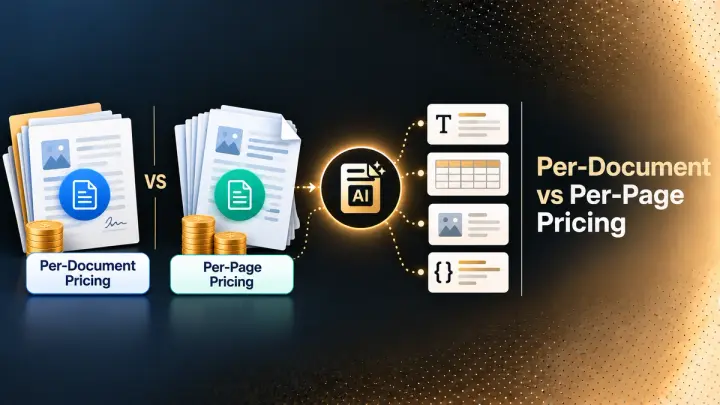
Per-Document vs Per-Page Pricing in AI Extraction Services (2026)
Per-document vs per-page pricing for AI extraction: Google Document AI 2026 invoice and form parser rates, per-document vendors, and cost-by-length math.