%20{%20:root%20{%20--deepread-stroke:%20%23E5E7EB;%20}%20}%20.dark%20{%20--deepread-stroke:%20%23E5E7EB;%20}%20%3c/style%3e%3crect%20x='40'%20y='30'%20width='220'%20height='260'%20rx='28'%20ry='28'%20stroke='var(--deepread-stroke)'%20stroke-width='16'%20fill='none'/%3e%3cpath%20d='M180%2030v52c0%2010%208%2018%2018%2018h62'%20stroke='var(--deepread-stroke)'%20stroke-width='16'%20fill='none'/%3e%3cline%20x1='70'%20y1='130'%20x2='200'%20y2='130'%20stroke='var(--deepread-stroke)'%20stroke-width='16'%20stroke-linecap='round'/%3e%3cline%20x1='70'%20y1='165'%20x2='200'%20y2='165'%20stroke='var(--deepread-stroke)'%20stroke-width='16'%20stroke-linecap='round'/%3e%3cline%20x1='70'%20y1='200'%20x2='170'%20y2='200'%20stroke='var(--deepread-stroke)'%20stroke-width='16'%20stroke-linecap='round'/%3e%3c!--%20green%20download%20arrow%20in%20bottom%20right%20corner%20--%3e%3cpath%20d='M210%20202v58'%20stroke='var(--deepread-accent)'%20stroke-width='18'%20stroke-linecap='round'/%3e%3cpath%20d='M195%20245l15%2015%2015-15'%20fill='none'%20stroke='var(--deepread-accent)'%20stroke-width='18'%20stroke-linecap='round'%20stroke-linejoin='round'/%3e%3c/svg%3e)
Data Extraction Platform: The Full Category, Explained (2026)
"Data extraction platform" spans three categories — ETL pipelines, web scraping, and document extraction. Here's how they differ and what to evaluate.
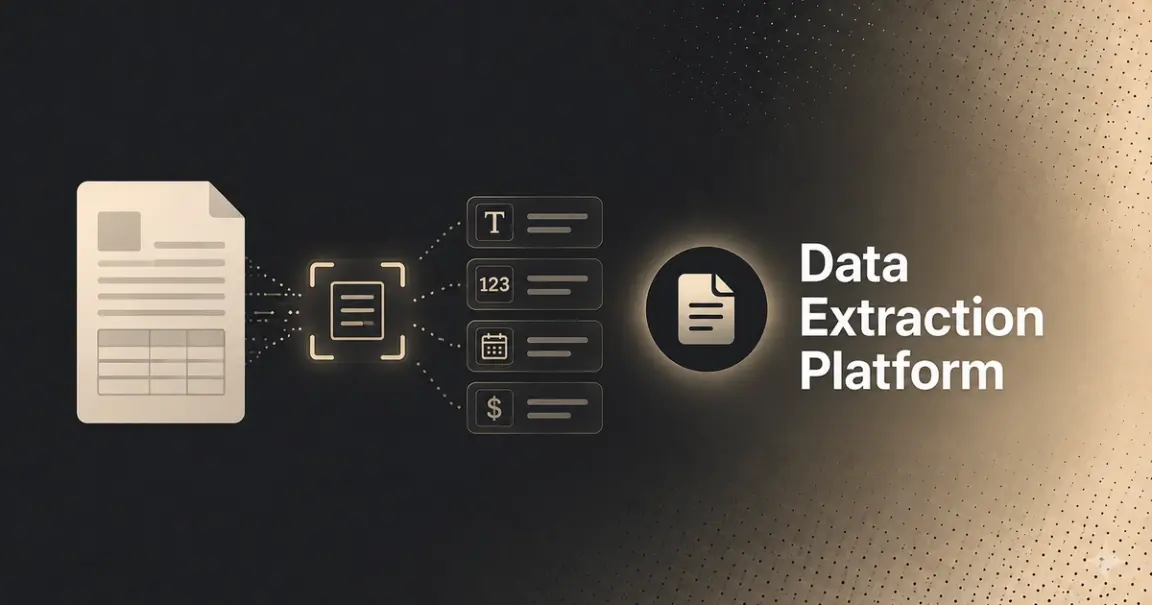
"Data extraction platform" sounds like one thing but covers three genuinely different jobs: moving structured data out of SaaS applications, databases, and data lakes into a warehouse (ETL/ELT), pulling data from public websites at scale (web scraping), and reading unstructured files like PDFs, scans, and images into usable data (document extraction). A business search for this term lands on all three, often in the same "best of" listicle, without much explanation of why they're different purchases.
This covers all three categories, what actually differs between them, and how to evaluate a platform once you know which one you actually need.
Who This Is For
- Data and analytics teams evaluating ETL/ELT platforms to centralize SaaS, database, and API data into a warehouse for reporting and analysis.
- Teams building on public web data — pricing intelligence, lead generation, market research — evaluating scraping infrastructure.
- Ops and engineering teams processing unstructured documents (invoices, forms, claims, contracts) who need extraction from files rather than systems or websites.
- Anyone comparing vendors across this space who's found the category harder to navigate than expected because it isn't actually one category.
Three Categories, Not One Market
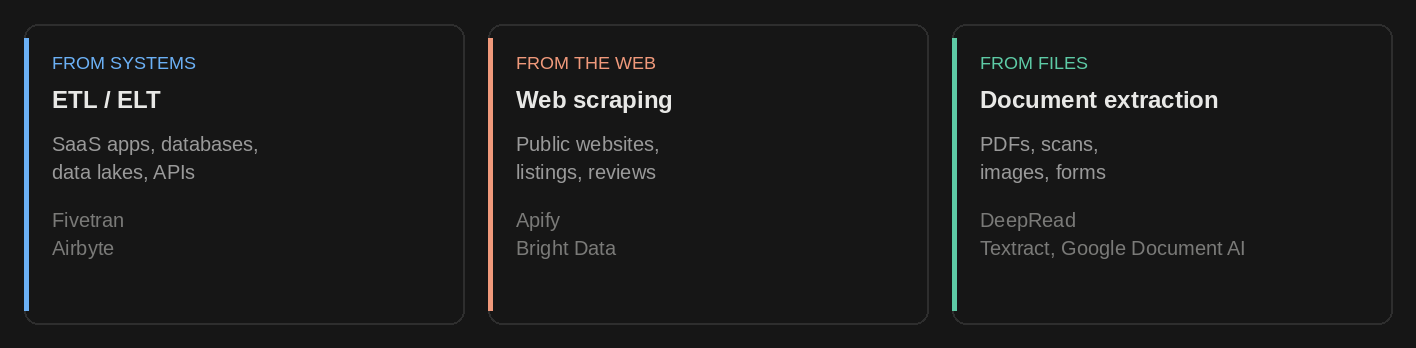
ETL/ELT data-pipeline platforms move data from SaaS applications, databases, data lakes, streaming systems, and APIs into a centralized destination for analysis. Most modern platforms in this category are ELT rather than older-style ETL — loading raw data first and transforming it afterward, typically with a tool like dbt, rather than transforming before loading. Some platforms also support reverse ETL — pushing transformed warehouse data back into the SaaS tools a business actually operates in (Fivetran's Activations product is a current example). This is the "modern data stack" category — Fivetran, Airbyte, Stitch, Matillion, built for structured or semi-structured data your organization already has access to, just spread across many systems.
Web scraping platforms extract data from public websites — product prices, listings, reviews, contact information, at scale, handling proxy rotation, bot detection, and page rendering that a simple script can't. Apify and Bright Data lead this category, aimed at teams needing data that lives on the open web rather than inside a system they already have credentials for.
Document extraction platforms read unstructured or semi-structured files — PDFs, scanned images, forms — and return structured data. This is where DeepRead, AWS Textract, Google Document AI, and Nanonets operate, built for data trapped inside documents rather than inside a database or a webpage.
The dividing line that actually matters when choosing: where does your data currently live, in a system you have API access to, on a public website, or inside a file someone sent you?
Why a Platform Instead of a Script?
All three categories exist because the ad hoc alternative — a custom script or a one-off manual pull, breaks down at scale. A script that syncs one API on a schedule works fine until the API changes its schema, the job silently fails at 3am, or five more data sources get added and nobody's tracking which ones are current. What a platform actually adds across all three categories: standardized, maintained connectors or scrapers so you're not rebuilding integration logic yourself, orchestration and scheduling, monitoring and alerting when something breaks, and reliability at a volume manual scripts don't hold up against.
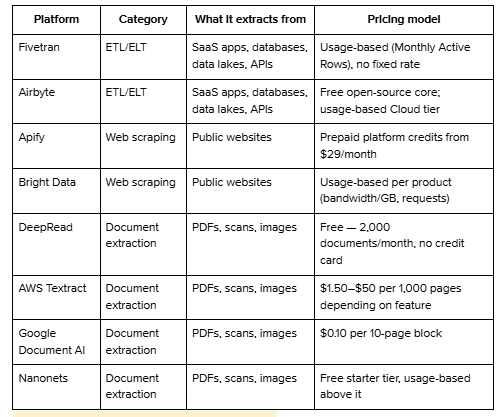
Platform Differentiation Table
ETL/ELT Data-Pipeline Platforms
Fivetran is one of the most established managed ELT platforms, syncing data from hundreds of connectors into warehouses like Snowflake, BigQuery, and Databricks.
- Strengths: Broad, well-maintained connector library (700+); minimal engineering overhead once configured; strong reliability reputation among established data teams.
- Best use case: Mid-market and enterprise teams on a major cloud warehouse needing reliable, hands-off syncing across many standard SaaS and enterprise sources.
- Pricing: Fivetran doesn't publish a single price. Billing is usage-based on Monthly Active Rows (MAR — rows created, updated, or deleted each month), calculated per connector with a $5 base charge on standard connections, plus a genuinely free plan. Confirm current rates directly, since the consumption model makes any flat number here misleading.
Airbyte is an ELT platform available as free, self-hosted open source or as a managed Airbyte Cloud offering.
- Strengths: Genuinely free open-source core for teams with engineering capacity; the connector development kit makes building custom connectors realistic for niche internal APIs; a real cost advantage over Fivetran at lower data volumes.
- Best use case: Engineering-heavy teams wanting self-hosting for compliance/data-residency reasons, or startups wanting to validate connectors without committing to Fivetran-scale spend.
- Pricing: Core (self-hosted) is free. Airbyte Cloud uses usage-based, volume-tiered pricing; Enterprise tier pricing isn't publicly disclosed. Confirm current rates directly given how frequently usage-based tiers shift.
Web Scraping Platforms
1. Apify
Apify is a cloud platform for building, running, and scaling web scrapers ("Actors"), with a large marketplace of pre-built scrapers alongside custom development tools (Crawlee, CLI, Git-based deploys).
- Strengths: Large scraper marketplace (30,000+ Actors) lowers the barrier for common scraping targets; genuinely developer-friendly tooling for custom builds; predictable, unified billing (compute, proxy, and storage under one credit system) compared to Bright Data's per-product billing.
- Best use case: Teams wanting a full scraping platform — hosting, scheduling, storage, rather than assembling scraping infrastructure themselves, especially for common targets with pre-built Actors already available.
- Pricing: Paid plans start at $29/month on prepaid platform credits covering compute, proxy usage, and storage; unused monthly credits typically don't roll over.
2. Bright Data
Bright Data is an established proxy and web-data infrastructure provider, selling residential/datacenter proxies, unblocking APIs, and pre-built datasets as separate product lines.
- Strengths: Deep infrastructure for genuinely hard-to-scrape targets, with fine-grained geo-targeting (country/region/city/ASN); pre-built datasets available for common data types without building a scraper at all.
- Best use case: Teams with high-volume or infrastructure-intensive scraping needs, particularly where Apify's marketplace doesn't already cover the target site well.
- Pricing: No fixed monthly plan — priced by product (proxy bandwidth per GB, API requests per 1,000). Multiple products are frequently combined, so total cost depends on which mix a specific use case requires; confirm directly rather than relying on any single per-unit figure, since these shift often.
A 2026 trend worth noting: both Apify and Bright Data have shipped MCP server integrations, letting AI agents interact directly with scraping infrastructure as a tool rather than requiring a human to configure and run a scrape manually. Worth checking if your evaluation criteria include agent-based workflows, since this is a genuinely active area of development in this category right now, not a stable feature to assume is equivalent across vendors.
Document Extraction Platforms
This is the category DeepRead operates in specifically, and it's worth a fuller breakdown for that reason.
DeepRead
DeepRead is a schema-driven document extraction API — invoices, medical bills, bank statements, and similar documents come back as structured JSON with a per-field confidence score, using multi-model consensus rather than a single model's output.
- Strengths: The one platform in this entire category comparison — ETL, scraping, or document- with a fully public, checkable accuracy methodology, run against Nanonets, Reducto, and Landing AI on identical documents against a manually verified ground truth. Async processing and webhook delivery are standard; uncertain fields are flagged needs_review rather than returned silently wrong.
- Best use case: Teams whose extraction problem specifically lives in documents — invoices, claims, forms, rather than systems or websites, wanting verifiable accuracy rather than an asserted number.
- Pricing: Free — 2,000 documents/month, no credit card required.
AWS Textract, Google Document AI, and Nanonet
AWS Textract, Google Document AI, and Nanonets round out the category — cloud-native extraction APIs (Textract, Google Document AI) for teams already inside that infrastructure ecosystem, and no-code extraction (Nanonets) for non-technical teams wanting fast setup without engineering involvement. Full profiles, verified pricing, and specific limitations for each are in the dedicated document-extraction comparison linked above.
What to Evaluate, Once You Know Which Category You're In
- Where does your data actually originate? This single question determines the category — a system you have credentials for (ETL), a public website (scraping), or a file someone sent you (document extraction). Mixing these up wastes evaluation time on the wrong vendors entirely.
- Usage-based pricing needs a volume estimate before it means anything. Nearly every platform across all three categories bills by usage (rows, credits, pages, bandwidth) rather than a flat rate — get a real cost estimate against your actual volume, not a headline "starting at" number.
- Check whether accuracy or reliability claims are independently checkable. This matters most in document extraction, where accuracy varies significantly by document type, but connector reliability in ETL and scraper success rate in web scraping deserve the same scrutiny.
- Compliance and security posture, especially for ETL platforms. Data pipeline tools move data between systems that often include customer or financial records — SOC 2 and GDPR support are worth confirming directly, the same way they matter in document extraction, even though ETL vendor marketing tends to foreground speed and connector count over this.
- Open-source or self-hosted options exist in two of the three categories (Airbyte for ETL, Tesseract/PaddleOCR for document extraction), worth considering if engineering capacity exists and vendor cost is the primary constraint.
Common Challenges Across This Category
- Usage-based pricing that's genuinely hard to estimate upfront. Fivetran's per-connector MAR billing and Bright Data's per-product bandwidth pricing both require a real usage estimate to price accurately — a "starting at" number from any vendor in this space should be treated as a floor, not a forecast.
- Category confusion during vendor evaluation. Because "data extraction platform" gets used for all three categories, it's easy to end up comparing an ETL platform against a document extraction API as if they solve the same problem; they don't overlap functionally at all.
- Connector or scraper reliability degrades over time. ETL connectors break when source APIs change; scrapers break when target websites change their markup. Both categories require ongoing maintenance that a one-time setup cost doesn't capture.
- Document accuracy assumed to be uniform across document types. In the document extraction category specifically, a platform's accuracy on invoices doesn't predict its accuracy on handwritten forms or scanned contracts — this needs testing per document type, not assumed from an overall accuracy claim.
Conclusion
"Data extraction platform" isn't one purchase decision; it's three, depending on where your data actually lives. ETL/ELT platforms move data between systems you already have access to. Web scraping platforms pull data from the open web. Document extraction platforms read unstructured files. All three exist for the same underlying reason: a custom script or manual process breaks down at real volume, and a platform adds the maintained connectors, orchestration, and reliability that scale requires. Get the category right first; only then does comparing specific vendors within it make sense. For the document extraction category specifically, which is where DeepRead operates — a fuller, named-vendor comparison with verified pricing and benchmarked accuracy is available in our dedicated guide.
FAQ
Is a data extraction platform the same as an ETL tool?
Not exactly; ETL/ELT platforms (Fivetran, Airbyte) are one sub-category of the broader "data extraction platform" term, specifically for moving data between systems. The term also covers web scraping platforms and document extraction platforms, which solve different problems.
Which category of data extraction platform do I need?
It depends entirely on where your data currently lives. If it's inside a SaaS app, database, or API you have credentials for, that's ETL/ELT. If it's on public websites, that's web scraping. If it's inside files like PDFs, scans, or images, that's document extraction.
What's the difference between ETL and ELT?
ETL transforms data before loading it into the destination; ELT loads raw data first and transforms it afterward, typically using a separate tool like dbt. Most modern platforms in this category (Fivetran, Airbyte) are ELT, which is generally more flexible since raw data stays available for reprocessing without re-extracting from the source.
Why don't most of these platforms publish fixed pricing?
Nearly all of them bill by usage — rows moved, records scraped, pages processed, because cost scales directly with data volume rather than a flat subscription making sense. Get a quote or estimate based on your actual expected volume rather than trusting a "starting at" headline figure.
Can one platform cover more than one of these categories?
Generally no, the underlying technology is different enough (API/database connectors vs. proxy and browser infrastructure vs. document/vision models) that vendors specialize rather than covering all three well. Some vendors have expanded slightly at the edges (e.g., ETL platforms adding reverse ETL, or limited document sources), but a true cross-category platform is rare.
Is DeepRead relevant to the ETL or web scraping categories in this guide, or only document extraction?
Only document extraction. DeepRead reads unstructured files — PDFs, scans, images- and has no functional overlap with moving data between systems (ETL/ELT) or pulling data from public websites (web scraping). Its relevance in this piece is limited to the document extraction third of the category, not the full "data extraction platform" umbrella.
More articles
Structured Data Extraction: A Technical Guide
How to extract structured data from documents using an AI API, the architecture, grounding, and named tools compared.
Key Features of AI Document Workflow Automation
AI document workflow automation features, governance, prioritization framework, and real examples with measurable benefits for 2026.