%20{%20:root%20{%20--deepread-stroke:%20%23E5E7EB;%20}%20}%20.dark%20{%20--deepread-stroke:%20%23E5E7EB;%20}%20%3c/style%3e%3crect%20x='40'%20y='30'%20width='220'%20height='260'%20rx='28'%20ry='28'%20stroke='var(--deepread-stroke)'%20stroke-width='16'%20fill='none'/%3e%3cpath%20d='M180%2030v52c0%2010%208%2018%2018%2018h62'%20stroke='var(--deepread-stroke)'%20stroke-width='16'%20fill='none'/%3e%3cline%20x1='70'%20y1='130'%20x2='200'%20y2='130'%20stroke='var(--deepread-stroke)'%20stroke-width='16'%20stroke-linecap='round'/%3e%3cline%20x1='70'%20y1='165'%20x2='200'%20y2='165'%20stroke='var(--deepread-stroke)'%20stroke-width='16'%20stroke-linecap='round'/%3e%3cline%20x1='70'%20y1='200'%20x2='170'%20y2='200'%20stroke='var(--deepread-stroke)'%20stroke-width='16'%20stroke-linecap='round'/%3e%3c!--%20green%20download%20arrow%20in%20bottom%20right%20corner%20--%3e%3cpath%20d='M210%20202v58'%20stroke='var(--deepread-accent)'%20stroke-width='18'%20stroke-linecap='round'/%3e%3cpath%20d='M195%20245l15%2015%2015-15'%20fill='none'%20stroke='var(--deepread-accent)'%20stroke-width='18'%20stroke-linecap='round'%20stroke-linejoin='round'/%3e%3c/svg%3e)
Best Mortgage Document Automation Software (2026)
Comparing the best mortgage document automation software for 2026 — extraction platforms, verification tools, and full LOS options, with verified pricing.
A single mortgage loan file can run past 2,000 pages, spread across dozens of document types — loan applications, pay stubs, W-2s, bank statements, tax returns, appraisals, title reports, closing disclosures, homeowners insurance declarations, flood certificates; arriving in formats that vary by borrower, employer, and lender. Adoption of AI to handle this is accelerating: according to STRATMOR Group's survey on AI in mortgage lending, 63% of AI-using lenders report using it for document classification and indexing, and 54% for document reading.
This compares the leading options across the full category — since "mortgage document automation software" spans legacy rule-based routing, AI extraction platforms, mortgage-specific verification tools, full loan origination systems, and borrower-facing workflow platforms, each solving a different piece of the problem.
Who This Is For
- Mortgage processors and underwriters looking to reduce manual data entry and document review time without sacrificing accuracy on income and asset verification.
- Lending operations leaders evaluating whether to adopt a mortgage-specific platform or build extraction into an existing loan origination system (LOS).
- Engineering teams at lenders, brokers, or mortgage tech companies deciding between a full platform and building on a general-purpose extraction API.
- Compliance and post-close/QC teams who need document handling that's audit-ready across the full loan lifecycle, not just at intake.
Four Categories of Mortgage Document Automation
- Rule-based systems follow fixed "if this, then that" logic — renaming files, routing PDFs, sending alerts. Fast to set up, but they break down as soon as documents vary from the expected pattern, which is most of the time in mortgage lending. Largely a legacy category at this point, still present in older stacks but increasingly replaced by the categories below.
- AI extraction platforms specialize in reading and structuring document data without requiring a template per format. DeepRead, Lido, and AWS Textract's AnalyzeLending API fall here; they don't run the loan itself; they feed clean data into whatever system does.
- Mortgage-specific verification platforms go beyond extraction, calculating qualifying income, detecting altered documents, and producing analysis reports tailored to underwriting decisions. Ocrolus is the clearest example.
- Full loan origination systems and borrower-facing platforms run large parts of the loan lifecycle, with document automation as one feature inside a much broader system — ICE Mortgage Technology Encompass, Blue Sage, and a growing set of workflow-and-automation platforms (Addy, airSlate, TRUE, Wilqo, SimpleNexus) that layer AI review, condition tracking, and e-signature on top of or alongside an LOS.
Platform Differentiation Table
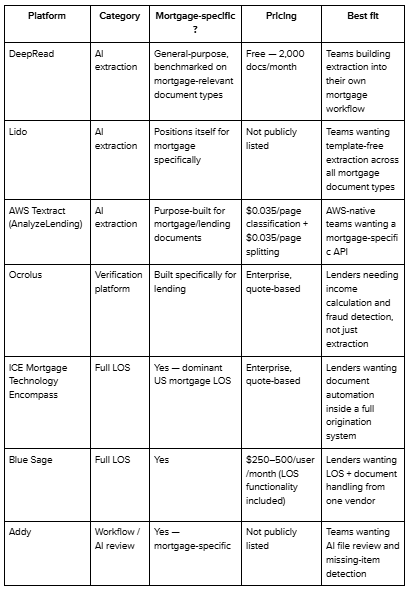
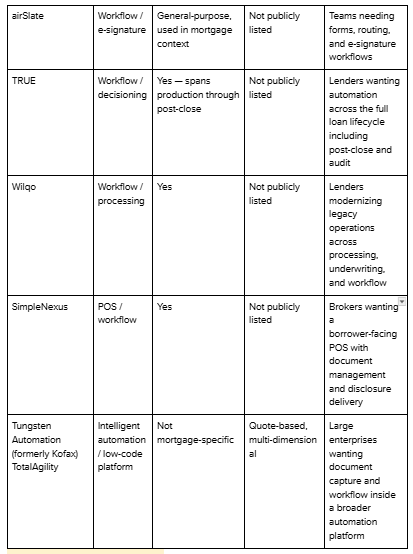
AI Extraction Platforms
1. DeepRead
DeepRead is a schema-driven document extraction API — pay stubs, bank statements, W-2s, and similar documents come back as structured JSON with a per-field confidence score, using multi-model consensus rather than a single model's output.
Three of DeepRead's eight publicly benchmarked document types are exactly the core mortgage income-verification documents this category revolves around:
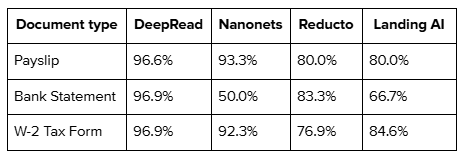
- Strengths: The only platform in this comparison with a fully public, checkable accuracy methodology specifically on payslip, bank statement, and W-2 extraction — the same documents run through DeepRead and three named competitors, compared against a manually verified ground truth. Async processing and webhook delivery are standard, relevant given how large mortgage loan files get. Uncertain fields are flagged needs_review rather than returned silently wrong, worth noting specifically for income figures that directly affect qualifying calculations.
- Honest limitation: DeepRead is an extraction layer, not a mortgage-specific platform — it doesn't calculate qualifying income, run fraud detection tuned to lending patterns, or integrate natively with an LOS out of the box. It's the component a team would build a mortgage workflow on top of, not a finished underwriting tool.
- Pricing: Free — 2,000 documents/month, no credit card required.
2. Lido
Lido positions itself specifically around mortgage document automation, marketing template-free extraction across the full range of mortgage document types without requiring a separate model per format variation.
- Strengths: Purpose-marketed for the mortgage use case specifically, covering the full range of document types a loan file might contain.
- Limitations: No independently published accuracy benchmark found for mortgage-specific document types; pricing isn't publicly listed.
- Pricing: Not publicly disclosed — confirm directly.
3. AWS Textract (AnalyzeLending API)
AWS Textract (AnalyzeLending API) is Amazon's mortgage-specific extraction API, automatically classifying document types within a loan package (pay stubs, bank statements, tax forms) and extracting relevant fields, distinct from Textract's general-purpose APIs.
- Strengths: Native classification of mixed mortgage document bundles, not just extraction from a single known document type — useful given how loan files arrive as large, mixed-format packages. Deep integration for teams already on AWS infrastructure.
- Limitations: Notably more expensive than Textract's general-purpose APIs given the added classification step; you're still building the surrounding workflow (income calculation, fraud rules, LOS integration) yourself.
- Pricing: $0.035 per page for classification plus $0.035 per page for splitting (roughly $70 per 1,000 pages combined) — confirmed on AWS's public pricing.
Mortgage-Specific Verification Platform
1. Ocrolus
Ocrolus is built specifically for lending, extracting data from bank statements, pay stubs, and tax returns, then running income calculation models, fraud/alteration detection, and producing borrower analysis reports for underwriters.
- Strengths: Goes meaningfully beyond extraction — income calculation and document fraud detection are built in, not something you'd need to build separately. Integrates with major loan origination systems including Encompass, Byte, and LoanPASS.
- Limitations: Worth being direct about here, independent reviews report real concerns around processing speed, occasional missing information requiring manual double-checking, and cost-effectiveness at scale, despite Ocrolus's own stated accuracy claims. It's also mortgage-and-lending-only, so not useful outside that scope, and enterprise pricing puts it out of reach for smaller brokerages.
- Pricing: Enterprise, quote-based; not publicly listed.
Full Loan Origination Systems
1. ICE Mortgage Technology Encompass
ICE Mortgage Technology Encompass is the dominant loan origination system in the US mortgage market, with document automation as one feature inside a full origination platform covering the entire loan lifecycle.
- Strengths: End-to-end coverage — document handling doesn't sit as a separate system you have to integrate, since it's native to the platform running the loan.
- Limitations: A much larger commitment than a standalone extraction tool — appropriate for lenders wanting to run their entire origination process on one platform, not for teams that just need better document extraction inside an existing system.
- Pricing: Enterprise, quote-based.
2. Blue Sage
Blue Sage is a full LOS with document management included as part of the platform rather than sold separately.
- Strengths: One vendor for both loan origination and document handling, avoiding a separate integration project.
- Limitations: Priced as full LOS functionality, not comparable to standalone document tools at the same price point, a meaningfully bigger commitment than an extraction API.
- Pricing: Not publicly listed.
Workflow, AI Review, and Borrower-Facing Platforms
This category covers tools that automate parts of the mortgage process beyond pure extraction — AI file review, condition tracking, e-signature, and borrower-facing document collection.
1. Addy
Addy markets AI that reviews files, finds missing items, and prepares files within the mortgage process. Worth noting it's evaluated here from a source (its own blog) that ranks itself first in its own comparison — a disclosed conflict worth being aware of rather than treating the ranking as independent.
- Best fit: Teams wanting AI-assisted file review and missing-document detection specifically, as part of loan prep.
2. airSlate
airSlate provides forms, routing, and e-signature workflow automation, used in mortgage contexts alongside more specialized document extraction tools.
- Best fit: Teams whose primary gap is intake, routing, and e-signature rather than data extraction itself.
3. TRUE AI
TRUE AI automates document handling, borrower intelligence, validation, and decisioning across the loan lifecycle, with automation extending into post-close and audit workflows specifically — one of the few platforms in this list explicitly addressing that later stage.
- Best fit: Lenders wanting automation to extend beyond origination into post-close and audit, not just intake.
4. Wilqo
Wilqo offers coordinated automation across processing, underwriting, and workflow management, positioned for lenders modernizing legacy operations at scale.
- Best fit: Lenders replacing older, disconnected point solutions with one coordinated automation layer.
5. SimpleNexus
SimpleNexus is a borrower-facing point-of-sale (POS) platform with document management and automated disclosure delivery built in, integrating directly with Encompass.
- Best fit: Brokers wanting a borrower-facing digital mortgage experience with document collection built in, particularly if already running Encompass.
6. Tungsten Automation
Tungsten Automation (formerly Kofax) TotalAgility is an intelligent automation and low-code platform combining AI-driven document processing with process orchestration — not mortgage-specific, but used by some lenders as part of a larger document automation and workflow setup.
- Best fit: Lenders wanting one platform across multiple document-heavy processes, not just mortgage, with low-code tooling for building and adjusting workflows in-house.
- Pricing: Not publicly listed; multi-dimensional and quote-based.
What to Evaluate
- Accuracy on your actual document mix, not a demo set — pay stubs, bank statements, and W-2s vary enormously by employer and format, and accuracy on one doesn't guarantee accuracy on another.
- Does it classify mixed document bundles, or does it assume one document type per file? A real loan file is rarely submitted as cleanly separated documents.
- Coverage across the full document set — income verification is only part of it; appraisals, title reports, closing disclosures, insurance declarations, and flood certificates are all part of a complete loan file and not every tool covers all of them equally well.
- Confidence scoring on income-relevant fields specifically — an error in a qualifying income figure has direct financial consequences, not just an inconvenience.
- Condition-clearing and checklist automation, if relevant — some platforms automatically mark underwriting conditions resolved when the correct document is received, which meaningfully reduces manual tracking versus extraction alone.
- Coverage beyond origination — post-close audit and QC review is a distinct stage most platforms in this category don't address; TRUE is a notable exception worth checking if this matters to your workflow.
- LOS integration depth, if you're not building the workflow yourself — confirm native connectors to Encompass or whichever system you run loans through.
- Is the accuracy claim independently checkable? Most platforms in this category assert accuracy without a public methodology — ask what document set any number was measured against.
Common Challenges
- Pilot accuracy on clean sample documents doesn't predict real borrower document accuracy — pay stubs and bank statements from real employers and banks vary far more than a curated demo set.
- Mixed document bundles treated as single files by tools not built for mortgage intake specifically, creating manual sorting work upstream of extraction.
- Income-relevant field errors treated with the same confidence threshold as low-stakes fields, when they arguably need stricter scrutiny given direct impact on loan qualification.
- Post-close and audit stages left out of the automation project entirely, since most tooling and evaluation attention concentrates on intake and origination, leaving QC and audit as manual as before.
- LOS integration effort underestimated — a platform's extraction quality doesn't guarantee it plugs cleanly into your existing origination system without real implementation work.
Conclusion
There's no single "best" mortgage document automation software — it depends on whether you need a component to build with, a specialized underwriting tool, a full origination system, or a workflow layer on top of one. DeepRead, Lido, and AWS Textract's AnalyzeLending API suit teams building their own mortgage workflow and wanting accurate, verifiable extraction as the foundation. Ocrolus suits lenders wanting income calculation and fraud detection built in. Encompass and Blue Sage suit lenders wanting document handling inside a full origination system.
Addy, airSlate, TRUE, Wilqo, and SimpleNexus each address a specific slice — AI review, e-signature, post-close automation, coordinated modernization, or borrower-facing collection, worth matching to the specific gap in your process rather than assuming any one of them covers the whole lifecycle. Whichever direction fits, test accuracy on your own borrower documents, pay stubs, bank statements, and W-2s specifically, before committing, since that's the layer every category above ultimately depends on.
FAQ
What's the difference between a standalone extraction tool and a mortgage verification platform like Ocrolus?
A standalone extraction platform (DeepRead, Lido, AWS Textract) reads and structures document data; you build the income calculation, fraud checks, and workflow logic around it. A verification platform like Ocrolus includes income calculation and fraud detection as part of the product, at the cost of being mortgage-and-lending-only and typically enterprise-priced.
Do I need a full loan origination system, or is extraction software enough?
It depends on whether you're running the entire loan lifecycle through one system or looking specifically to reduce manual document review inside an existing process. If you already have an LOS and just need better document extraction feeding into it, a standalone extraction platform is usually the more direct fix.
Does mortgage document automation cover anything beyond loan origination?
It should, but most tools concentrate on intake and origination specifically. Post-close audit and QC review is a distinct stage that fewer platforms address — TRUE is one of the few in this list explicitly extending automation into that stage, worth checking directly if post-close is part of your need.
How accurate does mortgage document extraction actually need to be?
Higher accuracy matters most on income-relevant fields specifically — pay stub amounts, W-2 figures, bank statement balances — since errors there directly affect loan qualification decisions. It's worth testing accuracy per document type rather than trusting a single overall accuracy number.
What does AWS Textract's AnalyzeLending API do differently from its general extraction APIs?
AnalyzeLending automatically classifies document types within a mixed mortgage loan package, pay stubs, bank statements, and tax forms before extracting fields, which Textract's general-purpose APIs don't do. It's priced accordingly, at roughly $70 per 1,000 pages for classification and splitting combined.
Is DeepRead a mortgage-specific platform?
No. DeepRead is a general-purpose document extraction API, not built specifically for mortgage workflows. Its relevance here comes from published accuracy on the specific document types mortgage income verification depends on (payslips, bank statements, W-2s), not from mortgage-specific features like income calculation or LOS integration.
More articles
Structured Data Extraction: A Technical Guide
How to extract structured data from documents using an AI API, the architecture, grounding, and named tools compared.
Key Features of AI Document Workflow Automation
AI document workflow automation features, governance, prioritization framework, and real examples with measurable benefits for 2026.