%20{%20:root%20{%20--deepread-stroke:%20%23E5E7EB;%20}%20}%20.dark%20{%20--deepread-stroke:%20%23E5E7EB;%20}%20%3c/style%3e%3crect%20x='40'%20y='30'%20width='220'%20height='260'%20rx='28'%20ry='28'%20stroke='var(--deepread-stroke)'%20stroke-width='16'%20fill='none'/%3e%3cpath%20d='M180%2030v52c0%2010%208%2018%2018%2018h62'%20stroke='var(--deepread-stroke)'%20stroke-width='16'%20fill='none'/%3e%3cline%20x1='70'%20y1='130'%20x2='200'%20y2='130'%20stroke='var(--deepread-stroke)'%20stroke-width='16'%20stroke-linecap='round'/%3e%3cline%20x1='70'%20y1='165'%20x2='200'%20y2='165'%20stroke='var(--deepread-stroke)'%20stroke-width='16'%20stroke-linecap='round'/%3e%3cline%20x1='70'%20y1='200'%20x2='170'%20y2='200'%20stroke='var(--deepread-stroke)'%20stroke-width='16'%20stroke-linecap='round'/%3e%3c!--%20green%20download%20arrow%20in%20bottom%20right%20corner%20--%3e%3cpath%20d='M210%20202v58'%20stroke='var(--deepread-accent)'%20stroke-width='18'%20stroke-linecap='round'/%3e%3cpath%20d='M195%20245l15%2015%2015-15'%20fill='none'%20stroke='var(--deepread-accent)'%20stroke-width='18'%20stroke-linecap='round'%20stroke-linejoin='round'/%3e%3c/svg%3e)
AI-Powered Fast Redaction Software: A 2026 Guide
Comparing AI-powered redaction software — document and multimedia types, named tools, true vs. visual-only redaction, and what to evaluate.
"Redaction software" now spans two content types that use almost entirely different technology under the same marketing language: document/text redaction, which removes PII from PDFs and records, and multimedia redaction, which blurs faces and license plates in video and mutes spoken PII in audio. Both get sold as "AI-powered" and "fast," but a tool built for one rarely does the other well.
This is a guide to both — the types of redaction technology involved, named tools across document and multimedia categories, the difference between redaction that's genuinely permanent and redaction that only looks that way, how industries from law enforcement to M&A actually use this, and what to evaluate before trusting sensitive data (or footage) to a vendor.
Who This Is For
- Legal and compliance teams handling FOIA requests, litigation discovery, or contract review where PII exposure carries real regulatory risk.
- Law enforcement and public safety agencies redacting body camera, dashcam, and CCTV footage before public release or court disclosure.
- Deal teams and M&A professionals redacting due diligence documents at volume before disclosure.
- Healthcare and financial services teams removing PHI or financial account details from records, or patient-identifying footage, before sharing or archiving.
- HR, recruiting, and real estate professionals handling personal and financial details in transaction and application documents.
- Engineering and data teams building redaction into a document processing pipeline, or scrubbing PII from datasets before using them to train or evaluate machine learning models.
Types of AI-Powered Redaction
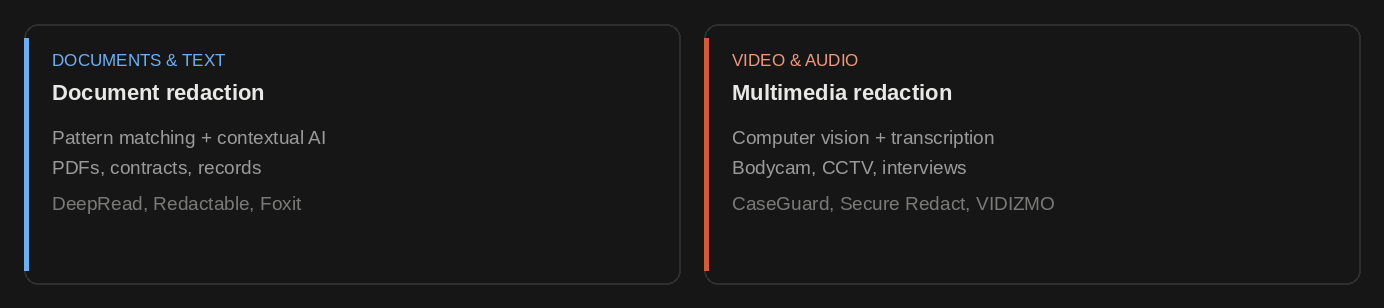
1. Document/Text Redaction
- Pattern-based (rule-based) redaction matches sensitive data against known formats — a Social Security number's digit structure, a credit card number's length and checksum, an email address's syntax. Fast and reliable for data that follows a fixed pattern, but blind to anything that doesn't — a name, an address, a case-specific reference number.
- Contextual AI redaction uses document understanding rather than fixed patterns to identify sensitive information, recognizing that a string of text is a person's name because of where it appears and how it's used, not because it matches a template.
- Manual and hybrid redaction still has a role even in "AI-powered" tools — a human reviewer confirming, correcting, or adding redactions the automated pass missed or flagged as uncertain.
2. Multimedia Redaction (Video/Audio)
A genuinely different technology stack from document redaction — computer vision instead of document-layout understanding, and object tracking instead of static field detection:
- Visual detection and tracking. AI identifies faces, license plates, screens, weapons, and other objects, then tracks them across frames as a subject moves through the footage, rather than detecting a static field once, the way document redaction does. Some tools let you designate one person to stay visible while every other face in the scene is masked, relevant for use-of-force reviews where a specific individual's identity is the point of the footage.
- Audio redaction via transcription. The audio track is automatically transcribed, and spoken PII — names, addresses, phone numbers, and in some tools 30+ additional categories — is detected in the transcript and can be muted or bleeped directly, rather than requiring someone to manually mark timestamps by ear.
- Metadata and multi-format handling. Beyond visible content, location data, device IDs, and other embedded metadata get scrubbed; leading tools accept 200+ video and audio formats and can merge footage from multiple cameras covering the same incident into one redaction pass.
- A meaningful workflow difference from document redaction: many multimedia tools let you disable or undo a redaction before final export, treating the redacted version as a working draft until you're satisfied — a more forgiving workflow than document redaction, where the emphasis is almost entirely on permanence from the start.
- Human review remains essential, and reputable vendors say so directly. Difficult conditions — low light, obstructed views, crowded scenes — mean automated detection alone isn't fully reliable. One vendor's own published claim is a useful, honestly-hedged benchmark for the category: recall above 99% of identifiable PII in security video, while explicitly noting no tool hits 100% across the full range of real-world CCTV, bodycam, and dashcam conditions.
True Redaction vs. Visual-Only Redaction: The Distinction That Actually Matters
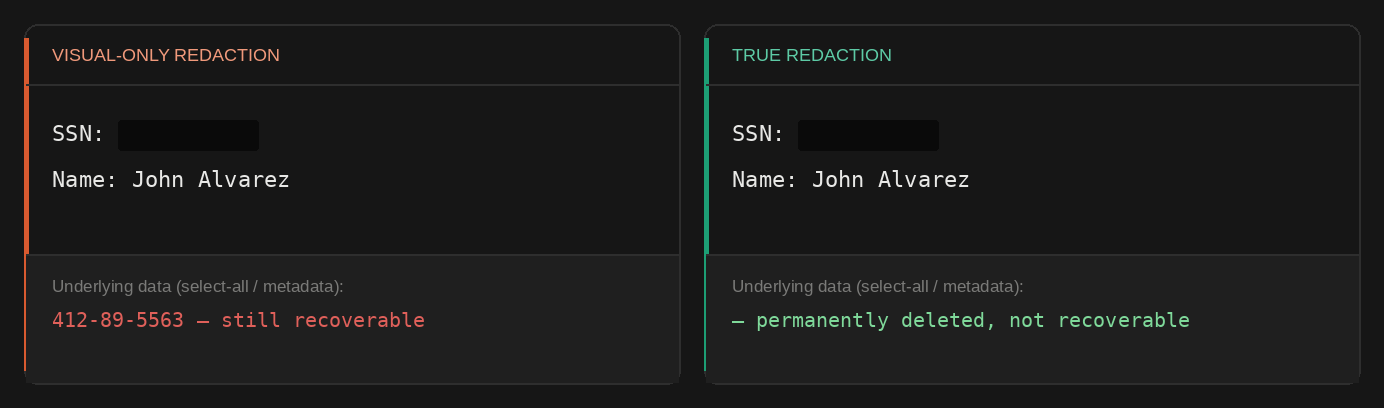
Worth being direct about, since it's the most common compliance failure mode across both content types: a black box over text, or a blur over a face, is not the same as redaction if the underlying data is still recoverable. In documents, this means the underlying text is still present — selectable, copyable, or recoverable through metadata, even though it looks hidden. In video, a "blurred" export that can be reversed or a face that's only obscured in one frame of a tracked sequence carries the same risk.
Genuine redaction permanently removes the underlying data — not just its visible representation, including hidden content like metadata, embedded scripts, or (in video) location and device data. This is worth confirming directly with any tool before trusting it with real sensitive material: ask specifically whether redacted content is deleted from the file, or only visually obscured.
Where AI-Powered Redaction Gets Used
Legal and government (FOIA, litigation, court filings). Public records requests and litigation discovery routinely involve documents that must be disclosed publicly or to opposing counsel, minus specific protected information. Redaction here carries direct legal consequences: under-redaction can violate privacy law, and over-redaction can trigger a legal challenge to the disclosure itself.
Law enforcement and public safety. The single largest market for video redaction specifically, driven by real, dated regulation — California's AB 748, in force since July 2019, requires critical-incident body-camera video to be released within 45 days and explicitly permits agencies to use redaction technology, including blurring or distorting images or audio, to protect privacy before disclosure. Bodycam, dashcam, and CCTV footage routinely capture bystanders who aren't the subject of an incident but whose identity still needs protecting before public release.
M&A and deal-room due diligence. Buyers reviewing a target company's financial records, contracts, and HR files need access to substance without exposure to competitively sensitive details. Deal timelines are typically tight, which is why bulk redaction across hundreds of documents at once is a specific feature this industry pushes vendors toward.
Healthcare. Medical records shared for research, insurance claims, audits, or legal proceedings need PHI removed while preserving clinical usefulness. This extends to video too, facility and procedure recordings needing patient de-identification before use in training or research. Notably, DeepRead's own published benchmark shows 98.6% accuracy on medical bill extraction specifically — a different measurement (extraction, not redaction) but relevant context, since reliable redaction depends on reliably understanding the document first.
Financial services. Bank statements, loan documents, and account records shared for audits, disputes, or regulatory review need account numbers, routing numbers, and cardholder data removed, often under frameworks like PCI DSS. DeepRead's benchmark on bank statement extraction specifically (96.9%) is relevant here for the same reason — extraction accuracy is the foundation redaction accuracy depends on.
HR and recruiting. Resume and application redaction removes identifying details to support blind or reduced-bias hiring review — a use case about fairness in process, not just legal exposure. DeepRead's benchmark includes offer letters specifically (95.0%), a document type that shows up directly in HR workflows.
Real estate. Purchase agreements, closing documents, and disclosures contain buyer and seller financial and personal information that needs removal before documents are shared more broadly.
Retail, traffic, and corporate security. CCTV and camera footage used for investigations, insurance claims, or compliance reviews needs the same bystander-privacy treatment as law enforcement footage, just outside a public-safety context.
Data Subject Access Requests (DSAR) under GDPR. Organizations receiving a DSAR involving video or audio recordings — CCTV, interviews, bodycam, need to deliver footage while protecting the privacy of anyone else captured in it, a specific, regulation-driven use case for multimedia redaction distinct from law enforcement.
AI/ML and data teams. Scrubbing PII from documents before they're used to train or evaluate machine learning models, or before a dataset is shared with a third party for model development, a fast-growing use case as more teams build on their own document data.
Named Tools: Document Redaction
1. DeepRead
DeepRead offers automated PII detection and black-bar redaction as one of its core capabilities, alongside OCR-based document extraction — built on the same document-understanding layer used for structured data extraction, rather than as a separate bolt-on tool.
- AI-driven PII detection integrated with the same extraction pipeline used for structured document data
- Part of a broader compliance workflow automation offering, not just single-document redaction
- Published, checkable extraction accuracy on several document types directly relevant to redaction use cases — medical bills (98.6%), bank statements (96.9%), driver's licenses (96.7%), offer letters (95.0%), insurance documents (95.8%) — though this measures extraction, not redaction specifically; no independently published redaction-specific benchmark exists for this piece, so confirm current redaction performance directly.
- Pricing: covered under DeepRead's general free tier — 2,000 documents/month, no credit card required.
2. Redactable
Redactable is a browser-based redaction tool built for legal, healthcare, FOIA, resume, and real estate redaction workflows, with cloud storage integrations (Google Drive, Dropbox, OneDrive, SharePoint, Box).
- States document redaction 98% faster than Adobe, per its own comparison
- Automatic audit trail generation without manual logging
- Real-time collaboration for teams reviewing redactions together
3. Nitro/Foxit (Smart Redact)
Nitro (Smart Redact) / Foxit (Smart Redact) are both PDF-editor-integrated redaction tools using confidence-based AI grouping — detected PII sorted by category and confidence level for faster bulk review.
- Named PII category coverage: financial (bank/routing numbers, IBAN, SWIFT, card numbers, PINs), government IDs, and healthcare identifiers
- States temporary-session processing with no storage or data retention — worth confirming directly given how central this is to trusting a redaction tool with sensitive files
- Foxit's Smart Redact includes a quota of 50 documents within Editor+, with additional plans available beyond that.
4. Redact AI
Redact AI (by Doxai) markets high-volume batch processing — stated to handle 10,000+ documents and 2,000+ pages in under two minutes, with approval-based review workflows before export.
- States SOC 2, ISO 27001, and GDPR compliance
5. Intralinks and Ansarada
Intralinks and Ansarada are deal-room-specific redaction tools built into virtual data room (VDR) platforms for M&A due diligence.
- Intralinks states detection of 80+ PII data elements across documents in 50+ languages, and gives users access to redacted, unredacted, and original file versions separately
- Ansarada scans documents as soon as they enter the data room index rather than waiting until redaction begins, and supports bulk redaction across 500+ documents at once
Named Tools: Multimedia Redaction (Video/Audio)
This is a genuinely separate market from document redaction, with its own leading vendors, almost none of which overlap with the document-redaction list above:
1. CaseGuard
CaseGuard offers one-click blurring of faces, plates, notepads, screens, and 8+ other objects, with object tracking that follows a marked item frame by frame, plus audio muting/bleeping directly from a transcript view.
- Combines video, audio, and document redaction in one platform
- Metadata permanently scrubbed on export, with the option to disable redactions and re-adjust before finalizing
2. Secure Redact
Secure Redact (by Pimloc) is built specifically for high-volume video and audio redaction for law enforcement, with claimed recall above 99% of identifiable PII in security video, explicitly caveated as not 100% across all real-world footage conditions.
- Deployment flexibility: SaaS, API, or private/customer cloud, with region-specific data processing (US, UK, EU)
- Audio transcription with automatic detection and removal of names, places, and dates
3. VIDIZMO Redactor
VIDIZMO Redactor positions itself around "multimodal" redaction — video, audio, images, and documents in one platform, with compliance certifications spanning GDPR, HIPAA, CJIS, and FERPA.
- Object tracking designed to maintain accuracy across fast-moving subjects
- Flexible deployment including air-gapped environments, relevant for the most security-sensitive law enforcement and government use cases
4. Veritone Redact
Veritone Redact provides automated redaction across video, audio, and images with audit trails built for evidentiary integrity, partnered with major platforms including AWS, Microsoft, and several video management system providers (Milestone, Genetec-adjacent ecosystem, Eagle Eye Networks).
5. Blurit
Blurit focuses specifically on automatic face and license plate blurring across video and images, with both bulk automated processing and manual touch-up options, deployable in cloud or on-premise environments.
6. PatrolEyes
PatrolEyes offers face detection, object-following redaction (credit cards, plates, signs), and full-body redaction, marketed specifically to smaller law enforcement agencies via a simple web interface.
What to Evaluate
- Whether redaction is truly permanent — data deleted from the file or footage, including metadata and hidden layers, not just visually obscured. This is the single most important thing to confirm before trusting a tool with real sensitive data.
- Data retention and storage architecture. Given that redaction tools require uploading unredacted, sensitive documents or footage, this deserves scrutiny above almost everything else on this list — does the tool process content in a temporary session with no retention, or does it store files afterward, and for how long?
- Confidence-based review, not blanket auto-redaction with no oversight.
- File and format coverage — for documents, PDFs versus scanned images and embedded content; for video, the range of camera and file formats a tool ingests without manual conversion.
- Version management — can you retain original, unredacted, and redacted versions separately, or does the tool overwrite the source by default?
- Batch/bulk capability at the volume your workflow actually needs.
- Deployment flexibility, if data residency or infrastructure requirements matter — SaaS-only versus private cloud, on-premise, or air-gapped options, particularly relevant for law enforcement (CJIS) and healthcare use cases.
- Compliance certifications (SOC 2, ISO 27001, GDPR, CJIS, HIPAA, FERPA depending on your sector) confirmed directly, not assumed from marketing language.
- Audit trail depth — for video specifically, look for logs that capture PII category, timestamp, confidence score, reviewer identity, and any legal exemption code, not just a basic activity log.
- Whether speed/accuracy claims are independently checkable, and whether a vendor is honest about limitations (the "no tool hits 100%" framing is a positive signal, not a weakness, when a vendor states it directly).
Common Challenges
- Visual-only redaction mistaken for true redaction — the most consequential failure mode across both content types, and one that's caused real, public data leaks.
- Uneven PII category coverage in documents, or missed subjects in difficult footage conditions (low light, crowds, obstructions) in video — human review remains necessary in both cases.
- Bulk redaction with no review step, creating over-redaction or under-redaction with no confidence signal to guide review.
- Data retention practices not confirmed before uploading sensitive content — a genuine risk specific to this category, since the input itself is exactly the data you're trying to protect.
- Choosing a document-only or video-only tool for a mixed-media need, when the workflow actually requires both — worth confirming whether a single vendor genuinely covers both content types well, or whether that claim is thinner than it looks.
Conclusion
"AI-powered fast redaction software" covers two genuinely different technologies wearing the same label, document/text redaction and multimedia (video/audio) redaction — each with its own detection methods, named vendors, and failure modes. What holds across both: true redaction means the underlying data is gone, not just hidden from view; data retention practices deserve as much scrutiny as detection accuracy, since you're uploading exactly the sensitive material you're trying to protect; and speed and accuracy claims are almost universally vendor-stated, worth treating as a starting point for evaluation rather than a settled fact.
FAQ
What's the difference between document redaction and multimedia redaction software?
Document redaction removes PII from text-based files like PDFs, using pattern matching and document-understanding AI. Multimedia redaction blurs faces, plates, and screens in video and mutes spoken PII in audio, using computer vision and automatic transcription. The technology and vendors are almost entirely separate between the two.
Is a black box or blur the same as redaction?
No, and this is the most common compliance mistake in this category. If the underlying text is still recoverable from a document, or a video export can be reversed to reveal a blurred face, it isn't genuinely redacted. Confirm directly whether a tool deletes underlying data or only obscures it visually.
What happens to my documents or footage after I upload them to a redaction tool?
This varies significantly by vendor and is worth confirming before uploading anything sensitive. Some tools process content in a temporary session with no storage; others retain files for a period. Given that redaction tools inherently require handling unredacted, sensitive material, this is arguably the most important question to ask before choosing one.
Why is video redaction so concentrated in law enforcement specifically?
Regulation is a major driver — laws like California's AB 748 require critical-incident body-camera footage to be released within a set window (45 days) while explicitly permitting redaction technology to protect bystander privacy first. That combination of a legal deadline and a legal carve-out for redaction tools has made this the largest single market for video redaction software.
How accurate is AI video redaction?
Leading vendors report recall above 99% of identifiable PII in security video, but reputable vendors are explicit that no tool hits 100% across the full range of real-world footage conditions — low light, obstructions, crowded scenes. Human review remains a necessary part of the workflow, not an optional add-on.
Does DeepRead offer redaction, or just document extraction?
Both PII removal and automated redaction is one of DeepRead's core capabilities, built on the same document-understanding layer used for structured extraction. It doesn't have an independently published redaction-specific benchmark, though its extraction accuracy is published across several document types directly relevant to redaction use cases (medical bills, bank statements, driver's licenses, offer letters, insurance documents), confirm current redaction-specific capability directly.
More articles
Structured Data Extraction: A Technical Guide
How to extract structured data from documents using an AI API, the architecture, grounding, and named tools compared.

Key Features of AI Document Workflow Automation
AI document workflow automation features, governance, prioritization framework, and real examples with measurable benefits for 2026.