%20{%20:root%20{%20--deepread-stroke:%20%23E5E7EB;%20}%20}%20.dark%20{%20--deepread-stroke:%20%23E5E7EB;%20}%20%3c/style%3e%3crect%20x='40'%20y='30'%20width='220'%20height='260'%20rx='28'%20ry='28'%20stroke='var(--deepread-stroke)'%20stroke-width='16'%20fill='none'/%3e%3cpath%20d='M180%2030v52c0%2010%208%2018%2018%2018h62'%20stroke='var(--deepread-stroke)'%20stroke-width='16'%20fill='none'/%3e%3cline%20x1='70'%20y1='130'%20x2='200'%20y2='130'%20stroke='var(--deepread-stroke)'%20stroke-width='16'%20stroke-linecap='round'/%3e%3cline%20x1='70'%20y1='165'%20x2='200'%20y2='165'%20stroke='var(--deepread-stroke)'%20stroke-width='16'%20stroke-linecap='round'/%3e%3cline%20x1='70'%20y1='200'%20x2='170'%20y2='200'%20stroke='var(--deepread-stroke)'%20stroke-width='16'%20stroke-linecap='round'/%3e%3c!--%20green%20download%20arrow%20in%20bottom%20right%20corner%20--%3e%3cpath%20d='M210%20202v58'%20stroke='var(--deepread-accent)'%20stroke-width='18'%20stroke-linecap='round'/%3e%3cpath%20d='M195%20245l15%2015%2015-15'%20fill='none'%20stroke='var(--deepread-accent)'%20stroke-width='18'%20stroke-linecap='round'%20stroke-linejoin='round'/%3e%3c/svg%3e)
Insurance Document Processing Automation: A 2026 Guide
How document processing automation works across insurance claims and underwriting, what makes insurance documents hard, and what to evaluate.
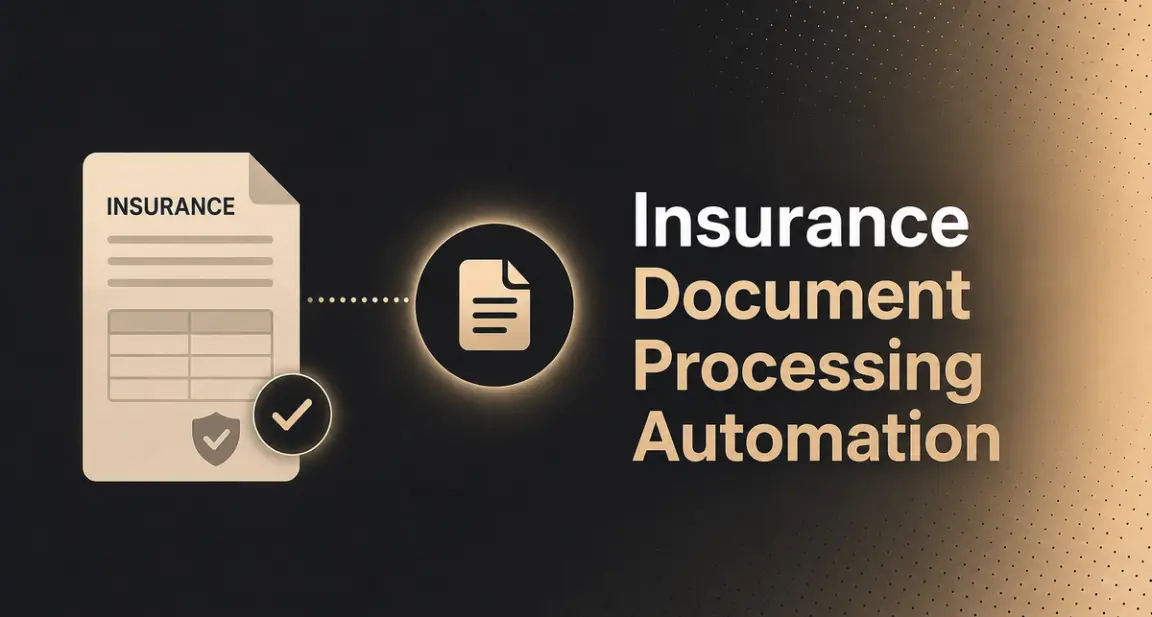
Few industries generate as much document volume, in as many inconsistent formats, under as much compliance pressure, as insurance. A single claim can arrive with a first notice of loss form, adjuster notes, medical records, photos, police reports, and repair estimates, submitted by email, fax, portal upload, or paper mail, often as one messy attachment bundle rather than separate files. Underwriting submissions look similar: ACORD forms mixed with loss runs, financial statements, and free-text broker emails, all needing to become structured data before a quote can even start.
This is a guide to what document processing automation actually does across the insurance policy lifecycle, what makes insurance documents specifically harder than general business documents, and how to evaluate a platform, including a published, checkable accuracy benchmark for the insurance document type specifically.
Who This Is For
- Claims operations leaders trying to reduce manual intake and triage time without sacrificing accuracy on fraud-sensitive or compliance-sensitive fields.
- Underwriting operations teams processing submissions that arrive as inconsistent document bundles — ACORD forms, loss runs, financial statements, needing structured data before quoting can start.
- Compliance and privacy officers at insurers who need to know what automated document handling actually implies for PII/PHI exposure and audit readiness, not just processing speed.
- Engineering teams at carriers, MGAs, and insurtechs building or extending claims and underwriting platforms, deciding whether to buy a full IDP suite or build on an extraction API.
Where Document Processing Automation Fits in the Policy Lifecycle
Insurance document automation isn't one workflow — it shows up differently at each stage:
- Policyholder onboarding. New policy issuance and welcome documentation, often the first automated touchpoint in the relationship and a meaningful driver of early customer experience.
- Submissions and underwriting intake. Broker submissions arrive as a mix of ACORD forms (the standardized industry forms for applications, certificates, and loss information), loss run reports, financial statements, and unstructured email text — all needing classification and extraction before an underwriter can even begin risk assessment.
- First notice of loss (FNOL) and claims intake. A claim typically starts with a FNOL form, then accumulates supporting documents over time — medical records, repair estimates, photos, police reports, witness statements, arriving from multiple sources at different times, not as one clean package.
- Claims adjudication. Adjusters need extracted, structured data from all of the above to validate coverage, assess damages, and detect inconsistencies that might indicate fraud — this is where confidence scoring and human review matter most, since a wrong field here has direct financial consequences.
- Policy servicing and endorsements. Amendments, renewals, and coverage changes generate their own document trail, often needing to reconcile against the original policy documents.
- Reinsurance. Reinsurance treaties, cession statements, and loss reporting between primary insurers and reinsurers generate their own document trail, frequently across multiple parties and formats.
- Subrogation. Recovery claims against a third party after a payout involve their own document set — demand letters, liability documentation, settlement records, distinct from the original claim.
- Compliance and audit. Every stage above needs a reconstructable record — what was extracted, what was flagged, who reviewed it — since insurance is one of the most heavily audited industries for exactly this kind of documentation trail.
Insurance Document Automation Also Means Generating Documents, Not Just Extracting Them
Most of this category gets discussed as an inbound problem, extracting data from claims and submissions that arrive. That's half of it. The other half is outbound: generating and populating policy documents, certificates of insurance, and endorsements from templates, often paired with digital signature workflows for distribution.
This matters because the two directions have different failure modes. Inbound extraction accuracy determines whether claims and underwriting data is trustworthy. Outbound generation accuracy determines whether the policy itself, the document a policyholder actually reads and relies on, is correct. An error in a generated endorsement or certificate isn't a data-quality problem; it's a document a customer or regulator may act on directly. Worth evaluating both directions separately if your automation need spans the full lifecycle rather than just claims intake.
What Makes Insurance Documents Specifically Hard
A few things distinguish insurance documents from general business documents, and they're worth naming directly since they determine what actually matters in a platform evaluation:
- ACORD forms plus free text, in the same submission. Underwriting submissions routinely mix standardized ACORD forms with unstructured broker emails and attached loss runs — a platform that only handles one of these well creates manual work on the other.
- Multi-document bundles, not single files. A claim or submission is rarely one document — it's a bundle that needs to be split, classified, and routed to the right extraction logic per document type, before extraction even starts.
- Handwritten and low-quality inputs. Claims forms filled out by hand, faded fax submissions, and photographed documents are common — this is a genuine handwriting-recognition problem, not just a text-extraction one.
- Coverage language isn't just fields — it's dense, unstructured text. Confirming something like flood coverage often means understanding policy language itself, not just extracting labeled fields, which is a meaningfully different capability than structured-field extraction.
- Fraud-relevant fields need higher scrutiny, not just extraction. Dates, amounts, and signatures on claims documents carry fraud risk that a generic extraction pipeline doesn't account for unless confidence scoring and validation are built in specifically.
- PHI exposure in claims documents. Medical records attached to claims carry health information that most general-purpose extraction tools don't treat as a first-class concern.
What DeepRead's Published Benchmark Shows for Insurance Documents
Most of the document-automation category asserts accuracy without a public methodology behind it. One place this is genuinely measured and checkable specifically for insurance: DeepRead's benchmark includes the Insurance document type as one of its measured categories, run against identical documents through multiple engines against a manually verified ground truth.
This is worth being precise about scope: it measures three named competitors — Nanonets, Reducto, and Landing AI, not every platform in this category, since those weren't part of the measured comparison. But it's one of the few genuinely checkable data points specific to insurance documents in a category where "AI-powered accuracy" is usually asserted rather than demonstrated.
View the full results and methodology.
Beyond accuracy, a few things make DeepRead a relevant fit specifically for insurance workflows:
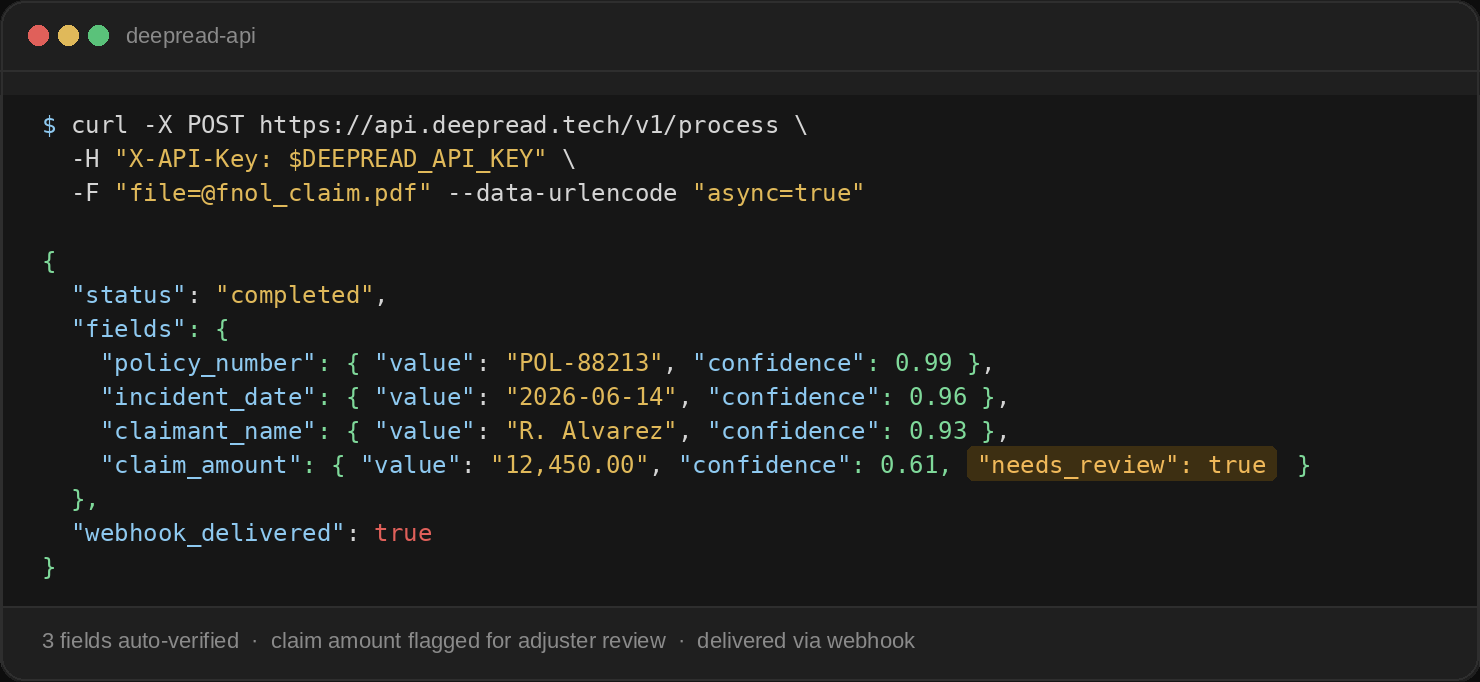
- Per-field confidence scoring with needs_review flagging, directly relevant to fraud-sensitive fields (dates, amounts, signatures) where silent errors carry real financial and compliance risk.
- Async processing and webhook delivery — claims volume spikes after events (storms, accidents) in ways that need batch processing without blocking the rest of a claims platform.
- Schema-driven extraction without retraining per document type — relevant given how many document types a single claim or submission can involve (FNOL forms, medical records, ACORD forms, loss runs), rather than needing a separately trained model for each.
- PII detection and redaction — directly relevant to claims documents carrying PHI, where redaction is often still a manual compliance step today rather than automated.
Compliance Considerations for Insurance Document Automation
Insurance sits under both general data-protection expectations and industry-specific regulatory scrutiny (state insurance departments, NAIC model regulations, and HIPAA-adjacent requirements wherever health information is involved in claims). A few things worth building into any insurance document automation implementation regardless of platform:
- Audit logging by default: What was extracted, what was flagged, who reviewed it, reconstructable on demand, since insurance is a heavily audited industry.
- PHI handling as a first-class step: Not an afterthought bolted on after extraction, given how routinely medical records show up in claims documentation.
- Decision traceability: For any claim or submission, the ability to explain exactly why a field was auto-processed or routed to human review.
- Fraud-relevant field validation: Not just extraction; confidence thresholds tuned specifically for financially consequential fields.
Getting Started with Insurance Document Automation
A reasonable sequence, rather than trying to automate the full lifecycle at once:
- Assess: Map your current document-heavy processes and identify where manual handling is the actual bottleneck (claims intake, underwriting submissions, policy generation), not where automation sounds appealing in the abstract.
- Set a specific goal: Reduced claims cycle time, fewer manual re-keying hours, faster underwriting turnaround, something measurable, not "modernize document handling."
- Pilot narrowly: One document type (FNOL forms, or ACORD submissions specifically), not the entire claims or underwriting pipeline at once.
- Involve compliance and IT from the start, not after a vendor is chosen — PHI handling and audit requirements are easier to build in than retrofit.
- Expand only after the pilot's accuracy and exception rate hold up on a second, different document type.
What to Evaluate
- Accuracy on your actual document mix, not a clean demo set — ACORD forms, handwritten claims, faded scans, mixed-format submission bundles specifically, not just typed English-language forms.
- Multi-document bundle handling — can the platform split and classify a mixed submission or claims package, or does it assume one document type per file?
- Confidence scoring on fraud-relevant fields, not just an overall accuracy number.
- PHI/PII detection and redaction built in, not a separate manual step.
- Batch handling for volume spikes — claims volume isn't steady; a platform that only handles even, predictable load will struggle after a catastrophic event.
- Audit trail depth appropriate to how heavily insurance gets audited relative to other industries.
Common Challenges
- Pilot accuracy on clean ACORD samples: Pilot results on clean ACORD forms often fail to reflect real-world performance, where submissions may be handwritten, scanned at an angle, incomplete, or bundled with unrelated attachments.
- Multi-document bundles: Platforms that are not purpose-built for insurance intake often treat bundled files as a single document, forcing teams to manually separate and organise them before extraction can begin.
- Exception queues without a named owner: Claims and underwriting teams are frequently operating at full capacity, so introducing an automation workflow without assigning ownership for exception handling simply shifts the bottleneck instead of eliminating it.
- PHI handling addressed too late: Treating protected health information (PHI) as a downstream compliance issue rather than designing for it during the extraction stage makes the process more complex, costly, and difficult to retrofit later.
- Uniform confidence thresholds for all fields: Applying the same confidence threshold to fraud-sensitive fields as to routine data overlooks the higher financial and operational risks associated with extraction errors in critical information.
Conclusion
Insurance document processing automation isn't a single workflow; it spans onboarding, underwriting intake, claims, reinsurance, subrogation, and compliance, plus the outbound side of generating policy documents and endorsements, each with different document types and different stakes. What separates automation that actually works from automation that just adds a dashboard on top of manual work: accuracy on real, messy insurance-specific documents (ACORD forms, handwritten claims, mixed bundles), confidence scoring tuned to fraud-relevant fields, and compliance built in from the start rather than retrofitted. Test any platform's accuracy claim against your own documents, and check whether it's independently verifiable, the way DeepRead's insurance-specific benchmark is, before it factors into your decision.
FAQ
What's the difference between OCR and document processing automation for insurance specifically?
OCR extracts text from an image. Insurance document processing automation goes further — classifying document types within a bundle, extracting context-aware fields (not just text), scoring confidence on fraud-relevant data, and routing the result into claims or underwriting workflows.
What are ACORD forms, and why do they matter for insurance document automation?
ACORD forms are standardized industry forms used across applications, certificates, and loss information in underwriting submissions. A platform's ability to handle ACORD forms specifically, alongside the unstructured documents typically submitted alongside them, is a meaningful test of fit for insurance use cases.
Does insurance document automation cover generating documents, not just reading them?
Yes, the outbound side (generating policy documents, certificates of insurance, and endorsements from templates, often with digital signature workflows) is a distinct half of the category from inbound claims and submission extraction, and it's worth evaluating separately since the two have different accuracy stakes.
Does insurance document processing need to handle handwriting?
Yes, routinely, claims forms are frequently filled out by hand, and this is a genuinely harder technical problem than printed-text extraction. Worth testing specifically rather than assuming a platform's general accuracy number applies to handwritten claims documents.
How does DeepRead's benchmark handle insurance documents specifically?
DeepRead's published benchmark measures accuracy on the Insurance document type directly, run against Nanonets, Reducto, and Landing AI on identical documents against a manually verified ground truth, currently showing DeepRead at 95.8% versus 76.5%, 52.9%, and 52.9% respectively. Full methodology is public on the benchmarks page.
What compliance requirements are specific to insurance document automation?
Beyond general data protection, insurance sits under state insurance department oversight, NAIC model regulations, and HIPAA-adjacent requirements wherever claims documents include health information. Audit logging, PHI handling, and decision traceability are worth building in from the start rather than retrofitting.
More articles
Structured Data Extraction: A Technical Guide
How to extract structured data from documents using an AI API, the architecture, grounding, and named tools compared.
Key Features of AI Document Workflow Automation
AI document workflow automation features, governance, prioritization framework, and real examples with measurable benefits for 2026.