%20{%20:root%20{%20--deepread-stroke:%20%23E5E7EB;%20}%20}%20.dark%20{%20--deepread-stroke:%20%23E5E7EB;%20}%20%3c/style%3e%3crect%20x='40'%20y='30'%20width='220'%20height='260'%20rx='28'%20ry='28'%20stroke='var(--deepread-stroke)'%20stroke-width='16'%20fill='none'/%3e%3cpath%20d='M180%2030v52c0%2010%208%2018%2018%2018h62'%20stroke='var(--deepread-stroke)'%20stroke-width='16'%20fill='none'/%3e%3cline%20x1='70'%20y1='130'%20x2='200'%20y2='130'%20stroke='var(--deepread-stroke)'%20stroke-width='16'%20stroke-linecap='round'/%3e%3cline%20x1='70'%20y1='165'%20x2='200'%20y2='165'%20stroke='var(--deepread-stroke)'%20stroke-width='16'%20stroke-linecap='round'/%3e%3cline%20x1='70'%20y1='200'%20x2='170'%20y2='200'%20stroke='var(--deepread-stroke)'%20stroke-width='16'%20stroke-linecap='round'/%3e%3c!--%20green%20download%20arrow%20in%20bottom%20right%20corner%20--%3e%3cpath%20d='M210%20202v58'%20stroke='var(--deepread-accent)'%20stroke-width='18'%20stroke-linecap='round'/%3e%3cpath%20d='M195%20245l15%2015%2015-15'%20fill='none'%20stroke='var(--deepread-accent)'%20stroke-width='18'%20stroke-linecap='round'%20stroke-linejoin='round'/%3e%3c/svg%3e)
How Banks Automate KYC & Customer Document Verification
How banks automate KYC and customer document verification, the full pipeline, named platforms, and where general OCR tools fall short
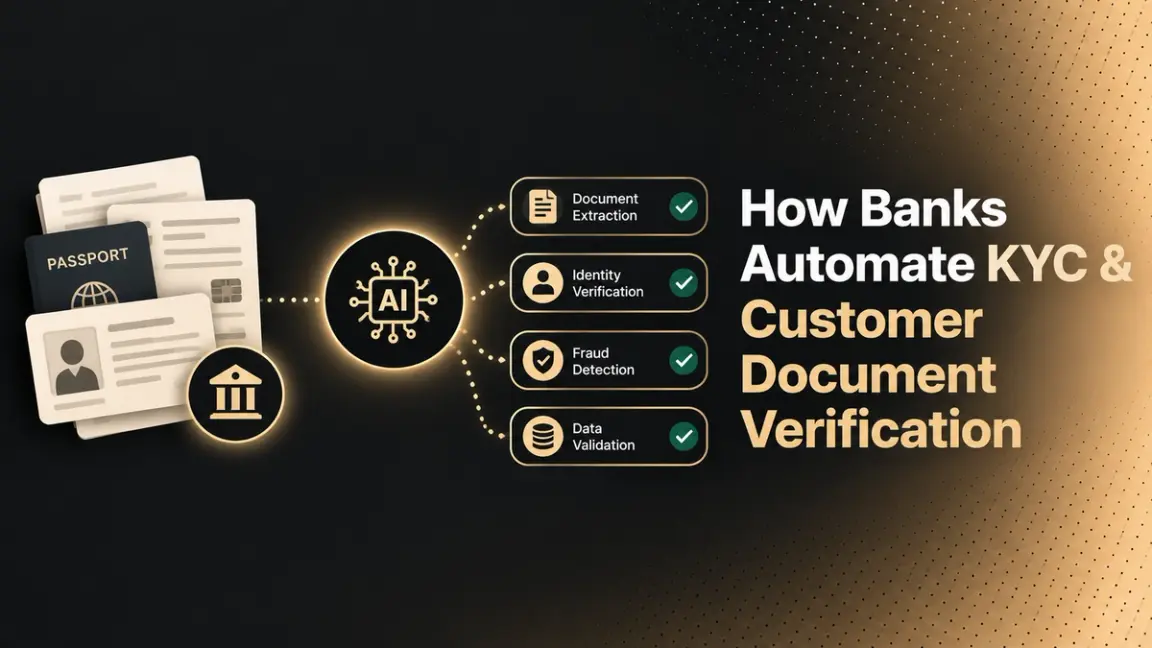
Manual KYC review is slow, expensive, and error-prone in ways that compound at scale - a single identity check can take up to 24 hours when done manually, tying up staff time that should be reviewing genuinely ambiguous cases rather than reading passports one at a time. This guide covers how banks actually automate this process end to end, what makes KYC documents specifically hard, a real gap in the customer experience most automation efforts miss, and named platforms across the categories this space breaks into.
Who This Is For
- Compliance and operations leaders at banks and fintechs planning or evaluating a KYC automation initiative.
- Product teams building customer onboarding flows that need document verification as one step in a larger journey.
- Engineering teams deciding between a full KYC platform, a specialized vendor stack, or building components themselves.
What Automated KYC Actually Is
Automated KYC verification replaces manual document review, identity checks, and compliance screening with digital workflows, verifying a customer's identity and screening for regulatory risk without requiring a person to review every case individually. It's built from several distinct technical components working together, not one tool doing everything.
Key Components of Automated KYC Verification Systems
Before looking at the pipeline as a sequence, it helps to know the core technical components that make it up, since these are what you're actually evaluating when comparing vendors:
- Document capture interface: Web and mobile upload, often with in-app camera guidance to ensure a usable image before submission.
- OCR and data extraction engine: Reads structured fields (name, date of birth, address, document number) from the captured document.
- Document authenticity and fraud detection module: Checks the document itself for signs of tampering, forgery, or manipulation, distinct from reading its content.
- Biometric matching and liveness detection engine: Confirms the person presenting the document matches the document's photo, and that a real, live person is present.
- Screening and database integration: Connects to AML, sanctions, PEP, and adverse media databases to check the customer against regulatory watchlists.
- Risk scoring and decisioning engine: Applies risk-based logic to determine what level of verification a given customer or transaction requires.
- Workflow and case management layer: Routes ambiguous or flagged cases to human reviewers with supporting evidence, rather than a raw document dump.
- Audit and reporting layer: Logs every check, result, and decision in a form that holds up during a regulatory review.
- API and integration layer: Connects the system to core banking, CRM, and existing compliance infrastructure.
A vendor might cover all of these in one platform, or specialize narrowly in one or two (extraction only, or screening only), which is exactly why understanding this component breakdown matters more than a single "does it work" evaluation.
The KYC Automation Pipeline
This sequence shows up consistently across independent sources describing how banks actually implement this, worth understanding as the backbone of the whole category:
- Digital document capture: A customer uploads an ID or corporate document via web or mobile, rather than visiting a branch or mailing physical copies.
- Document authenticity verification and OCR extraction: The system checks the document itself for signs of forgery or tampering, while OCR pulls out key fields (name, date of birth, address, document number). These are genuinely distinct checks: one confirms the document is real, the other reads what it says.
- Biometric validation and liveness detection: A selfie or short video is matched against the photo on the document, with liveness checks confirming a real person is present rather than a photo of a photo or a synthetic image.
- AML and sanctions screening: The customer is checked against global sanctions lists, politically exposed persons (PEP) databases, and adverse media, catching regulatory risk that document verification alone can't surface.
- Risk-based routing: Verification requirements scale with customer risk; a retail savings account might need only basic ID verification, while a private banking client triggers enhanced due diligence with source-of-wealth documentation.
- Case management and human review: Even in highly automated systems, some cases route to a compliance officer, ideally with a full evidence trail and AI-generated reasoning summary rather than a raw pile of documents to re-review from scratch.
- Continuous monitoring: Rather than treating KYC as a one-time onboarding check, "perpetual KYC" (pKYC) continuously monitors for material changes to a customer's risk profile after onboarding, flagging only what's actually changed for review.
What Makes KYC Documents Specifically Hard
- Extreme document variety: Passports, national IDs, driver's licenses, utility bills, and bank statements all need to be handled, each with different formats and layouts across different countries and issuing authorities.
- Genuine, forged, damaged, and expired documents all need different handling: A platform needs deep document expertise across all four conditions, not just clean, valid examples, since a real applicant population includes all of them.
- Region-specific document formats: A verification system tuned on one country's ID formats won't automatically generalize to another's, given how much passport and ID layouts vary internationally.
- Low-quality scans and handwritten notes: Real-world document submissions are far messier than demo conditions, and this is where AI-powered extraction still requires the most ongoing improvement.
- Real, evolving fraud techniques: Sophisticated document forgery and synthetic identity fraud are active, evolving threats, not a solved, static problem.
The Customer Experience Gap Most Automation Misses
Worth naming directly, since it's a genuinely distinct insight rather than a repeat of the technical pipeline above: most KYC automation efforts focus entirely on the backend verification checks and leave the applicant in what one vendor aptly calls a "communication black hole" when something goes wrong. A failed document upload or a request for additional verification with no status update, no guidance, and no way to ask a question is a real, common failure mode that pure backend automation doesn't solve on its own. The strongest implementations pair backend verification automation with active, multi-channel guidance (chat, email, SMS) that walks an applicant through exactly what's needed next, rather than treating a failed check as a dead end.
Named Platforms
A note on how to read this list: several figures cited by vendors in this category (cost-per-review, percentage cost reductions) are vendor-stated rather than independently verified. Treat them as directional.
1. Regula IDV Platform
Regula IDV Platform combines document and biometric verification, customizable workflows, AML/PEP and database screening, manual review, and identity lifecycle management in one environment, positioned to integrate with existing systems rather than requiring a full stack rebuild.
- States over 30 years of document examination experience and a database of 16,000+ document templates across 254 countries and territories, directly relevant to the document-variety challenge named above
- Names customer deployments across banking, fintech, and crypto specifically
- Best fit: institutions wanting document authenticity expertise breadth (genuine, forged, damaged, expired, region-specific) alongside biometric and screening in one platform
2. Infrrd
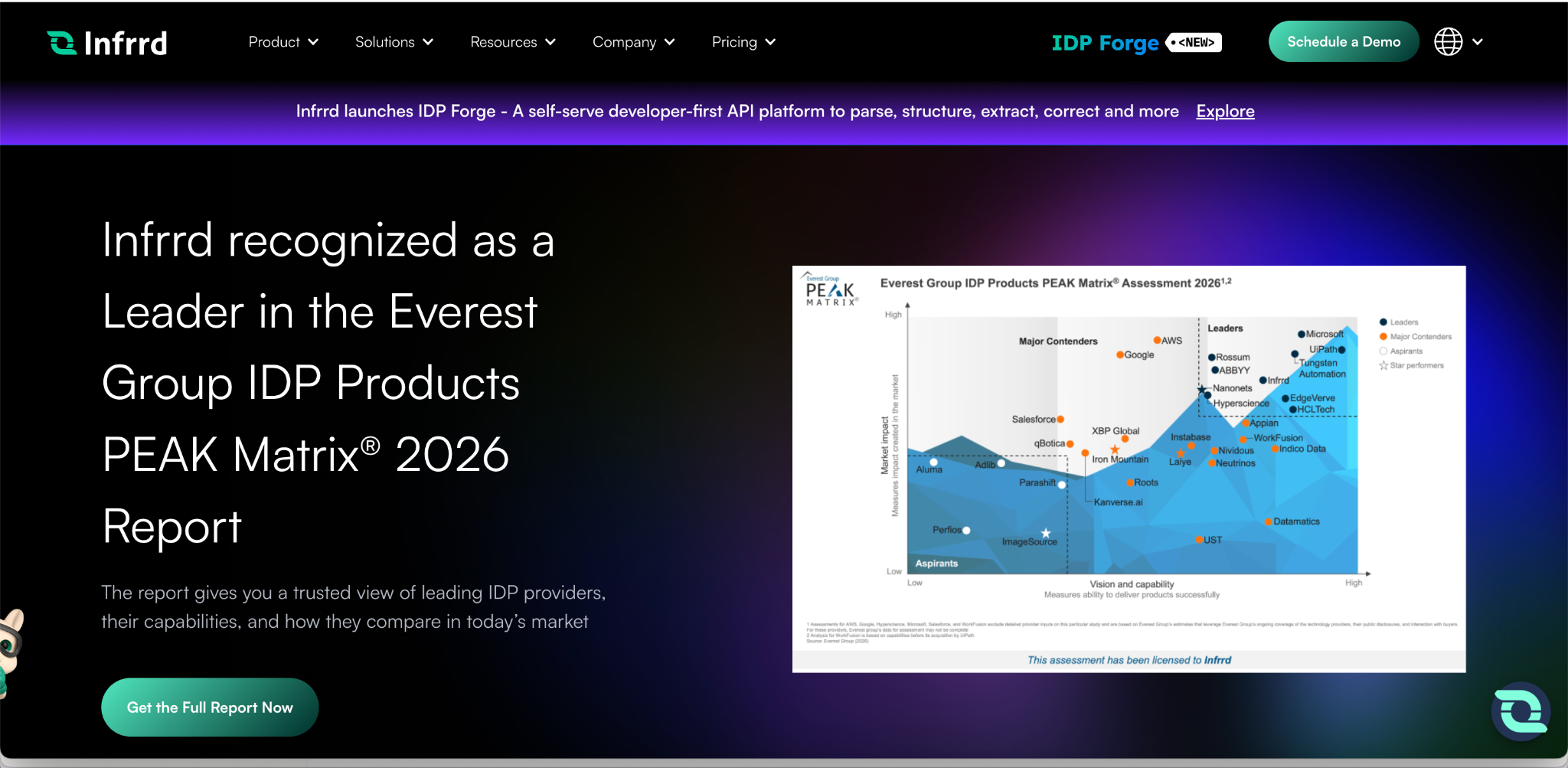
Infrrd provides a full KYC automation platform combining data extraction, validation, monitoring, and system integration, positioned for institutions wanting one platform covering the fuller pipeline rather than assembling point solutions.
- Best fit: institutions wanting a single, integrated platform spanning extraction through monitoring, rather than combining separate specialized vendors for each pipeline stage.
3. Docsumo
Docsumo offers pre-trained AI models tailored specifically for various KYC document types and formats, with smart table extraction for documents like bank statements and transaction records, and stated "touchless" end-to-end extraction and validation.
- Best fit: teams wanting fast setup with document-type-specific pre-trained models rather than building custom extraction logic.
4. Datamatics Intelligent Automation Platform

Datamatics Intelligent Automation Platform combines RPA and intelligent automation specifically for KYC intake, validation, and downstream system integration, including automated closure of non-KYC-compliant accounts and integration with central KYC (CKYC) portals in applicable jurisdictions.
- States a 50% reduction in man-hours for the full KYC processing cycle in its own materials, worth treating as a vendor-stated figure rather than an independently verified benchmark
- Best fit: institutions wanting RPA-driven automation across the full intake-to-compliance-reporting cycle, including jurisdiction-specific portal integration
5. Lorikeet

Lorikeet handles the customer-facing side of KYC specifically, distinct from the backend-verification vendors above. AI agents guide applicants through failed checks or additional verification requests across voice, chat, email, SMS, and WhatsApp, addressing the communication gap described above directly rather than assuming backend automation alone drives completion rates.
- Best fit: institutions whose backend verification is already solid but whose onboarding completion rates suffer from poor applicant communication during friction points
Is Open-Source OCR Like Tesseract Viable for KYC?
Worth addressing directly, since it's a real question teams ask when scoping a build-it-yourself approach: Tesseract is a free, open-source OCR engine, not a KYC company or platform; it reads text from images, and that's the extent of what it does natively. It has no built-in document authenticity or forgery detection, no biometric matching, no liveness detection, and no AML/sanctions screening capability. Using it for KYC would mean building all of that surrounding infrastructure yourself: a fraud-detection layer, biometric SDK integration, screening-database connections, and the risk-routing logic covered above.
This is a real, viable option only for teams with substantial engineering capacity treating KYC as a genuinely custom-built system, not a practical starting point for most institutions wanting a working solution without a large build project attached.
Where a General-Purpose Extraction API Fits, and Where It Doesn't
Worth being precise about this distinction, since it applies directly to evaluating any tool in this space: document field extraction and identity verification are different capabilities, even though they're both part of the same overall KYC pipeline. Extraction reads what's on a document (name, date of birth, address); verification confirms the document is genuine and belongs to the person presenting it.
DeepRead's published benchmark includes driver's license extraction (96.7% accuracy, measured against named competitors on identical documents against a manually verified ground truth), which is directly relevant to step 2 of the pipeline above: the OCR field-extraction half of document processing. It is not relevant to document authenticity verification, biometric matching, liveness detection, or AML/sanctions screening, none of which are things DeepRead does.
A general-purpose, schema-driven extraction API like this is a reasonable component for the extraction sub-step of a KYC pipeline a bank or fintech is building internally, but it is not a KYC verification solution on its own, and shouldn't be evaluated against the full-stack platforms named above as if it were.
Choosing a KYC Automation Vendor
- Document expertise breadth, specifically experience with genuine, forged, damaged, expired, and region-specific documents, not just clean examples.
- Real deployments in regulated financial services, where verification speed, fraud prevention, and auditability all matter simultaneously, not just a general AI capability claim.
- Audit logs showing what was checked, what result was returned, and why a case passed, failed, or was escalated, essential for regulatory defensibility.
- Identity lifecycle management, so teams can review, update, and reverify customer identity data beyond the initial onboarding step, supporting continuous/perpetual KYC rather than a one-time check.
- Integration with existing systems (CRM, core banking, AML, fraud, case management), since a multi-vendor stack is common in this space and isn't automatically a problem, provided integration is genuinely solid.
- Customer-facing communication during failed checks, not just backend verification accuracy, given how directly this affects actual onboarding completion rates.
Conclusion
Bank KYC automation is a multi-stage pipeline, not one tool: document capture, authenticity verification and OCR extraction, biometric liveness matching, AML and sanctions screening, risk-based routing, human review for edge cases, and continuous monitoring after onboarding. The strongest platforms cover document expertise breadth across genuine, forged, and region-specific formats, real regulated-industry deployments, and increasingly, the customer-facing communication layer that pure backend automation tends to overlook. A general-purpose extraction API can be a genuine component for the OCR field-extraction step specifically, but it isn't a substitute for the authenticity, biometric, and screening capabilities a real KYC platform provides, and open-source OCR alone requires building all of that surrounding infrastructure yourself.
FAQ
What's the difference between document extraction and identity verification in KYC?
Extraction reads the data on a document (name, date of birth, address). Verification confirms the document itself is genuine and that it belongs to the person presenting it, through authenticity checks, biometric matching, and liveness detection. Both are part of the same pipeline, but they're genuinely different technical capabilities.
Can I build a KYC system using open-source OCR like Tesseract?
Tesseract is an OCR engine, not a KYC platform, and has no built-in fraud detection, biometric matching, liveness detection, or sanctions screening. Using it for KYC means building all of that infrastructure yourself, which is realistic only for teams with substantial engineering capacity, not a practical shortcut for most institutions.
What is "perpetual KYC" (pKYC)?
Continuous monitoring of a customer's risk profile after onboarding, rather than treating KYC as a one-time check, automatically flagging only material changes for human review instead of requiring periodic full reverification.
Why do banks need customer-facing communication tools alongside backend KYC verification?
Because backend automation alone doesn't solve what happens when a document upload fails, or additional verification is needed. Applicants left with no status update or guidance frequently abandon onboarding, which is a real, distinct problem from verification accuracy that some vendors address specifically.
What's the difference between AML screening and KYC document verification?
KYC document verification confirms who a customer is, checking their identity documents for authenticity and matching them to the person presenting them. AML (anti-money laundering) screening checks that confirmed identity against sanctions lists, politically exposed persons databases, and adverse media, looking for regulatory risk rather than confirming identity itself. Both are part of the same onboarding pipeline but check for different things.
Is DeepRead a KYC verification tool?
No, DeepRead is a general-purpose document extraction API with published, checkable accuracy on driver's license field extraction specifically. This is relevant to the OCR extraction step of a KYC pipeline, but DeepRead doesn't perform document authenticity verification, biometric matching, liveness detection, or AML/sanctions screening, all of which a genuine KYC platform requires.
More articles
Structured Data Extraction: A Technical Guide
How to extract structured data from documents using an AI API, the architecture, grounding, and named tools compared.
Key Features of AI Document Workflow Automation
AI document workflow automation features, governance, prioritization framework, and real examples with measurable benefits for 2026.