%20{%20:root%20{%20--deepread-stroke:%20%23E5E7EB;%20}%20}%20.dark%20{%20--deepread-stroke:%20%23E5E7EB;%20}%20%3c/style%3e%3crect%20x='40'%20y='30'%20width='220'%20height='260'%20rx='28'%20ry='28'%20stroke='var(--deepread-stroke)'%20stroke-width='16'%20fill='none'/%3e%3cpath%20d='M180%2030v52c0%2010%208%2018%2018%2018h62'%20stroke='var(--deepread-stroke)'%20stroke-width='16'%20fill='none'/%3e%3cline%20x1='70'%20y1='130'%20x2='200'%20y2='130'%20stroke='var(--deepread-stroke)'%20stroke-width='16'%20stroke-linecap='round'/%3e%3cline%20x1='70'%20y1='165'%20x2='200'%20y2='165'%20stroke='var(--deepread-stroke)'%20stroke-width='16'%20stroke-linecap='round'/%3e%3cline%20x1='70'%20y1='200'%20x2='170'%20y2='200'%20stroke='var(--deepread-stroke)'%20stroke-width='16'%20stroke-linecap='round'/%3e%3c!--%20green%20download%20arrow%20in%20bottom%20right%20corner%20--%3e%3cpath%20d='M210%20202v58'%20stroke='var(--deepread-accent)'%20stroke-width='18'%20stroke-linecap='round'/%3e%3cpath%20d='M195%20245l15%2015%2015-15'%20fill='none'%20stroke='var(--deepread-accent)'%20stroke-width='18'%20stroke-linecap='round'%20stroke-linejoin='round'/%3e%3c/svg%3e)
Document Processing API with Fallback Logic & Confidence Scoring
How confidence scoring and fallback logic actually work in document processing APIs - calculation methods, patterns, and named implementations.
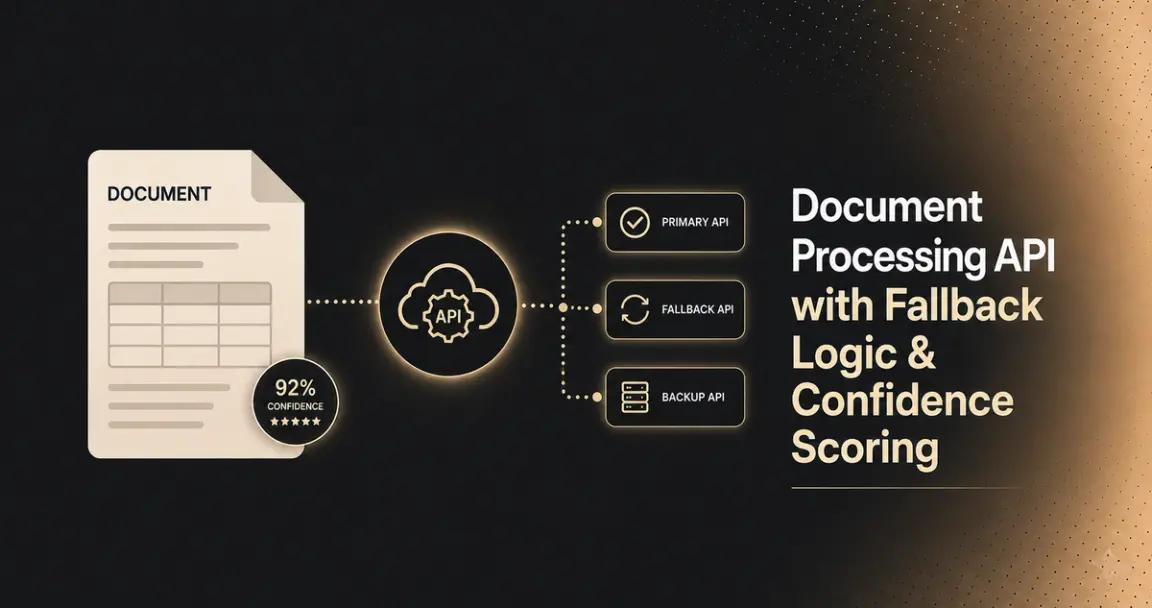
A document processing API that returns a result with no signal about how confident it is in that result is a liability in production, not a convenience. The difference between a pipeline that fails safely and one that silently ships wrong data comes down to two mechanisms working together: confidence scoring (knowing how certain the system is about each extracted value) and fallback logic (what actually happens when that confidence is low).
This is a guide to how both actually work — how confidence scores get calculated, not just what they mean; the distinct fallback patterns that show up in production systems; and named platforms implementing these well.
Who This Is For
- Developers building document processing pipelines who need extraction results they can trust enough to automate, not just a text dump to manually review.
- Engineering teams evaluating extraction APIs specifically on confidence scoring and failure-handling, not just raw accuracy.
- Teams running multi-vendor document processing who need a real architecture for routing between providers based on performance.
- Anyone optimizing document processing cost who wants a genuine technical pattern for reducing spend without sacrificing accuracy on hard documents.
What Is Confidence Scoring?
Confidence scoring is a numeric or categorical estimate — a percentage, a decimal (0.875 meaning 87.5% confident), or a label like High/Medium/Low- that a document processing system attaches to an extracted value, indicating how certain it is that the value is correct. It's generated at extraction time, alongside the data itself, not calculated afterward against a known answer.
This distinction matters: confidence is the system's real-time self-assessment, not historical accuracy. A platform can be highly accurate on average while still correctly flagging one uncertain field on one document — poor scan quality, an unusual format, ambiguous handwriting, that an aggregate accuracy number can't surface. Confidence is typically returned per field, per document, or both; per-field is the more useful signal, since it distinguishes one uncertain field among ten confident ones from a document that's uncertain throughout.
How Confidence Scores Actually Get Calculated
Confidence scores aren't a single, universal thing — different platforms calculate them through genuinely different mechanisms:
- Multi-model agreement. One documented approach runs multiple models on the same field and analyzes their agreement — when models converge on the same value, confidence is high; when they diverge, confidence drops. This is a form of ensemble evaluation, and the tradeoff is explicit: it takes several times longer than a single-model call, in exchange for more reliable confidence metadata.
- Response consistency across varied prompts. A different, documented technique sends multiple requests for the same extraction with intentional variation — a paraphrased system prompt, a shuffled field order — and aggregates results based on how consistently the same value comes back. Consistent responses across variation indicate genuine confidence; inconsistent ones flag a field the system is actually uncertain about, not just uncertain-sounding.
- Weighted field importance. A more granular approach worth knowing: one detailed architecture example calculates overall document confidence as a weighted average — 80% from required fields, 20% from optional ones — specifically so that a missing required field drags the score down much more than a missing optional one, rather than treating every field as equally consequential.
- Asymmetric error penalties. The same architecture example penalizes different failure types differently: a missing field is penalized more heavily than a wrong value, on the reasoning that a wrong extraction at least indicates the model found the right location on the document, while a hallucinated value is penalized less than a missing one specifically because hallucinations tend to be easier to catch in human review than a field that's silently absent.
Worth knowing separately from calculation method: some platforms treat low-confidence extractions as a training signal, not just a one-off flag — Mindee's own documentation describes a continuous learning loop where corrections on low-confidence fields feed back into future confidence calibration on similar documents, rather than each correction being a dead end.
The practical takeaway: a confidence score is only as trustworthy as the calculation method behind it. A single number with no disclosed methodology is closer to a marketing claim than a usable engineering signal — ask what's actually driving the number before building routing logic on top of it.
Three Fallback Logic Patterns
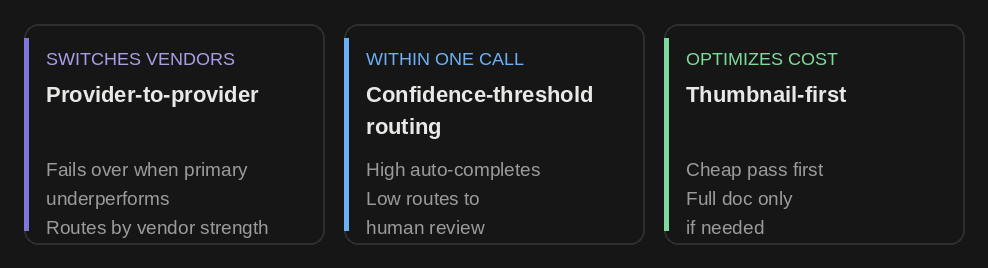
Fallback logic isn't one thing either — three genuinely distinct patterns show up across production systems, each solving a different problem.
Provider-to-provider fallback
The most common pattern: a secondary document processing API is called only when the primary provider underperforms or is unavailable, using the returned confidence score (or another accuracy signal) to decide whether to fail over. In practice, this is often implemented as a simple availability check in code — one documented pattern calls a function like get_available_providers() and routes to the next available provider, with availability determined by whether an API key was configured at initialization, rather than anything more elaborate.
Done well, this extends into a broader routing strategy — building a performance map of multiple vendors across criteria like language, document type, or specific fields, then sending each document to whichever provider performs best for its specific characteristics, rather than committing to one vendor for every document type.
Confidence-threshold-triggered routing
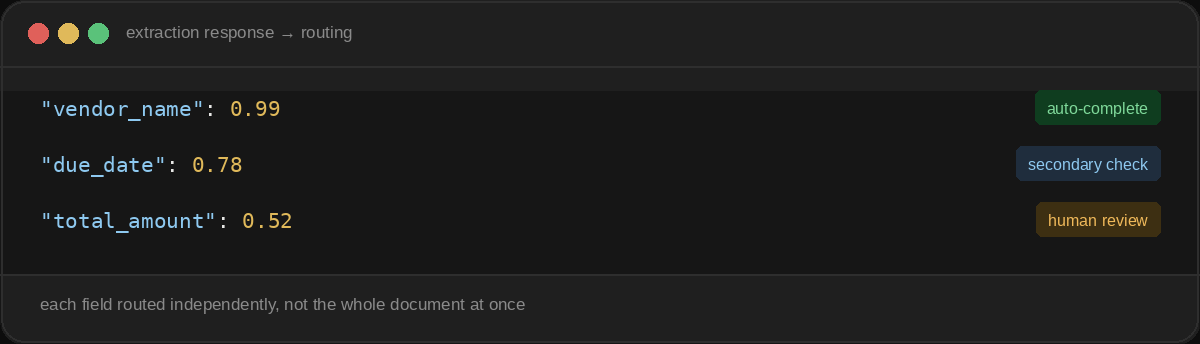
Rather than a binary pass/fail, this pattern routes based on threshold bands — one documented implementation uses three tiers: high-confidence extractions pass through and auto-populate downstream systems (an ERP or CRM) automatically, medium-confidence extractions trigger conditional logic (a secondary check or a different processing path), and low-confidence extractions route to human review. This is the pattern most directly analogous to what a needs_review-style flag implements: not every uncertain field needs the same treatment, and threshold bands let you calibrate exactly how much gets automated versus reviewed.
- Cross-field validation is a related but distinct check worth running alongside confidence scoring — business-rule logic that catches inconsistencies between fields (a denial reason paired with an authorization number that shouldn't co-occur, for instance), which per-field confidence alone won't catch, since each field can individually score high-confidence while still being logically inconsistent with another field on the same document.
Thumbnail-first cost optimization
A genuinely clever, less obvious pattern worth knowing specifically: process a cheap, low-resolution thumbnail of a document first, extract and validate against required fields and a confidence threshold, and only fall back to processing the full, expensive version of the document if validation fails or confidence is too low. One documented implementation reports this approach can cut AI processing costs by 70–95% for the majority of documents that extract cleanly from a thumbnail alone, reserving full-resolution (and higher-cost) processing specifically for the harder cases that actually need it.
Named Platforms Implementing This Well
A note on how to read this list: descriptions reflect public product documentation and vendor content; verify current capability directly.
DeepRead
A schema-driven document extraction API with confidence scoring and fallback handling built into the core response, not as an add-on feature.
- Every extracted field returns a per-field confidence score, with uncertain fields explicitly flagged needs_review rather than returned silently — the same threshold-routing pattern described above, implemented as a first-class part of the API response rather than a separate configuration layer
- Async processing and webhook delivery, relevant for building the kind of routing and review-queue architecture this article describes without a blocking, synchronous call
- Honest scope: DeepRead's confidence scoring applies within a single extraction call — it doesn't itself orchestrate fallback across multiple third-party providers the way Eden AI's routing layer does. Building a provider-to-provider fallback architecture with DeepRead as one node in that chain is something you'd construct yourself on top of its confidence output, not a built-in multi-vendor orchestration feature
- Free tier — 2,000 documents/month, no credit card required
Mindee
States a documented confidence-scoring feature combining multi-model agreement with configurable thresholds — high-confidence fields can be automatically approved and pushed downstream, while medium-or-lower confidence fields are routed to human validation or fallback logic (default values, user input). Explicitly documents the latency tradeoff: the ensemble approach can take several times longer than a standard call.
Extend
Markets what it calls "agentic confidence scoring," assigning each extraction a 1–5 confidence score via a review agent designed to catch specific failure modes (rule violations, ambiguous outputs, incorrect field values) rather than returning a single opaque probability. Supports webhook-based routing of low-confidence documents into existing validation queues. States the same latency tradeoff as Mindee — ensemble evaluation adds processing time compared to a single-pass extraction.
Eden AI
Positioned specifically around multi-provider orchestration rather than a single extraction engine — the documented pattern is exactly the provider-to-provider fallback described above: route to a secondary API only when the primary underperforms, using confidence scores or other accuracy signals, and build a vendor-performance map over time to route each document to whichever provider handles it best.
Box Extract
Documents confidence scores calibrated to approximate real-world correctness probability, calculated via multiple LLM responses to the same request with intentional variation (paraphrased prompts, shuffled field order), aggregated by response consistency — directly matching the "response consistency" calculation method described above, with Box's own documentation explicitly recommending threshold validation be tested against your specific document types rather than assumed universal.
A Practical Architecture Pattern
Putting the pieces together, a production-grade document processing pipeline with real fallback logic typically looks like:
- Extract with confidence scoring — call the primary extraction API, receiving per-field values plus confidence scores, not just raw text.
- Apply weighted thresholds — evaluate overall confidence with required fields weighted more heavily than optional ones, rather than treating every field equally.
- Route by threshold band — high confidence auto-completes and flows downstream; medium confidence triggers a secondary check (a different provider, a business-rule validation, or a cheaper re-extraction attempt); low confidence routes to human review.
- Fail over to a secondary provider only when justified — not for every uncertain field, but when the primary provider's confidence pattern suggests a systematic issue (a document type or format it consistently struggles with), rather than one-off variance.
- Feed corrections back, where the platform supports it — human corrections on flagged fields are genuinely useful training signal, not just a one-time fix.
What to Evaluate
- How confidence scores are actually calculated — multi-model agreement, response consistency, or something undisclosed — since this determines how much you can trust routing decisions built on top of it.
- Whether confidence is per-field or only document-level — per-field is meaningfully more useful for routing, since a single low-confidence field shouldn't necessarily send an entire otherwise-clean document to manual review.
- The latency and cost tradeoff of higher-confidence methods — ensemble and consistency-based approaches are explicitly slower and often more expensive than single-pass extraction; confirm this is an acceptable tradeoff for your volume and SLA.
- Whether fallback logic is built in or something you construct yourself — a platform with native threshold routing is a different integration effort than one that only returns a raw score and expects you to build the routing logic around it.
- Whether the platform supports async processing and webhooks, relevant for any fallback architecture involving multiple processing attempts or provider calls per document.
Common Pitfalls
- Treating a confidence score as ground truth without knowing its calculation method — a score with no disclosed methodology is a claim, not a verified signal.
- Building routing logic around document-level confidence when the actual need is per-field — a document with one uncertain field and nine confident ones gets the same treatment as a document that's uncertain throughout, if confidence is only assessed at the document level.
- Ignoring the latency/cost tradeoff of higher-confidence methods — ensemble and consistency-based confidence calculation genuinely costs more time and money per call; this needs to be budgeted for, not discovered in production.
- Failing over to a secondary provider on every low-confidence result rather than reserving fallback for cases that actually warrant it, which can turn a cost-optimization pattern into a cost multiplier.
- Not testing confidence thresholds against your actual document types before trusting them in production — Box's own documentation makes this point directly, and it applies to any platform's default thresholds.
Conclusion
Confidence scoring and fallback logic aren't separate features bolted onto a document processing API — they're the mechanism that makes automation trustworthy at all. How a platform actually calculates confidence (multi-model agreement, response consistency, weighted field importance) determines how much you can rely on it; how fallback logic routes based on that confidence (provider-to-provider escalation, threshold-based routing, cost-optimized thumbnail-first processing) determines whether uncertain documents get caught before they cause a problem or after. Whatever platform you build on, understand the calculation method behind its confidence scores before building production routing logic on top of the number alone.
FAQ
How is confidence score different from accuracy?
Accuracy measures how often an extraction is correct across a dataset, calculated after the fact against ground truth. A confidence score is the system's own real-time estimate of how certain it is about a specific extraction, generated at the moment of extraction — a tool can have high average accuracy while still correctly flagging individual low-confidence fields where it's actually uncertain.
What's the difference between provider-to-provider fallback and confidence-threshold routing?
Provider-to-provider fallback calls a secondary API when the primary underperforms or is unavailable. Confidence-threshold routing works within a single extraction, directing individual fields or documents to different downstream paths (auto-approve, secondary check, human review) based on confidence level. They're complementary, not competing patterns — a production system often uses both.
Does higher confidence scoring accuracy always mean slower processing?
Often, yes — the more rigorous calculation methods (multi-model ensemble evaluation, multiple varied-prompt responses aggregated for consistency) inherently require more processing than a single-pass extraction, and platforms documenting this tradeoff are being honest about a real cost, not just an implementation detail.
Does DeepRead support multi-provider fallback out of the box?
Not as a built-in orchestration feature, DeepRead provides per-field confidence scoring and needs_review flagging within its own extraction calls, which you can use as the trigger condition in a fallback architecture you build yourself, similar to how Eden AI's orchestration layer routes between providers based on returned confidence.
Is the thumbnail-first pattern only useful for cost savings?
Primarily cost and latency, since a low-resolution thumbnail processes faster and cheaper than a full document, but it also functions as a genuine confidence-triggered fallback pattern, since the decision to process the full document is itself gated on whether the thumbnail extraction met a confidence and completeness threshold.
More articles

Metrics to Measure the ROI of Document Workflow Automation (2026)
The metrics that measure document workflow automation ROI: baselines, formulas, cost per document, STP rate, payback, and how to read the statistics.
API for Utility Bill and Multi-Service Statement Processing (2026)
How document processing APIs handle utility bills and multi-service statements: how the market splits, schema design, validation, and named options.