%20{%20:root%20{%20--deepread-stroke:%20%23E5E7EB;%20}%20}%20.dark%20{%20--deepread-stroke:%20%23E5E7EB;%20}%20%3c/style%3e%3crect%20x='40'%20y='30'%20width='220'%20height='260'%20rx='28'%20ry='28'%20stroke='var(--deepread-stroke)'%20stroke-width='16'%20fill='none'/%3e%3cpath%20d='M180%2030v52c0%2010%208%2018%2018%2018h62'%20stroke='var(--deepread-stroke)'%20stroke-width='16'%20fill='none'/%3e%3cline%20x1='70'%20y1='130'%20x2='200'%20y2='130'%20stroke='var(--deepread-stroke)'%20stroke-width='16'%20stroke-linecap='round'/%3e%3cline%20x1='70'%20y1='165'%20x2='200'%20y2='165'%20stroke='var(--deepread-stroke)'%20stroke-width='16'%20stroke-linecap='round'/%3e%3cline%20x1='70'%20y1='200'%20x2='170'%20y2='200'%20stroke='var(--deepread-stroke)'%20stroke-width='16'%20stroke-linecap='round'/%3e%3c!--%20green%20download%20arrow%20in%20bottom%20right%20corner%20--%3e%3cpath%20d='M210%20202v58'%20stroke='var(--deepread-accent)'%20stroke-width='18'%20stroke-linecap='round'/%3e%3cpath%20d='M195%20245l15%2015%2015-15'%20fill='none'%20stroke='var(--deepread-accent)'%20stroke-width='18'%20stroke-linecap='round'%20stroke-linejoin='round'/%3e%3c/svg%3e)
Automated Data Extraction For Finance Teams: A 2026 Guide
How automated data extraction actually works for finance teams — bank statements, financial reports, tax filings — tools, risks, and what to evaluate.
Every finance team spends real hours on the same manual task: opening a bank statement, a financial report, a tax filing, or an invoice, and re-keying numbers into a spreadsheet or system of record. AFP's 2025 FP&A Benchmarking Survey identifies unreliable and inaccessible data as a primary barrier holding FP&A teams back from effective technology adoption, this is a structural problem in how finance data actually gets aggregated, not a tooling preference.
This is a guide to what automated data extraction actually does for finance teams beyond basic OCR, the named tools in this category, where it gets used across close, credit, and compliance workflows, why financial data specifically carries more accuracy risk than general business documents, and how to evaluate a platform before committing to one.
Who This Is For
- Finance and accounting leaders trying to reduce manual data entry during month-end close, reconciliation, and reporting cycles.
- FP&A professionals aggregating data from multiple sources and formats before analysis can even start.
- Credit and lending analysts extracting data from financial statements, bank statements, and tax documents as part of underwriting or credit review.
- Compliance, KYC/KYB, and tax teams handling format-specific filings and client onboarding documentation, where a single missing or wrong field carries real regulatory risk.
- Engineering teams at fintechs and finance platforms deciding whether to build financial document extraction on an API or adopt a full point solution.
What Automated Financial Data Extraction Actually Does
The real value isn't OCR alone — it's OCR combined with structured extraction, validation, and workflow integration, so a document goes from PDF to usable, checked data without a person re-typing it. Financial documents in particular arrive across an unusually wide range of formats — PDFs, scans, spreadsheets, photos, emails, often for the same document type across different banks, vendors, or jurisdictions, which is exactly what makes template-based, rules-only extraction break down here more than in most categories.
Named Tools in This Category
1. DeepRead
DeepRead is a schema-driven document extraction API — bank statements, financial documents, and related record types come back as structured JSON with a per-field confidence score, using multi-model consensus rather than a single model's output.
- The only platform in this comparison with a fully public, checkable accuracy methodology — on the Bank Statement document type specifically, published results show DeepRead at 96.9%, against Nanonets (50.0%), Reducto (83.3%), and Landing AI (66.7%), measured on identical documents against a manually verified ground truth. Full methodology on the benchmarks page.
- Async processing and webhook delivery are standard, relevant given batch volume during close cycles
- Uncertain fields are flagged needs_review rather than returned silently wrong, directly relevant to numeric fields where a wrong figure has real financial consequences
- Honest limitation: DeepRead is an extraction layer, not a finance-specific platform, it doesn't do financial spreading, credit scoring, or reconciliation logic itself, unlike HighRadius or Scry AI, which bundle broader financial workflow logic directly
- Pricing: free — 2,000 documents/month, no credit card required
2. Nanonets
Nanonets is a no-code AI extraction platform covering invoices, receipts, bank statements, and general financial documents, with models that improve from user corrections over time rather than requiring a template per format.
- Template-free setup with no coding required
- Learns from corrections, improving accuracy on recurring document formats
- Broad ERP/CRM integration ecosystem
- Pricing: free starter tier with usage-based pricing above it — specific rates weren't independently confirmed against Nanonets' own site for this piece, so treat any number as directional and confirm directly.
3. Docsumo
Docsumo is a financial-document-focused extraction platform built specifically for lenders, insurers, and financial-services workflows, with table detection and validation against business rules.
- Strong fit for lending, KYC, and financial-document verticals specifically, rather than general-purpose use
- Table detection organizes line items and rows into clean, structured output
- Exports directly into ERPs and accounting systems (QuickBooks, Xero, BigQuery, and similar)
- Pricing: not publicly disclosed anywhere, entirely sales-led. Third-party estimates for Docsumo's pricing vary so widely across sources ($0.10/invoice in one, $299/month in another) that none of them are trustworthy; get a quote directly rather than budgeting off any published figure.
4. Parseur
Parseur is a no-code extraction platform offering multiple parsing engines (AI-based field suggestion, zonal OCR, text-template parsing), positioned partly against LLM-only reliability risk in its own marketing.
- Genuinely easy to set up without technical skills
- Multiple extraction approaches in one tool, useful across varied document sources
- Direct integrations with Zapier, Power Automate, and similar automation tools
- Pricing: confirmed directly on Parseur's own site — Free tier (20 credits/month), Micro at $39/month (100 credits), Pro at $399/month (10,000 credits), custom Enterprise pricing above that.
5. HighRadius
HighRadius is a much broader financial operations platform, order-to-cash, accounts payable, treasury, record-to-report, where document extraction is one module inside a large enterprise suite, not a focused product on its own.
- 110+ bank, 40+ credit agency, and 50+ ERP integrations, per its own positioning
- Covers a wider scope than extraction alone: collections, cash application, treasury forecasting
- Built for large enterprises, not smaller finance teams needing a focused extraction tool
- Pricing: not publicly disclosed anywhere, subscription-based, pay-as-you-go, entirely quote-driven based on modules, users, and volume.
6. Scry AI
Scry AI (Collatio) is an IDP platform aimed at regulated industries (banking, insurance, trade finance), with n-way reconciliation matching bank statements against invoices, ledgers, and related records.
- Flexible deployment: SaaS, private cloud, or on-premises, relevant for data-residency-sensitive teams
- n-way reconciliation goes beyond extraction into matching and exception review
- Learns from human corrections over time, though this isn't independently benchmarked
- Pricing: not publicly disclosed. Worth noting directly: Scry AI's own marketing claims 99% line-item accuracy, but this figure isn't independently verified; treat it the same as any other unverified vendor claim in this comparison.
Where This Gets Used Across Finance Workflows
- Bank reconciliation. Matching transactions across bank statements and internal records, where format inconsistency across different banks is the norm rather than the exception.
- Financial statement analysis and spreading. Converting balance sheets, income statements, and cash flow statements into a standardized, analyzable format, a specific, named workflow in credit and lending analysis often called "financial spreading."
- Tax and regulatory filings. VAT returns, SAF-T files, and similar format-specific compliance documents where a single missing field can trigger penalties or rejected submissions.
- Credit and lending review. Extracting and structuring data from financial statements, bank statements, and tax documents to support underwriting decisions.
- KYC/KYB and client onboarding. Verifying identity and business documentation as part of compliance-driven onboarding, a workflow multiple platforms in this category name explicitly.
- Accounts payable and invoice processing. Covered in more depth in our dedicated AP automation and invoice-OCR guides, this is one slice of the broader financial-document problem, not the whole of it.
- Month-end close. Aggregating data from multiple internal and external sources before reporting and analysis can begin, the specific bottleneck AFP's own research points to.
Why Financial Data Carries More Accuracy Risk Than General Documents
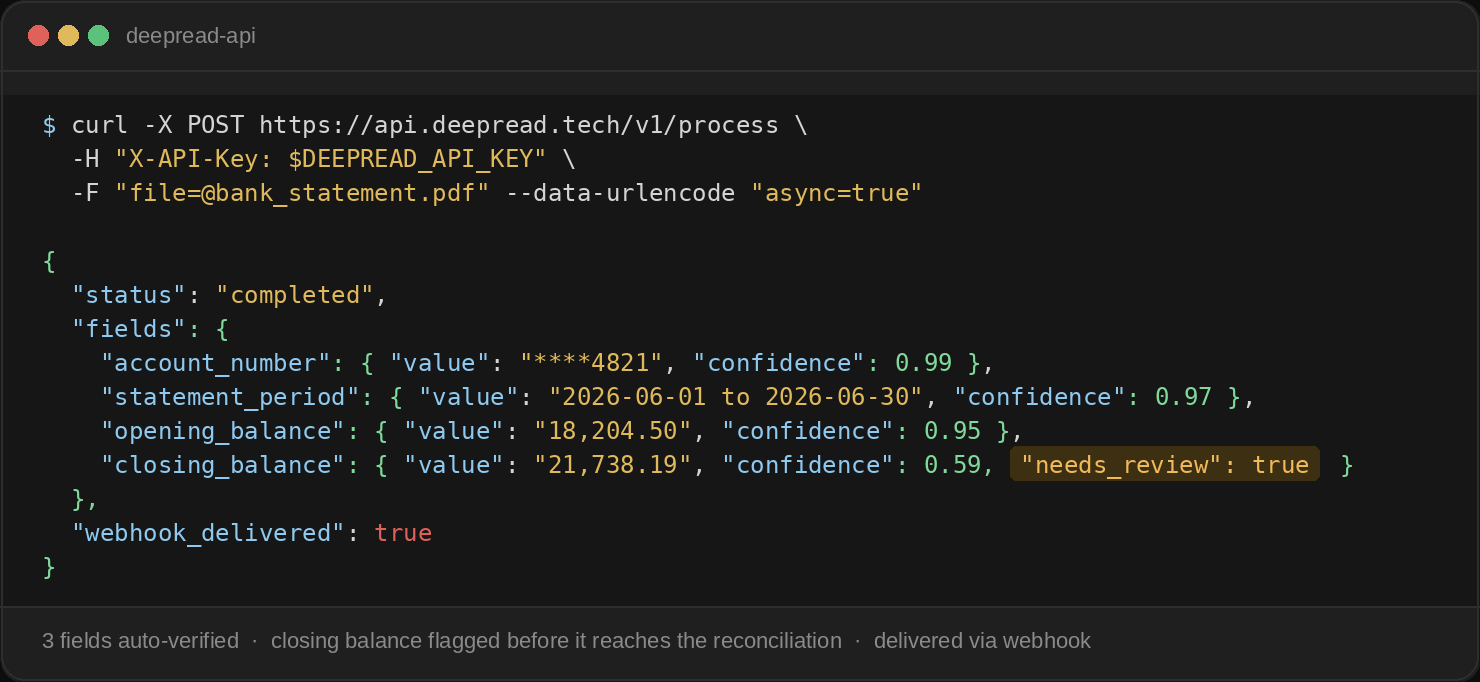
Worth being specific about this rather than treating financial extraction like any other document category: LLMs are probabilistic by design. They generate output based on patterns in language and layout, not verified calculations, which means an LLM-based extraction system can produce a plausible-but-wrong number with no visible signal that anything went wrong.
In most business contexts, that's an inconvenience. In a financial context, a mistyped decimal on a balance sheet, a transposed figure in a bank reconciliation- that's a materially different kind of error, one that can propagate into a report, a credit decision, or a regulatory filing before anyone catches it.
This is why deterministic validation matters more here than in general document processing: confidence scoring on financial figures, reconciliation checks against expected totals, and a genuine human-review step for anything uncertain aren't optional nice-to-haves in this category; they're the difference between automation that's trustworthy for finance-grade use and automation that just moves the error somewhere less visible.
What Makes Financial Documents Specifically Hard
- Extreme format diversity for the same document type. A bank statement looks completely different depending on the issuing bank; there's no single template, and thousands of banks mean thousands of layout variations.
- Country- and jurisdiction-specific compliance formats. VAT filings, SAF-T files, and similar documents follow rules that vary by jurisdiction, and getting the format wrong isn't just an accuracy problem; it's a compliance one.
- Numeric precision matters more than in general text extraction. A misread character in a name is embarrassing; a misread digit in a financial figure changes a calculation, a decision, or a filing.
- Fraud risk specific to financial documents. Duplicate invoices, altered bank statements, and inconsistent figures across related documents are a real risk category that generic extraction doesn't address unless validation is built in specifically.
Getting Started
A reasonable sequence rather than automating every financial workflow at once:
- Pick the single highest-friction document type, bank statements for reconciliation, or financial statements for credit review, rather than attempting close, credit, and compliance extraction simultaneously.
- Test on your own documents specifically, not a vendor demo set, given how much bank statement formats vary by institution.
- Set a confidence threshold before launch, and route anything below it to a named reviewer, not an unstaffed queue.
- Confirm integration into your actual system of record (ERP, accounting platform, credit system) before rolling out beyond a pilot.
- Expand to a second document type only after the first shows a stable, acceptable exception rate.
What to Evaluate
- Accuracy on your actual document mix, not a clean demo set; bank statements specifically vary enormously by issuing institution.
- Confidence scoring on numeric fields, not just an overall accuracy percentage — given how much more consequential a wrong number is in finance than in general document processing.
- Validation and reconciliation logic, not extraction alone- does the platform check extracted figures against expected totals, or just return raw values?
- Integration depth with your actual systems — ERP, accounting software, credit or treasury platforms, since extracted data is only useful once it lands where your team actually works.
- Jurisdiction-specific format support, if VAT, SAF-T, or similar compliance filings are part of your workflow.
- Fraud-relevant checks — duplicate detection, alteration detection, if that's a real risk in your document flow.
- Data security and handling practices, given the sensitivity of financial data: where is data processed and stored, and for how long?
- Is the accuracy claim independently checkable? Ask what document set any number was measured against, and whether the methodology is public.
Common Challenges
- Treating financial extraction like general document extraction, when numeric precision and validation matter more here than accuracy alone conveys.
- LLM-based extraction without a validation layer, producing confident-sounding but occasionally wrong figures with no visible signal that something's off.
- Underestimating format diversity in bank statements specifically — a platform that performs well on one bank's statement format doesn't guarantee performance on another's.
- No named owner for the exception queue — flagged, uncertain financial figures need a specific person reviewing them, or the automation just relocates the bottleneck rather than removing it.
- Choosing a broad platform when a focused extraction tool would do, or vice versa — HighRadius and Scry AI-style full platforms solve a different problem than a focused extraction API, and picking the wrong category wastes an evaluation cycle.
Conclusion
Automated data extraction for finance teams isn't just OCR applied to a new document category, it needs to account for extreme format diversity across bank statements and financial documents, jurisdiction-specific compliance formats, and a level of numeric precision that general document extraction doesn't demand.
The real risk with LLM-based extraction specifically is that it's probabilistic by nature, which makes confidence scoring and validation the feature that actually matters, not an add-on. Whether the right fit is a focused extraction API or a broader platform bundling reconciliation and workflow logic depends on how much of the surrounding process you want to build versus buy, but whichever direction fits, testing accuracy on real documents and confirming what happens to uncertain fields is worth more than any headline accuracy number.
FAQ
Is automated financial data extraction just OCR?
No, OCR reads text from an image. Automated financial data extraction adds structured field mapping, validation against expected values, and often confidence scoring, which matters more in finance than general document processing given the consequences of a wrong numeric figure.
Why does LLM-based extraction carry more risk for financial data specifically?
LLMs are probabilistic; they generate output based on learned patterns, not verified calculations — which means they can produce a plausible but incorrect number without a visible error signal. In financial contexts, that risk is more consequential than in general text extraction, which is why confidence scoring and validation matter more here.
What is "financial spreading," and does extraction software help with it?
Financial spreading is the process of converting financial statements (balance sheets, income statements) into a standardized, analyzable format, common in credit and lending analysis. Extraction software provides the structured data spreading depends on, though spreading itself often involves additional analysis logic beyond extraction alone.
How is my financial data handled and secured by extraction software?
This varies by vendor and is worth confirming directly rather than assuming — where documents are processed and stored, retention periods, and relevant certifications (SOC 2, GDPR) should all be verifiable, especially given how sensitive bank statements and financial records are relative to general business documents.
Should I choose a focused extraction tool or a broader platform like HighRadius or Scry AI?
It depends on how much surrounding workflow you need. A focused extraction API (DeepRead, Nanonets, Parseur) gives accurate, structured data you build reconciliation and workflow logic around. A broader platform (HighRadius, Scry AI's Collatio) bundles extraction with reconciliation, matching, and workflow in one product, at the cost of less control over any single piece.
How accurate does financial document extraction need to be?
Higher than general document extraction, particularly on numeric fields, since errors propagate into reports, credit decisions, or regulatory filings. Testing accuracy specifically on bank statements and financial documents, not just an overall accuracy claim, is worth doing before committing to a platform.
More articles
Structured Data Extraction: A Technical Guide
How to extract structured data from documents using an AI API, the architecture, grounding, and named tools compared.
Key Features of AI Document Workflow Automation
AI document workflow automation features, governance, prioritization framework, and real examples with measurable benefits for 2026.